

PicoScope® 2000 Series
Precision You Can Trust
NABL-Accredited Calibration | Available on Request
The PicoScope 2000 Series USB Mixed Signal Oscilloscope combines two analogue channels, 16 digital inputs and a built-in function and arbitrary waveform generator in a compact USB-powered instrument. Depending on the selected model, it offers 25 MHz to 100 MHz analogue bandwidth, up to 1 GS/s real-time sampling and up to 128 MS buffer memory for embedded-system debugging, serial bus analysis, electronics testing, education and portable field measurements..
- Detail
- Special Features
- Specification
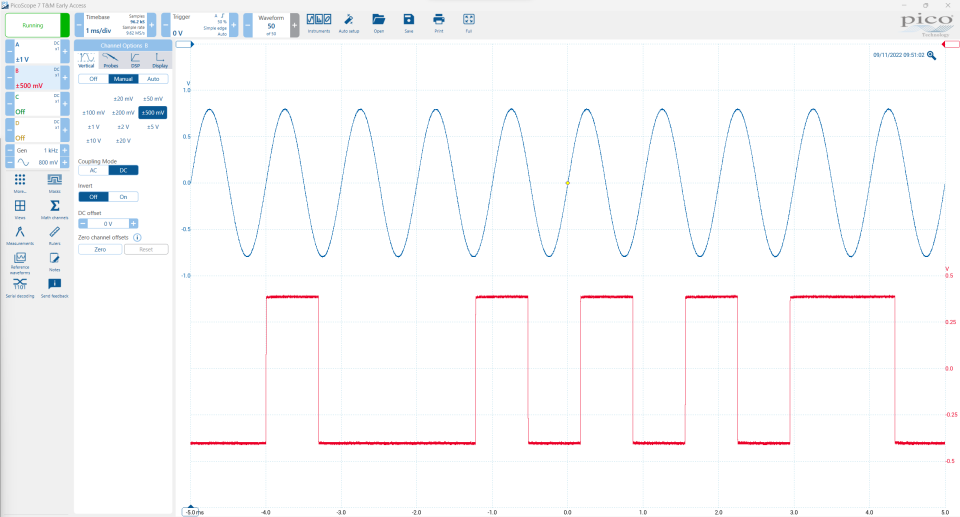
The PicoScope 2000 Series USB Mixed Signal Oscilloscope is a compact PC-based test instrument designed for electronics engineers, embedded developers, technicians, educational laboratories and OEM test systems.
The MSO models combine:
- Two analogue oscilloscope channels
- Sixteen digital logic channels
- Built-in function generator
- Built-in arbitrary waveform generator
- USB-powered operation
- PicoScope 7 software
- Serial protocol decoding
- Spectrum analysis
- Advanced digital triggering
- Segmented-memory acquisition
- PicoSDK support for custom applications
The range includes MSO models with analogue bandwidths from 25 MHz to 100 MHz, maximum real-time sampling rates from 200 MS/s to 1 GS/s, and buffer memory configurations extending up to 128 MS, depending on model.
Two Analogue and Sixteen Digital Channels
PicoScope 2000 MSO models provide:
- Two analogue BNC input channels
- Sixteen digital inputs
- Two groups of eight digital channels
- Independent threshold control for each digital group
- Time-correlated analogue and digital acquisition
- Logic-pattern triggering
- Serial decoding using analogue or digital inputs
The digital inputs support signals with frequencies up to 100 MHz, data rates up to approximately 200 Mb/s and minimum detectable pulses of 5 ns. Their input range is ±20 V, with overvoltage protection up to ±50 V.
This makes the instrument suitable for debugging:
- Microcontroller GPIO signals
- FPGA and CPLD outputs
- Address and data buses
- Clock and enable lines
- SPI, I²C and UART communication
- Digital control signals
- Mixed analogue and digital systems
- ADC and DAC interfaces
Model Options
The current PicoScope 2000 MSO range includes:
| Model | Analogue Bandwidth | Analogue Channels | Digital Channels |
|---|---|---|---|
| PicoScope 2205A MSO | 25 MHz | 2 | 16 |
| PicoScope 2206B MSO | 50 MHz | 2 | 16 |
| PicoScope 2207B MSO | 70 MHz | 2 | 16 |
| PicoScope 2208B MSO | 100 MHz | 2 | 16 |
The product page should avoid presenting the highest series specification as standard across every model. Bandwidth, sample rate, memory and signal-generator performance depend on the selected unit.
Up to 100 MHz Analogue Bandwidth
The highest-bandwidth MSO model, the PicoScope 2208B MSO, provides up to 100 MHz analogue bandwidth.
Other available MSO bandwidths include:
- 25 MHz
- 50 MHz
- 70 MHz
- 100 MHz
Typical applications include:
- Embedded-system debugging
- Microcontroller testing
- Digital clock analysis
- PWM waveform measurement
- Sensor signal testing
- Power-supply troubleshooting
- Communication-interface analysis
- General electronics development
- Educational experiments
- Portable maintenance work
Calculated rise time varies by bandwidth, from approximately 14 ns for 25 MHz models to 3.5 ns for 100 MHz models.
Up to 1 GS/s Real-Time Sampling
Maximum real-time sample rate depends on the selected model.
The PicoScope 2000 Series supports model-dependent rates of:
- 100 MS/s
- 200 MS/s
- 500 MS/s
- Up to 1 GS/s
The maximum rate is shared between active channels. On MSO models, each enabled group of eight digital inputs also uses acquisition resources. The maximum digital-channel sampling rate is 500 MS/s.
High-speed sampling helps reveal:
- Narrow pulses
- Timing errors
- Overshoot and ringing
- Short digital transitions
- Signal dropouts
- Communication faults
- Intermittent glitches
- Switching behaviour
Equivalent-Time Sampling
For repetitive signals, ETS mode can increase the effective sampling rate to as much as 10 GS/s on supported models.
Equivalent-time sampling builds a high-resolution waveform from several repetitive acquisitions. It is useful for stable periodic signals but is not suitable for isolated single-shot events.
Deep Buffer Memory
The PicoScope 2000 Series offers buffer memory ranging from small entry-level configurations to as much as 128 MS, depending on model.
Deep memory allows engineers to:
- Capture longer signal periods
- Maintain a useful sampling rate
- Zoom into individual events
- Record longer serial bus transactions
- Analyse start-up sequences
- Investigate intermittent faults
- Compare thousands of acquisitions
- Perform measurements across multiple buffers
Buffer memory is shared between active analogue and digital channels.
Segmented Memory and Rapid Triggering
PicoScope software can divide acquisition memory into multiple waveform segments.
Depending on the model, the software can manage up to:
- 10,000 buffers on A-series models
- Up to 40,000 buffers on supported B-series models
Rapid trigger mode reduces dead time between acquisitions by storing several captures in onboard memory before transferring them to the computer. This is useful for capturing packets, pulses and intermittent events without recording long inactive periods.
Fast Waveform Acquisition
Most PicoScope 2000 models use hardware acceleration to provide waveform update rates up to approximately 80,000 waveforms per second.
Fast acquisition helps identify:
- Rare glitches
- Runt pulses
- Timing violations
- Unstable edges
- Communication errors
- Occasional noise events
- Irregular control pulses
- Intermittent circuit faults
Actual waveform rate depends on the model, computer performance, acquisition settings and display configuration.
Built-In Function Generator
Every current PicoScope 2000 Series model includes a built-in function generator.
Available standard waveforms include:
- Sine
- Square
- Triangle
- Ramp
- DC
- Sinc
- Gaussian
- Half-sine
Supported B-series units additionally offer white noise and pseudorandom binary sequence outputs. Frequency sweeps can be configured with selectable start frequency, stop frequency, increment and direction.
Typical generator applications include:
- Amplifier testing
- Filter evaluation
- Circuit stimulus generation
- Relay endurance testing
- Sensor simulation
- Frequency-response experiments
- Educational demonstrations
- Input and output comparison
Arbitrary Waveform Generator
The built-in 12-bit arbitrary waveform generator can create user-defined test signals.
Users can:
- Draw waveforms in the editor
- Copy an acquired oscilloscope trace
- Import data from a CSV file
- Replay previously captured signals
- Generate application-specific test patterns
AWG memory and update rate vary by model. Supported configurations include update rates up to 20 MHz and buffers up to 32 kS.
Serial Protocol Decoding
PicoScope 7 includes a broad library of serial protocol decoders without requiring separate paid licences or subscriptions.
The software currently supports dozens of protocol decoders and can decode multiple protocols simultaneously, subject to available channels and sampling performance.
Common applications include:
- UART and RS232
- I²C
- SPI
- CAN
- LIN
- I²S
- 1-Wire
- USB
- Modbus
- Automotive and industrial buses
Decoded data can be displayed beside the waveform or in a table for easier packet-level analysis.
Advanced Digital Triggering
PicoScope digital triggering uses digitised waveform data to provide precise and flexible trigger conditions.
Trigger types include:
- Rising or falling edge
- Pulse width
- Window
- Dropout
- Runt pulse
- Logic level
- Combined analogue-channel conditions
- Digital pattern triggering
- Serial protocol conditions
On MSO models, users can trigger when a selected combination of the 16 digital channels matches a binary or hexadecimal pattern.
Spectrum Analyser
PicoScope 7 includes an FFT spectrum analyser that can operate alongside oscilloscope views.
It supports:
- Frequency-domain waveform display
- Up to one million FFT points
- Multiple spectrum views
- Average and peak-hold modes
- Spectrum masks
- Frequency-domain measurements
- Harmonic and distortion analysis
Available measurements include:
- Total harmonic distortion
- THD plus noise
- Signal-to-noise ratio
- SINAD
- Intermodulation distortion
The function is useful for noise analysis, filter evaluation, harmonic testing and identifying unwanted oscillations.
PicoScope 7 Software
PicoScope 7 software is available for Windows, macOS and Linux.
It provides:
- Oscilloscope display
- Spectrum analyser
- Serial decoding
- Automatic measurements
- Waveform mathematics
- Mask-limit testing
- Reference waveforms
- DeepMeasure analysis
- Multiple waveform views
- Custom probe support
- Automated actions
- Waveform buffer navigation
The computer monitor becomes the oscilloscope display, allowing larger and more flexible waveform layouts than compact standalone instruments.
USB-Powered Portable Design
All PicoScope 2000 Series oscilloscopes are powered through USB and do not require a separate mains adaptor.
The instruments are less than approximately 2 cm thick, making them suitable for:
- Portable engineering kits
- Laptop-based field testing
- Educational laboratories
- Mobile service work
- Compact workbenches
- OEM system integration
- Production test fixtures
The smallest models measure approximately 14.2 × 9.2 cm, including the BNC connectors.
PicoSDK and OEM Integration
PicoSDK provides direct access to the oscilloscope hardware for creating custom test, logging and automation applications.
It supports development through common programming environments and is suitable for:
- Automated production testing
- OEM integration
- Custom data-acquisition systems
- Research applications
- Remote monitoring
- High-speed streaming
- Bespoke user interfaces
The compact, passively cooled enclosure also makes the PicoScope 2000 Series suitable for integration into custom electronic equipment.
Applications
The PicoScope 2000 Series MSO is suitable for:
- Embedded-system development
- Microcontroller debugging
- FPGA and CPLD testing
- Mixed-signal circuit analysis
- Digital logic analysis
- Serial bus decoding
- Analogue circuit testing
- Sensor and actuator analysis
- Power-supply troubleshooting
- PWM testing
- Audio electronics
- Educational laboratories
- Electronic service and repair
- Automated production testing
- OEM integration
- Portable field measurements
Compact Mixed-Signal Test Platform
MSO models combine:
- Two analogue channels
- Sixteen digital channels
- Function generator
- Arbitrary waveform generator
- Spectrum analyser
- Serial protocol analyser
Up to 100 MHz Bandwidth
Available MSO bandwidths include:
- 25 MHz
- 50 MHz
- 70 MHz
- 100 MHz
Up to 1 GS/s Sampling
Model-dependent real-time sampling ranges from 200 MS/s to 1 GS/s on MSO configurations.
Sixteen Digital Inputs
Digital capabilities include:
- 100 MHz input bandwidth
- Up to 200 Mb/s signals
- 5 ns minimum pulse width
- ±20 V input range
- Two independently adjustable threshold groups
Up to 128 MS Memory
Deep memory supports:
- Long captures
- Waveform zooming
- Serial packet analysis
- Segmented acquisition
- Intermittent fault detection
Built-In 12-Bit AWG
The integrated generator supports:
- Standard waveforms
- Arbitrary waveforms
- Frequency sweeps
- Imported CSV waveforms
- Replayed oscilloscope traces
PicoScope 7 Software Included
Software capabilities include:
- Serial decoding
- FFT spectrum analysis
- Measurements
- Mask testing
- DeepMeasure
- Waveform mathematics
- Multiple views
USB-Powered Operation
No separate power adaptor is required, supporting laptop-based and portable testing.
Series Specifications
| Specification | PicoScope 2000 Series MSO |
|---|---|
| Product type | USB mixed-signal oscilloscope |
| Analogue channels | 2 |
| Digital channels | 16 |
| Analogue bandwidth | 25 MHz to 100 MHz, model-dependent |
| Maximum real-time sample rate | Up to 1 GS/s |
| Maximum digital sample rate | Up to 500 MS/s |
| Maximum memory | Up to 128 MS |
| Vertical resolution | 8 bits |
| Enhanced resolution | Up to 12 bits |
| Built-in function generator | Yes |
| Built-in AWG | Yes, 12-bit |
| Spectrum analyser | Included in PicoScope 7 |
| Serial decoding | Included in PicoScope 7 |
| Power | USB powered |
| Software | PicoScope 7 |
| SDK | PicoSDK |
MSO Model Comparison
| Model | Bandwidth | Maximum Real-Time Sampling | Maximum Buffer Memory |
|---|---|---|---|
| PicoScope 2205A MSO | 25 MHz | Up to 200 MS/s | Model-specific A-series memory |
| PicoScope 2206B MSO | 50 MHz | Up to 500 MS/s | Up to 32 MS class |
| PicoScope 2207B MSO | 70 MHz | Up to 1 GS/s | Up to 64 MS class |
| PicoScope 2208B MSO | 100 MHz | Up to 1 GS/s | Up to 128 MS class |
Memory is shared between enabled analogue channels and groups of digital inputs.
Analogue Input System
| Specification | Details |
|---|---|
| Analogue channels | 2 |
| Input coupling | AC or DC |
| Input connector | BNC |
| Vertical resolution | 8 bits |
| Enhanced resolution | Up to 12 bits |
| Input ranges | Up to ±20 V, model-dependent |
| Input impedance | Approximately 1 MΩ |
| Overvoltage protection | Up to ±100 V DC plus AC peak |
| Bandwidth | 25 MHz to 100 MHz on MSO models |
Digital Input System
| Specification | Details |
|---|---|
| Digital channels | 16 |
| Channel groups | D0–D7 and D8–D15 |
| Maximum input frequency | 100 MHz |
| Maximum data rate | Approximately 200 Mb/s |
| Minimum pulse width | 5 ns |
| Input range | ±20 V |
| Digital threshold range | ±5 V |
| Overvoltage protection | ±50 V |
| Input impedance | Approximately 200 kΩ |
| Threshold groups | Two independent controls |
Function Generator and AWG
| Specification | Details |
|---|---|
| Function generator | Included |
| AWG resolution | 12 bits |
| Standard waveforms | Sine, square, triangle, ramp, DC, sinc, Gaussian and half-sine |
| Additional B-series signals | White noise and PRBS |
| Maximum function-generator frequency | Up to 1 MHz, model-dependent |
| AWG update rate | Up to 20 MHz |
| AWG memory | Up to 32 kS |
| Output range | ±2 V |
| Output connector | Front-panel BNC |
| Sweep function | Supported |
Software and Connectivity
| Specification | Details |
|---|---|
| PC connection | USB |
| Power source | USB |
| Supported software | PicoScope 7 |
| Operating systems | Windows, macOS and Linux |
| Custom development | PicoSDK |
| Data logging | PicoLog support |
| Serial decoding | Included |
| Spectrum analysis | Included |
| Remote and OEM integration | Supported |