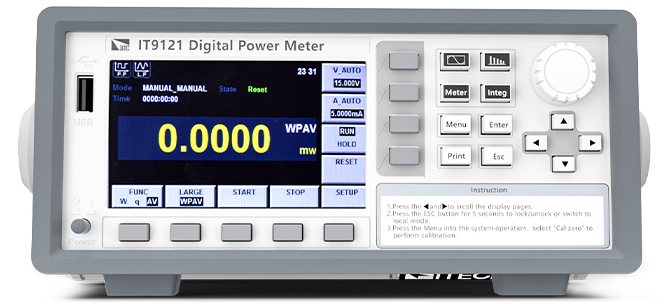
ITECH Power Meters: Precision Analysis for Efficiency and Compliance
Welcome to Revinetech's specialized category for ITECH Power Met...
ITECH Power Meters: Precision Analysis for Efficiency and Compliance
Welcome to Revinetech's specialized category for ITECH Power Meters. In modern electronics, accurate power consumption and quality analysis are essential for achieving energy efficiency goals, ensuring regulatory compliance, and certifying product performance. ITECH Power Meters are recognized globally for their high sampling rates, wide bandwidth, and superior accuracy, making them the indispensable tool for characterizing power supply units (PSUs), home appliances, lighting products, and renewable energy components.
You are seeking a high-performance instrument to precisely measure and analyze complex electrical parameters such as true power, power factor, harmonic distortion, and efficiency. Our selection features the complete range of ITECH power meters, including single-phase and multi-phase units with integrated analysis and data logging capabilities. Trust Revinetech to provide the genuine ITECH meter that delivers the speed, accuracy, and detailed diagnostic insight necessary for optimizing energy usage and verifying global compliance.
Why ITECH Power Meters Are Crucial for Design and Certification
ITECH instruments are engineered to tackle the complexities of modern power electronics, providing reliable and granular data where measurement errors can lead to compliance failure or significant energy waste.
Mastering Power Quality and Efficiency Measurement
ITECH's focus on high-fidelity measurement is crucial for all power-related industries:
-
True Power Measurement: Provides highly accurate, True RMS measurements of voltage, current, and active power (Watts), regardless of the complexity or distortion of the input waveforms (essential for switching power supplies).
-
Harmonic Analysis: Power meters offer detailed analysis of harmonic distortion (up to 50th or 100th order), which is mandatory for ensuring compliance with international standards like IEC 61000-3-2 (harmonic current emissions).
-
Power Factor Correction (PFC) Verification: Accurately measures the power factor (PF) and analyzes the efficiency of PFC circuits, vital for power supply design optimization.
-
Energy Efficiency Standards: Tools are designed to assist in complying with efficiency standards like Energy Star and IEC, helping manufacturers minimize standby power consumption.
High-Speed Data Acquisition and Wide Bandwidth
The ability to capture fast-changing power events is a hallmark of ITECH power meters:
-
High Sampling Rate: Instruments feature high sampling rates to accurately capture and analyze transient power events and high-frequency components that affect signal integrity and component stress.
-
Wide Bandwidth: Allows for the accurate measurement of power in high-frequency power electronics (e.g., inverters), ensuring precise characterization of fast-switching components.
-
Data Logging: Built-in memory and PC connectivity enable long-term monitoring and logging of power trends, crucial for diagnosing intermittent efficiency issues or capturing inrush currents.
Exploring the ITECH Power Meter Categories
Our catalogue features the specialized lines of ITECH power meters, categorized by their phase capability, accuracy level, and integrated analysis functions.
Single-Phase Precision Power Meters
These benchtop instruments are the workhorses for R&D and quality control testing of consumer electronics, appliances, and lighting products:
-
High Accuracy Classes: Available in various accuracy classes suitable for precision efficiency measurement and calibration applications.
-
Low Current Measurement: Specialized ranges allow for highly accurate measurement of very low standby power consumption, a key requirement for modern "always-on" devices.
-
Integrated Data Display: Features intuitive graphical interfaces for real-time visualization of voltage/current waveforms and harmonic bar charts, simplifying immediate fault diagnosis.
Multi-Phase and Three-Phase Power Analyzers
These advanced systems are mandatory for testing industrial equipment, motors, EV charging infrastructure, and large commercial power supplies:
-
Three-Phase Capability: Capable of simultaneously measuring three independent phases of AC power, essential for motor testing, UPS systems, and large inverter verification.
-
Flexible Wiring Modes: Supports various wiring configurations (e.g., 3P3W, 3P4W) for comprehensive testing across different industrial setups.
-
Inrush Current Measurement: Dedicated modes for accurately capturing and analyzing the large, short-duration current spike that occurs when equipment is first powered on, crucial for component selection.
Integrated Features for Streamlined Analysis
ITECH power meters incorporate intelligent features that accelerate the path from raw data capture to final engineering conclusion.
-
PC Software Connectivity: Dedicated software simplifies the programming of test sequences, automates data logging, and facilitates the generation of professional, standards-compliant reports.
-
Master/Slave Operation: Allows multiple power meter units to be synchronized and linked together to expand channel count for complex multi-channel power system analysis.
-
Digital I/O and Automation: Digital input/output channels enable synchronization with external systems (e.g., automated test handlers), streamlining integration into production test lines.
-
Flicker Measurement: Advanced analysis modes for measuring voltage fluctuation (flicker) to ensure product compliance in sensitive lighting and display applications.
Partner with Revinetech for ITECH Power Meter Solutions
Selecting the ideal ITECH Power Meter requires careful consideration of required accuracy class, maximum frequency bandwidth, and the necessity of multi-phase measurement. Revinetech is your authorized source for the complete ITECH power analysis portfolio. Our technical specialists are ready to assist you in matching the certified performance, high sampling rate, and advanced analysis features of the right ITECH meter to your specific R&D, compliance, and quality assurance demands.
Achieve precision power analysis and efficiency optimization. Browse our catalogue of ITECH Power Meters today, compare the best single-phase and three-phase solutions, and contact us for expert advice and a personalized quote.
Frequently Asked Questions (FAQs)
What is the difference between a True RMS measurement and a standard RMS measurement on a power meter?
A True RMS measurement accurately calculates the power of distorted or non-sinusoidal waveforms (common in switching power supplies). A standard RMS meter assumes a pure sine wave, leading to significant measurement errors when analyzing complex electronic loads. ITECH Power Meters utilize True RMS for certified accuracy.
Why is harmonic analysis critical for product compliance?
Harmonic analysis is critical because international standards (like IEC 61000-3-2) limit the amount of harmonic current a product can inject into the AC line. An ITECH power meter measures these harmonics, allowing engineers to verify compliance and prevent interference with other grid equipment.
Can an ITECH power meter measure standby power consumption?
Yes. ITECH Power Meters feature specialized low-current measurement ranges and high accuracy at low power levels, making them ideal for precisely measuring the tiny amount of power consumed by devices in "off" or "standby" mode, which is vital for energy efficiency certification.
What is the significance of the power meter's sampling rate?
The sampling rate determines how accurately the meter can digitize and analyze fast-changing power events and high-frequency components. A high sampling rate is necessary for precise measurement of transient events and for accurate analysis of high-order harmonics in modern power electronics.
What is Crest Factor, and how does the ITECH meter use it?
Crest Factor is the ratio of a waveform's peak value to its True RMS value. It indicates the amount of distortion in a waveform. ITECH power meters measure Crest Factor to help engineers characterize the complexity and potentially damaging peak currents drawn by the Device Under Test (DUT).