Anritsu Optical Measuring Instruments: Precision Tools for Fiber Optic Networks
Welcome to Revinetech's premium category for Anritsu...
Anritsu Optical Measuring Instruments: Precision Tools for Fiber Optic Networks
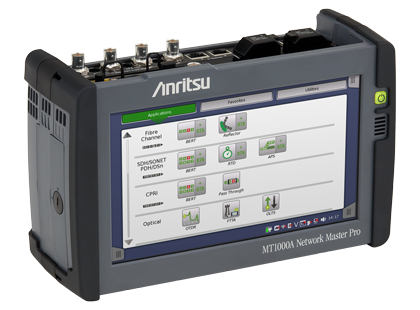
Welcome to Revinetech's premium category for Anritsu Optical Measuring Instruments. Anritsu is the definitive world leader in test and measurement solutions for high-speed communication networks. Their comprehensive suite of optical measuring instruments is absolutely essential for the installation, maintenance, and verification of modern fiber optic infrastructure, data centers, and telecommunications systems.
You are here seeking reliable, high-precision equipment to ensure the health, capacity, and integrity of your fiber optic links. Our selection features the full range of Anritsu optical testers, including the industry-standard Optical Time Domain Reflectometers (OTDRs), optical spectrum analyzers (OSAs), power meters, and light sources. Trust Revinetech to provide the genuine Anritsu optical instrument that delivers superior diagnostic speed, high measurement accuracy, and the certified performance your critical network demands.
Why Anritsu Dominates Optical Measurement
Anritsu's reputation in fiber optic testing is built on decades of innovation focused on solving the toughest challenges in high-bandwidth, long-haul, and FTTx (Fiber-to-the-x) networks.
The Gold Standard in OTDR Technology
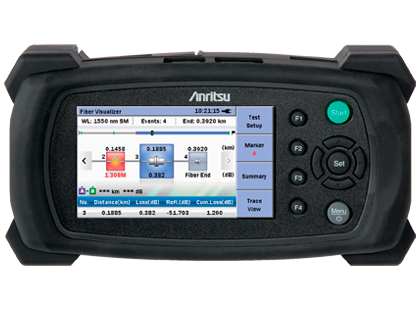
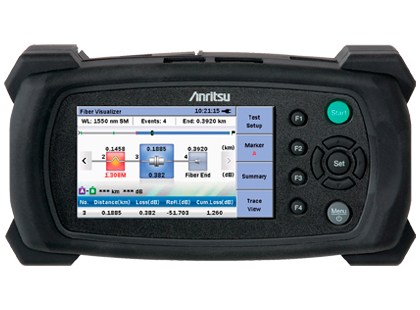
The Optical Time Domain Reflectometer (OTDR) is the primary diagnostic tool for fiber networks, and Anritsu sets the benchmark for this technology. Anritsu OTDRs provide:
-
High Dynamic Range: Essential for measuring long-distance fiber spans and accurately detecting faults near the end of the link.
-
Short Dead Zones: Minimizing the "dead zone" is crucial for detecting and characterizing events like connectors and splices close to the launch point, particularly in data centers and access networks.
-
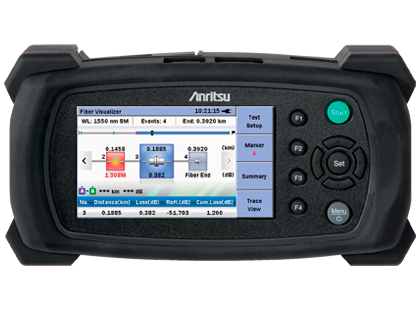
Intelligent Fault Location: Advanced software automatically analyzes the trace, identifying and characterizing events (splices, connectors, bends) with clear labels, significantly reducing the learning curve and troubleshooting time.
Ensuring Network Performance and Bandwidth
Beyond fault finding, Anritsu optical measuring instruments are vital for performance and compliance verification.
-
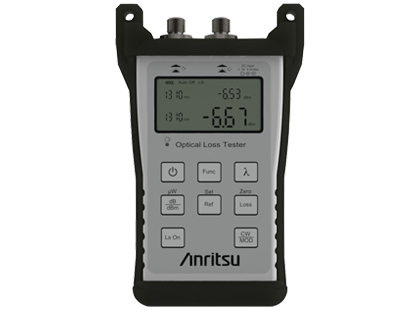
Optical Power Meters: Essential for measuring the absolute power transmitted through a fiber optic cable, verifying loss budgets, and ensuring transceiver output power is within specified limits.
-
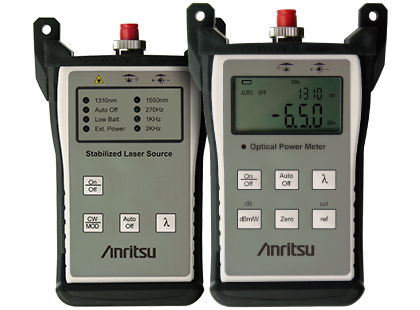
Optical Light Sources: Paired with power meters, light sources are used to perform end-to-end insertion loss measurements on fiber links, confirming signal degradation is within acceptable thresholds.
-
Compliance: Instruments are designed to perform measurements that align with international telecommunication and network standards, guaranteeing that your infrastructure is ready for deployment.
Exploring Anritsu Optical Instrument Categories
Our catalogue organizes the essential Anritsu optical instruments based on their primary function: fault identification, spectral analysis, or power measurement.
Optical Time Domain Reflectometers (OTDRs)
These are the indispensable tools for fiber installation and maintenance, providing a graphical representation of the fiber's "signature" along its entire length.
-
Single-Mode and Multi-Mode: Available in configurations to support both long-haul, high-bandwidth single-mode fiber and short-reach data center multi-mode fiber.
-
Portable Design: Built to be rugged, lightweight, and battery-powered, making them ideal for field installation and troubleshooting, even in harsh conditions.
-
High-Speed Testing: Designed for fast acquisition and processing to minimize technician time spent at remote sites.
Optical Spectrum Analyzers (OSAs)
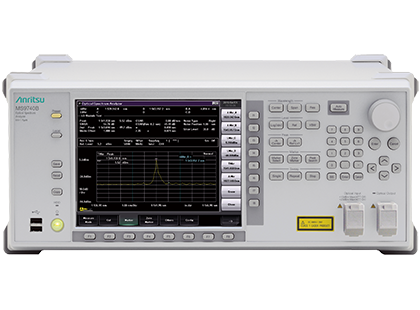
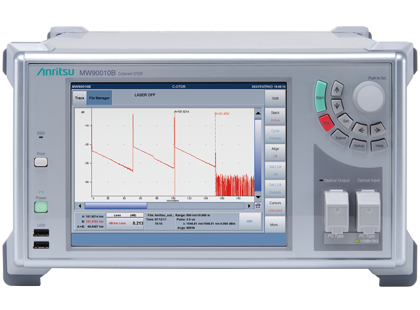
Optical spectrum analyzers are high-end diagnostic tools used primarily in R&D and high-capacity DWDM/WDM networks (Dense/Wavelength Division Multiplexing).
-
WDM Channel Analysis: Used to measure the power and wavelength of individual optical channels transmitted simultaneously over a single fiber, ensuring channel spacing and power uniformity.
-
OSNR Measurement: Accurately measure the Optical Signal-to-Noise Ratio (OSNR), a critical metric for assessing the quality and reach of high-speed transmission links.
-
Laser Source Characterization: Used to analyze the spectral purity, linewidth, and modulation characteristics of optical transmitters.
Optical Power Meters and Light Sources (OLS)
These fundamental tools are essential for basic link verification and loss budget testing.
-
Insertion Loss Measurement: The combination of an Anritsu light source and power meter allows for the precise measurement of signal loss (attenuation) in the fiber and across passive components.
-
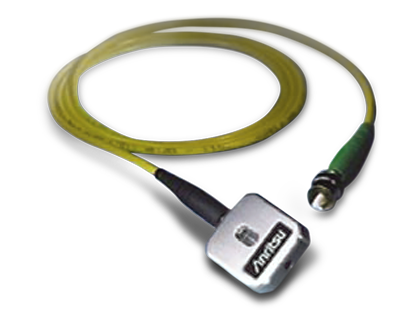
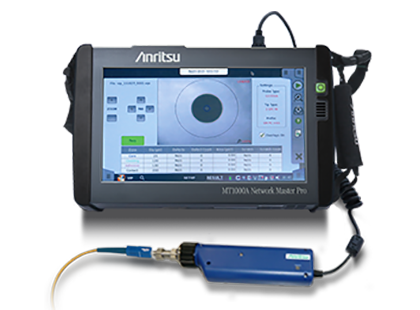
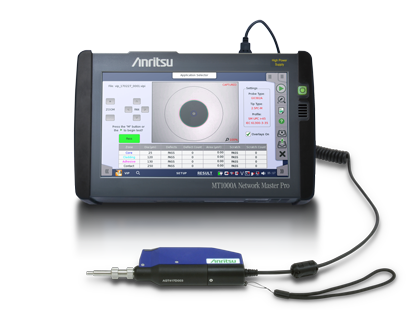
Fiber Inspection: Many meters are compatible with dedicated fiber inspection probes, ensuring connector end faces are clean and free of contamination, which is a major cause of signal loss.
Integrated Features for Field Efficiency
Anritsu equips its optical instruments with features that streamline fieldwork, reduce errors, and accelerate reporting.
-
Flexible Connectivity: Standard interfaces like USB and Ethernet, along with wireless options, ensure easy data transfer and software updates.
-
Integrated Reporting: Advanced software allows for the immediate generation of industry-standard acceptance reports (e.g., Bellcore/Telcordia standards) directly from the instrument.
-
Fluke Connect Compatibility: Select models integrate with the Fluke Connect ecosystem, allowing for seamless data linking with other diagnostic tools for comprehensive maintenance reports.
-
Superior User Interface: Large, high-resolution touchscreens and guided testing menus simplify complex measurements for field technicians.
Partner with Revinetech for Anritsu Optical Assurance
Selecting the precise Anritsu optical measuring instrument requires balancing required dynamic range, test wavelength, and spectral analysis capability. Revinetech is your authorized source for the full range of Anritsu fiber optic tools. Our technical specialists are ready to assist you in matching the certified performance and feature set of the right Anritsu optical tester to your specific network installation and maintenance requirements.
Ensure your fiber network performs at its peak. Browse our catalogue of Anritsu Optical Measuring Instruments today, compare the best OTDRs and OSAs, and contact us for expert advice and a personalized quote.
Frequently Asked Questions (FAQs)
What is an OTDR used for in fiber optic testing?
An OTDR (Optical Time Domain Reflectometer) is used to characterize a fiber optic cable after installation. It measures loss, identifies and locates physical faults (breaks, macrobends), and quantifies losses from splices and connectors along the entire length of the fiber.
What is Dynamic Range, and why is it important for an Anritsu OTDR?
Dynamic range defines the maximum optical loss the OTDR can analyze, directly affecting the maximum distance the fiber can be accurately measured. A high dynamic range is critical for testing long-haul or large metropolitan fiber optic networks.
What is OSNR and why is it measured with an Optical Spectrum Analyzer (OSA)?
OSNR (Optical Signal-to-Noise Ratio) is the ratio of the signal power to the accumulated noise power in an optical channel. It is a critical figure of merit for assessing the quality of transmission in high-speed, long-distance networks, and it must be measured by a precision OSA.
Can Anritsu optical testers measure insertion loss?
Yes. Insertion loss, the total loss of the fiber link, is typically measured using the combination of an Anritsu light source (transmitting a signal) and an optical power meter (measuring the received power) at the far end of the fiber.
What is a "dead zone" in OTDR testing?
The dead zone is the segment of fiber immediately following a high-reflectance event (like a connector) where the OTDR cannot accurately detect or measure subsequent events. Anritsu OTDRs feature minimized dead zones, which is vital for accurately characterizing close events in premises and data center networks.