
.png)
.png)
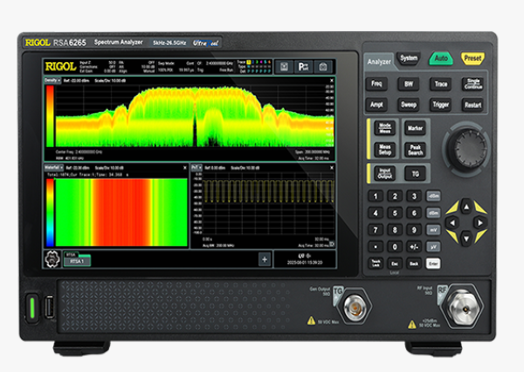
Rigol RSA6000 Series
Precision You Can Trust
NABL-Accredited Calibration | Available on Request
The RIGOL RSA6000 Series is a high-performance real-time spectrum analyzer designed for RF signal monitoring, interference detection, wireless communication testing, EMI pre-compliance and vector signal analysis. It offers frequency coverage from 5 kHz to 8.5 GHz, 14 GHz or 26.5 GHz, 80 MHz standard analysis bandwidth upgradeable to 200 MHz, 1 Hz minimum RBW, low phase noise and a 10.1-inch capacitive touchscreen..
The RIGOL RSA6000 Series Real-Time Spectrum Analyzer is developed for engineers, RF laboratories, electronics manufacturers and research teams that need to capture, identify and analyse complex or intermittent radio-frequency signals.
The series combines traditional swept-spectrum analysis with real-time spectrum analysis in a compact instrument platform. Optional software adds vector signal analysis, analog demodulation and EMI pre-compliance measurement capabilities.
The RSA6000 family includes three models:
- RSA6085: 5 kHz to 8.5 GHz
- RSA6140: 5 kHz to 14 GHz
- RSA6265: 5 kHz to 26.5 GHz
All three models provide the same core analysis platform, while the upper frequency limit varies by model.
Five Measurement Applications in One Platform
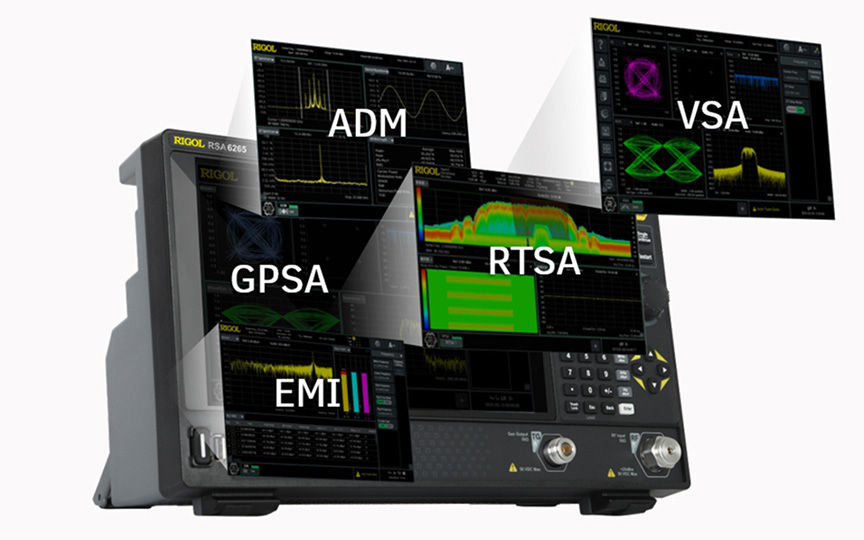
The RSA6000 can combine five primary analysis functions:
- General-Purpose Spectrum Analysis
- Real-Time Spectrum Analysis
- Vector Signal Analysis
- Analog Demodulation Analysis
- EMI Pre-Compliance Analysis
GPSA and RTSA are the primary operating modes. VSA, ADM and EMI capabilities require the relevant application options.
This integrated design reduces the need for multiple separate instruments during RF development, troubleshooting and pre-compliance testing.
General-Purpose Spectrum Analysis
General-Purpose Spectrum Analyzer mode uses swept-frequency analysis for conventional RF and microwave measurements.
It supports applications such as:
- Carrier frequency measurement
- Signal amplitude measurement
- Harmonic analysis
- Spurious-emission testing
- Channel-power measurement
- Occupied-bandwidth measurement
- Adjacent-channel power analysis
- Spectrum monitoring
- Amplifier testing
- Filter-response measurement
The frequency resolution is 1 Hz, while resolution bandwidth can be adjusted from 1 Hz to 10 MHz.
Real-Time Spectrum Analysis
RTSA mode continuously processes a selected frequency span and displays changing spectral activity with minimal signal-acquisition gaps.
This mode is designed to capture signals that conventional swept-spectrum analyzers may miss, including:
- Short-duration interference
- Frequency-hopping signals
- Burst transmissions
- Intermittent spurious emissions
- Transient RF events
- Pulsed signals
- Wireless coexistence problems
- Unstable oscillators
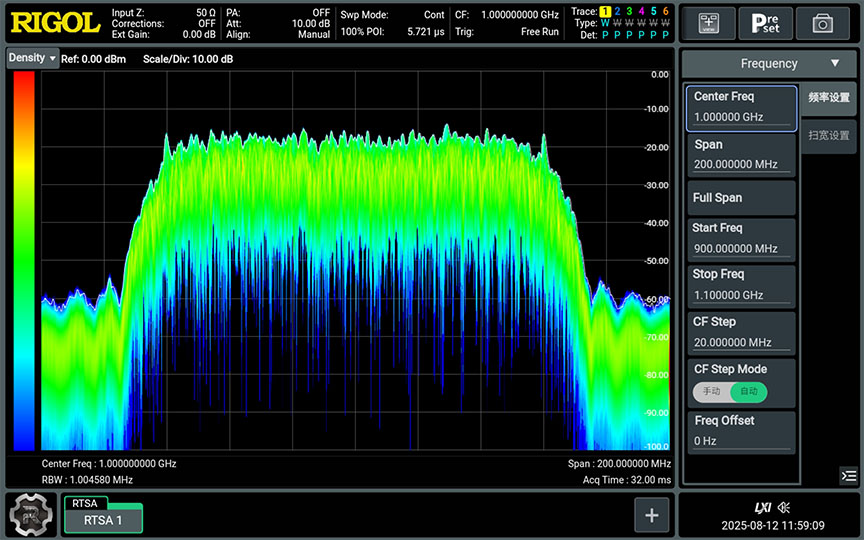
The RSA6000 provides 80 MHz standard real-time bandwidth. This can be expanded to 200 MHz using the appropriate bandwidth option.
Real-time displays can include:
- Spectrum
- Density display
- Spectrogram
- Power versus time
- Frequency versus time
- Triggered event views
These display formats allow engineers to analyse signal behaviour across frequency, amplitude and time.
200 MHz Analysis Bandwidth
With the appropriate bandwidth upgrade, the RSA6000 supports up to 200 MHz real-time and vector-demodulation bandwidth.
The wider bandwidth is useful for:
- Broadband wireless communication
- Wideband radar signals
- Complex digitally modulated signals
- Frequency-agile systems
- High-speed burst transmissions
- Multiple simultaneously active carriers
- Wideband interference analysis
The 200 MHz capability is optional. The standard analysis and real-time bandwidth is 80 MHz.
Vector Signal Analysis
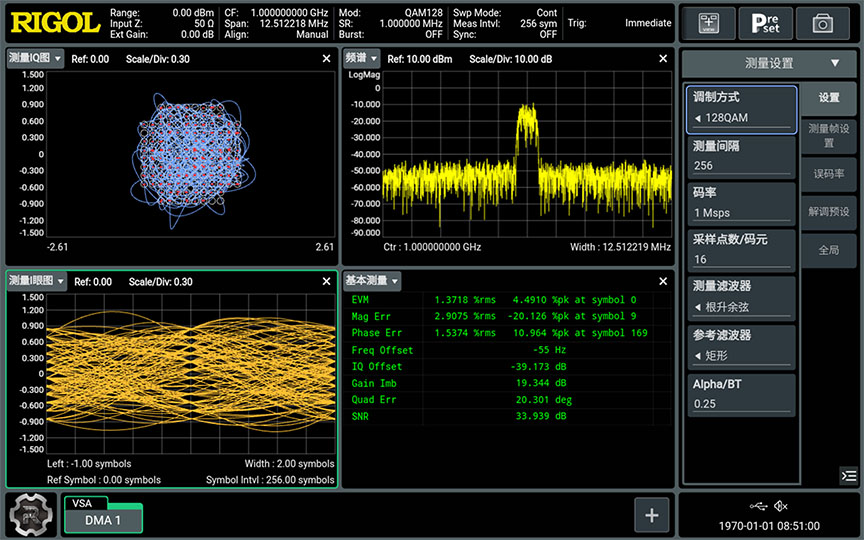
The optional VSA application supports detailed measurement of digitally modulated RF signals.
Depending on the installed options and signal type, engineers can analyse:
- Constellation diagrams
- Eye diagrams
- Error vector magnitude
- Magnitude error
- Phase error
- Frequency error
- Symbol characteristics
- Modulation quality
- Power and spectral characteristics
VSA measurements are suitable for wireless transmitter development, component testing and communication-system troubleshooting.
The maximum vector-demodulation bandwidth is 200 MHz with the relevant bandwidth and VSA options installed.
Analog Demodulation Analysis
The optional ADM application supports analysis of analog-modulated signals.
Supported modulation formats include:
- AM
- FM
- PM
The application can be used to measure modulation depth, frequency deviation, phase deviation, carrier behaviour and demodulated audio characteristics.
Typical applications include:
- Broadcast transmitter testing
- Two-way radio testing
- Analog communication-system development
- RF signal-generator verification
- Receiver and transmitter servicing
EMI Pre-Compliance Testing
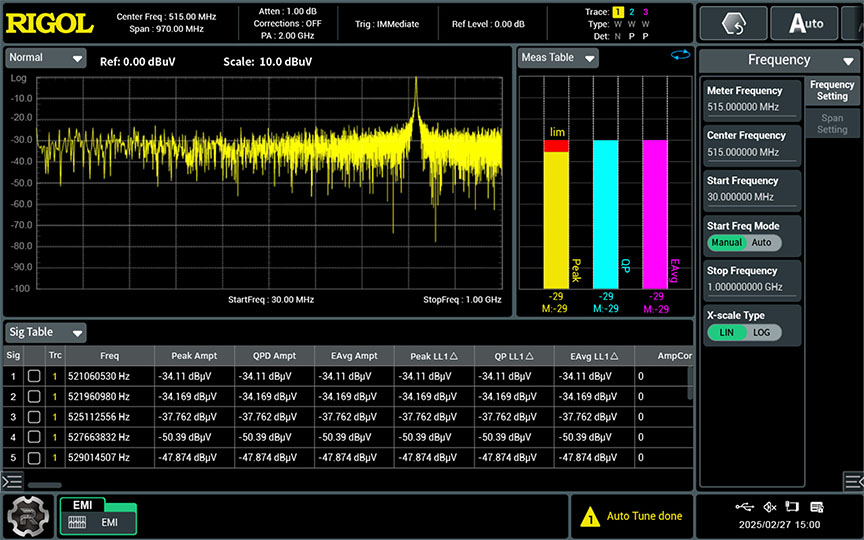
The optional EMI application supports conducted and radiated emissions pre-compliance testing before a product is submitted to an accredited EMC laboratory.
The application supports:
- CISPR-compliant resolution bandwidth filters
- Peak detection
- Quasi-peak detection
- Average detection
- Limit lines
- Frequency scanning
- Signal identification
- Emission-source troubleshooting
- Report-oriented measurement workflows
EMI pre-compliance testing helps engineers detect emission problems earlier in the product-development cycle.
It can be used with:
- Near-field probes
- LISNs
- Current probes
- Antennas
- Preamplifiers
- Attenuators
- EMC test fixtures
The RSA6000 is intended for pre-compliance and troubleshooting. Formal certification measurements must be completed according to the applicable standard and laboratory requirements.
Low Phase Noise
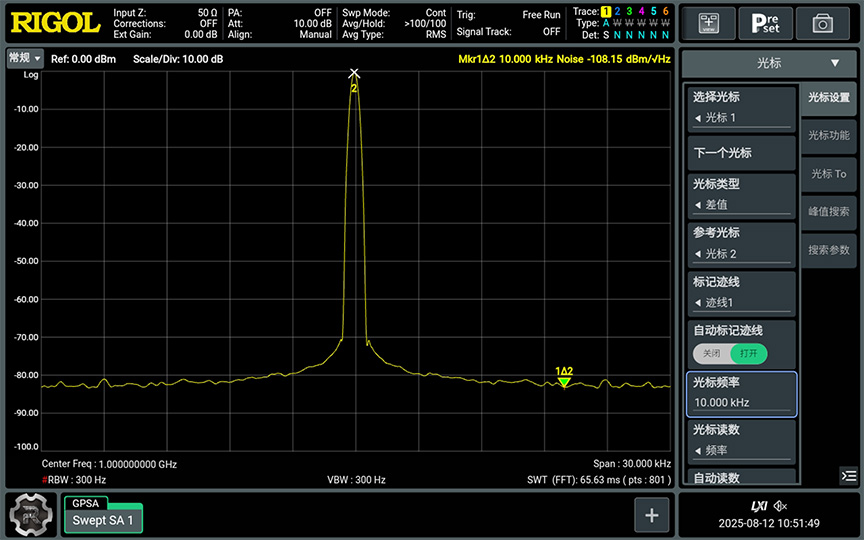
The RSA6000 provides typical phase noise below -108 dBc/Hz at a 1 GHz carrier and 10 kHz offset.
Low analyzer phase noise helps improve measurement accuracy when examining:
- Closely spaced signals
- Oscillator phase noise
- Weak signals near a strong carrier
- Radar sources
- Communication transmitters
- Frequency synthesizers
- RF and microwave signal generators
The measurement condition should always be stated with the phase-noise value because phase noise varies with carrier frequency and offset frequency.
Low Displayed Average Noise Level
The RSA6000 provides a typical displayed average noise level of approximately:
- -143 dBm/Hz with the preamplifier disabled
- -163 dBm/Hz with the optional preamplifier enabled
A lower noise floor improves the instrument’s ability to measure weak RF signals.
This is useful for:
- Receiver sensitivity investigations
- Low-level spurious-emission testing
- Antenna measurements
- Interference detection
- Low-power wireless-device testing
- Weak-signal monitoring
Actual DANL depends on frequency, attenuation, resolution bandwidth, preamplifier status and measurement configuration.
Tracking Generator
The RSA6000 platform supports a tracking generator for scalar transmission measurements.
A tracking generator can be used with the spectrum analyzer to test:
- Filters
- Amplifiers
- Cables
- Attenuators
- Splitters
- RF networks
- Frequency-response characteristics
Tracking-generator availability and output frequency range should be confirmed for the selected model and configuration.
Touch-Optimised User Interface
The analyzer includes a 10.1-inch capacitive multi-touch display with 1280 × 800 resolution.
The interface supports:
- Touch-based frequency and span adjustment
- Marker control
- Multi-window measurement display
- Trace configuration
- Spectrogram navigation
- Measurement setup
- Limit-line configuration
- Application switching
- File and screenshot management
The large display helps users view multiple measurement results without repeatedly changing screens.
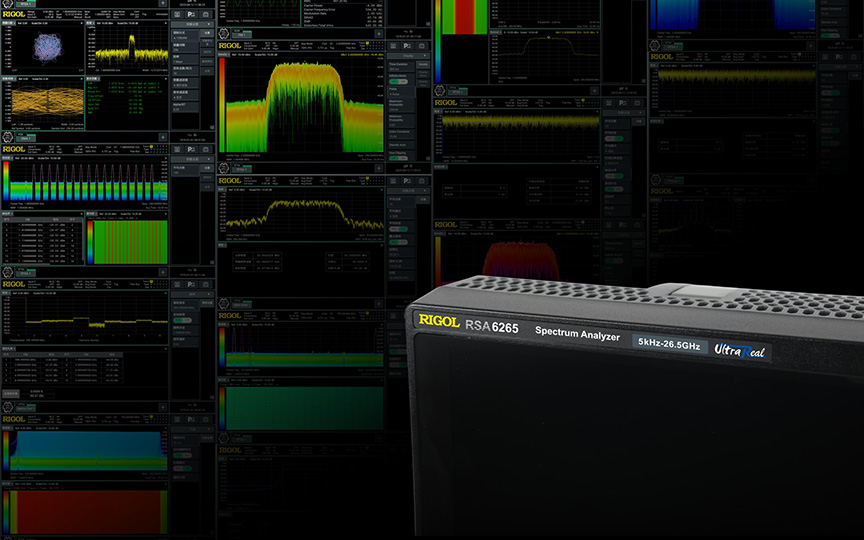
Compact and Portable Design
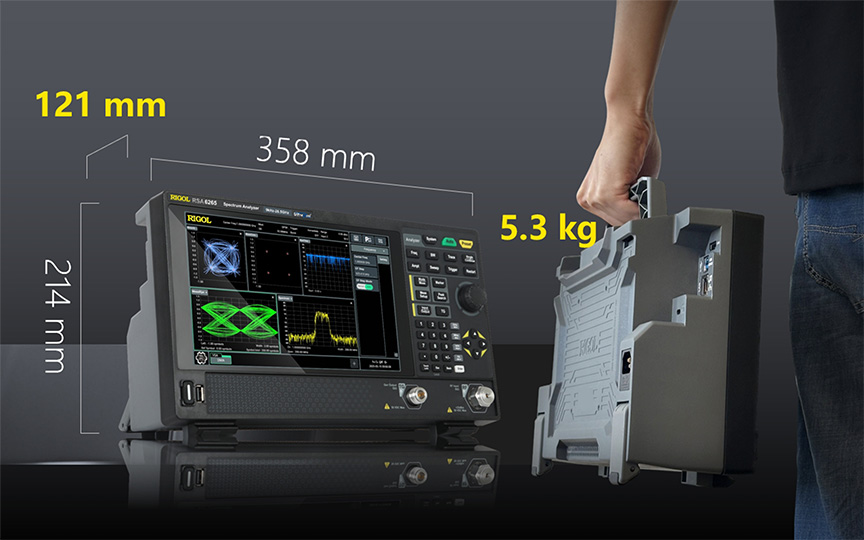
The RSA6000 combines microwave-frequency coverage and real-time analysis in a compact instrument weighing approximately 5.3 kg.
Its compact form factor is suitable for:
- Crowded laboratory benches
- Shared engineering laboratories
- Production test stations
- Field troubleshooting
- Mobile interference investigations
- On-site EMC diagnostics
Remote Control and Automated Testing
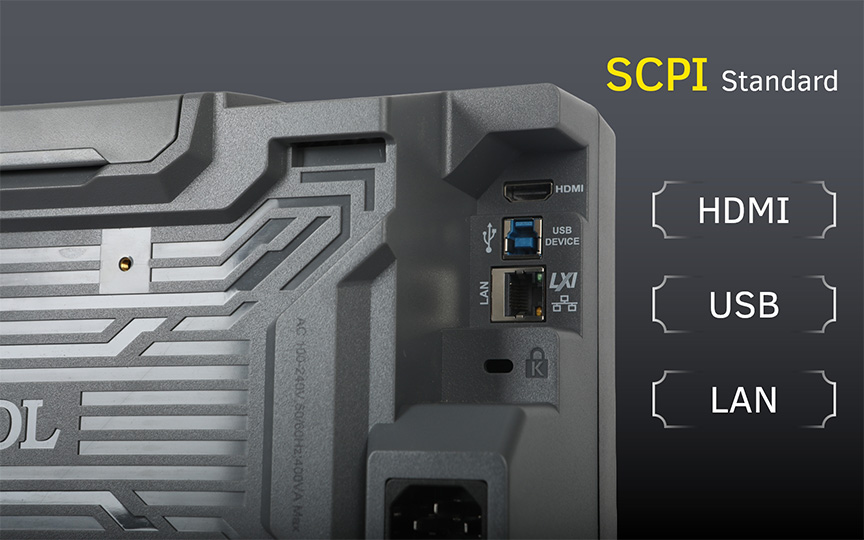
The RSA6000 supports multiple interfaces for remote control and system integration:
- USB Host
- USB Device
- LAN
- HDMI
- Web Control
- SCPI programming
The analyzer can be integrated into:
- Automated production systems
- Remote laboratories
- Long-duration monitoring stations
- RF validation platforms
- Custom measurement software
- Multi-instrument test systems
Standard SCPI support simplifies programming and automated measurement development.
Current Advanced Measurement Options
Current RIGOL documentation also lists application support for specialised measurements such as:
- Phase-noise analysis
- Pulse analysis
- Bluetooth Low Energy analysis
- Zigbee analysis
- LoRa analysis
These capabilities require the appropriate application licences and compatible firmware.
Applications:
The RIGOL RSA6000 Series is suitable for:
- RF and microwave signal analysis
- Wireless communication testing
- Interference detection
- Spectrum monitoring
- Radar signal analysis
- Pulsed RF testing
- Frequency-hopping signal analysis
- IoT device testing
- Bluetooth and Zigbee analysis
- LoRa signal analysis
- Automotive electronics
- Satellite communication testing
- Transmitter testing
- Receiver testing
- Amplifier characterisation
- Filter testing
- Oscillator analysis
- EMI pre-compliance testing
- Conducted-emission troubleshooting
- Radiated-emission troubleshooting
- Research and development
- Production testing
- Field diagnostics
- Educational RF laboratories
Why Buy from Revine Tech:
Revine Tech provides RF, microwave, EMC and general test and measurement equipment for engineering, industrial, laboratory and research applications.
Our technical team can help customers select the correct RSA6000 configuration based on:
- Maximum required frequency
- Real-time bandwidth
- Vector-demodulation bandwidth
- Required DANL
- Preamplifier requirements
- Tracking-generator requirements
- VSA software requirements
- Analog-demodulation requirements
- EMI pre-compliance requirements
- Phase-noise analysis
- Pulse analysis
- Wireless-standard analysis
- RF probes and antennas
- LISN selection
- Remote-control requirements
- Calibration and documentation
The final RIGOL RSA6000 price depends on the selected model, bandwidth upgrades, preamplifier, tracking generator, analysis applications and accessories.