
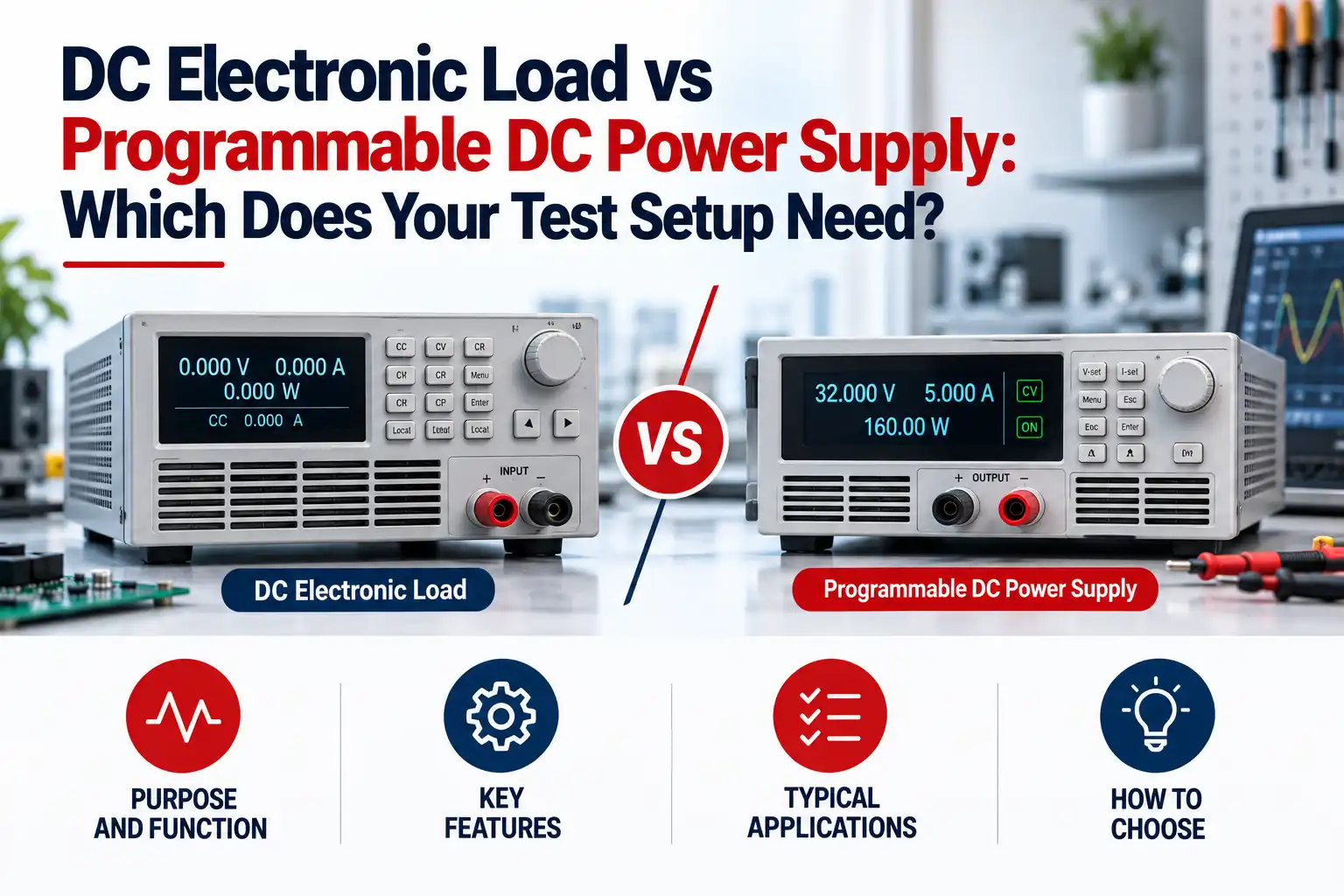
A new test bench needs a way to power a prototype. A charger validation bench needs a way to draw power from the charger. Those jobs sound similar, but they call for different instruments.
If you are comparing a DC electronic load vs power supply for an R&D lab in Bengaluru, start with one question: Does your device under test need to receive power, or does it produce power that you need to test? The answer will usually tell you which instrument to buy first. Some test setups need both.
This guide explains the difference, shows where each instrument fits, and gives you a practical checklist for discussing your requirements with a supplier.
DC Electronic Load vs Power Supply: The Core Difference
A programmable DC power supply delivers controlled electrical power to a device under test. You set its output voltage and current limit, then use it to power a circuit, module, motor controller, or other DC-powered product.
A DC electronic load draws controlled power from a source under test. You connect it to the output of a power supply, battery, charger, or DC-DC converter to see how that source behaves under different loads. Electronic loads commonly offer constant current, constant voltage, constant resistance, and constant power modes, depending on the model. ITECH’s IT8500+ series, for example, lists all four.
| Your immediate test question | Instrument to consider |
|---|---|
| “How does my prototype behave at different input voltages?” | Programmable DC power supply |
| “Can this charger maintain its output as demand increases?” | DC electronic load |
| “How does my DC-DC converter perform from input to output?” | Power supply at the input and electronic load at the output |
| “How long can this battery deliver a defined current?” | Electronic load with a suitable battery discharge function |
The simplest way to remember it: the supply provides power; the load consumes it.
When Do You Need a Programmable DC Power Supply?
Choose a programmable DC power supply when your test begins by delivering a controlled voltage or current to your device.
Consider an electronics team developing a sensor module. Engineers may need to check whether it starts reliably at the low end of its input range, how much current it draws during startup, and what happens as the input voltage changes. A programmable supply lets them repeat those conditions more consistently than an improvised power source.
For a Bengaluru R&D lab, common applications include:
- Powering embedded boards and electronic prototypes
- Testing products across their permitted input voltage range
- Supplying a DC-DC converter during efficiency or regulation tests
- Repeating voltage sequences in an automated test
- Limiting current while investigating a new design
When comparing ITECH DC power supplies, check the voltage, current, and power ratings together. A supply’s headline voltage and headline current may not both be available at the same time across its full operating range. Ask for the output operating curve for the exact model you are considering.
Also check output ripple and noise, programming resolution, protection functions, the number of channels, and the communication interfaces your bench actually uses. USB may suit a small lab setup; an automated production or validation system may require a different interface.
When Do You Need a DC Electronic Load?
Choose a DC electronic load when the product you are testing delivers electrical power and you need to control how much power is drawn from it.
Imagine testing a charger labelled for a particular output voltage and current. Measuring its no-load voltage tells you very little about how it performs when a device demands power. An electronic load lets you apply a defined current, step between load levels, and observe the charger’s output.
That makes loads useful for evaluating:
- DC power supplies and adapters
- Battery packs during discharge
- Battery chargers
- DC-DC converters
- Solar or other DC power sources, where the load’s capabilities match the test
For example, ITECH’s IT8500+ electronic load supports static and dynamic testing. Its battery discharge function can stop a constant-current test when a configured voltage, capacity, or time condition is reached. Check the exact model and test procedure before relying on any function for battery work.
If your team is building a charger, converter, or battery test bench, explore ITECH DC electronic loads with your test voltage, current, and duty cycle in hand. Those details make a supplier recommendation far more useful.
Why Many Test Benches Need Both
A DC-DC converter provides a clear example. It needs power at its input, so you connect a DC power supply there. You then need to simulate the devices that will draw power from its output, so you connect an electronic load there.
With that setup, you can ask more useful questions:
- Does the converter hold its output voltage as the load increases?
- How does it respond to a sudden change in load?
- What happens when its input voltage falls?
- How do input power and output power compare at different operating points?
- Does its protection behave as intended near a limit?
A supply alone cannot reproduce the full range of controlled output demand. A load alone cannot provide the converter’s input power. Specifying the whole test arrangement before buying helps prevent a capable instrument from ending up on an incomplete bench.
What Do CC and CV Mean on Each Instrument?
Constant current (CC) and constant voltage (CV) appear in descriptions of both power supplies and electronic loads. The labels are the same; the instrument’s role changes their meaning.
On a power supply, CV operation regulates the voltage it delivers. If the device tries to draw more current than the configured limit, the supply may enter CC operation to limit its delivered current.
On an electronic load, CC operation controls how much current the load draws from the source. In CV operation, the load adjusts its draw to regulate the voltage at its input, within the instrument’s operating limits.
This distinction matters when writing a test procedure. “Run the test in CC mode” is incomplete unless the team also states which instrument is in CC mode and what behaviour it is meant to simulate.
Electronic loads may also provide:
- Constant resistance (CR): Simulates a resistance within the load’s supported range
- Constant power (CP): Adjusts the draw to maintain a set power level within operating limits
- Dynamic modes: Switches between configured load levels to test a source’s response
Check the available modes, timing, and limits on the specific model. ITECH’s IT8500+ product information describes its modes and dynamic test functions.
How Should You Size the Equipment?
For a DC power supply
Write down the minimum and maximum voltage your device needs, its normal current, and its highest expected startup or operating current. Then check whether the proposed supply can deliver the required voltage and current at the same operating point.
Add requirements that affect the result: acceptable ripple, voltage accuracy, channel count, remote sensing, protection, and the interface needed for automation. If you plan to expand the bench, distinguish the capacity needed now from a possible future requirement.
For a DC electronic load
Record the highest source voltage, the highest current you intend to draw, and the power the load must handle. Power is approximately voltage × current: drawing 10 A from a 48 V source means the load must handle about 480 W at that test point. Confirm the instrument’s operating limits at every planned test point, including low-voltage, high-current conditions.
Then consider how long each test runs. A brief load step and an hours-long battery discharge place different demands on an instrument. Ask about minimum operating voltage, transient response, cooling requirements, protection, and whether the test needs an automated cutoff.
Standard electronic loads generally dissipate the power they draw as heat. Some regenerative models can return energy to the grid, but that is a feature of specific products and requires a suitable installation. ITECH identifies its IT8000 series as a regenerative DC electronic load.
Can One Instrument Work as Both?
Some bidirectional power systems can source and sink power. That may suit a bench where the test repeatedly moves between charge and discharge or other two-way power flows. Revine Tech lists the ITECH IT-M3600 regenerative power system as a product combining bidirectional supply and regenerative load functions.
Do not assume this applies to every programmable supply. Ask the supplier to confirm the exact model’s source and sink ratings, operating modes, interfaces, and installation needs. A dedicated supply and dedicated load may still be the better fit when tests need both functions at once at separate points in a circuit.
Questions to Send Your Supplier Before Requesting a Quote
A short test brief can save several rounds of emails. For an R&D or validation lab in Bengaluru, include:
- What is the device under test? A prototype board, charger, converter, battery pack, or complete system?
- Where must power flow? Into the device, out of it, or both?
- What are the actual test points? List voltage, current, power, and duration for each.
- Which behaviours must be measured? Startup, steady operation, load steps, discharge, or protection response?
- Will the bench be automated? State the software and communication interface requirements.
- What installation constraints apply? Consider available electrical supply, bench space, ventilation, and cooling.
- What documentation or services are needed? Ask about calibration options, accessories, training, and support for the proposed model.
Conclusion
Choose a programmable DC power supply when you need to deliver controlled power to a device. Choose a DC electronic load when you need to draw controlled power from a source under test. If your test moves power through a converter or similar system, plan the input and output sides together.
The right purchase starts with your test points and workflow, not a product category name. Share those requirements before asking for a model recommendation.
Get an ITECH Test Setup Recommendation for Your Bengaluru Lab
FAQs
Can a programmable DC power supply replace an electronic load?
A standard DC power supply delivers power; it does not perform the controlled power-drawing role of an electronic load. Some specified bidirectional systems can perform both roles, so check the capabilities of the exact model.
Do I need both instruments to test a DC-DC converter?
Often, yes. A supply can power the converter’s input while a load applies controlled demand to its output. The final setup depends on your converter and the measurements you need.
Which instrument is used for battery discharge testing?
A suitable DC electronic load can draw controlled current or power from a battery. Select a model with the required ratings and cutoff functions, and follow the battery manufacturer’s safety limits and test procedure.
What is the most common buying mistake?
Choosing from the maximum voltage, current, or power figures separately without checking whether the instrument supports the specific combination your test requires.
Where can I enquire about ITECH equipment for a Bengaluru lab?
Send Revine Tech your device type, test points, and planned workflow through its contact page. The company lists a Bengaluru branch there.