
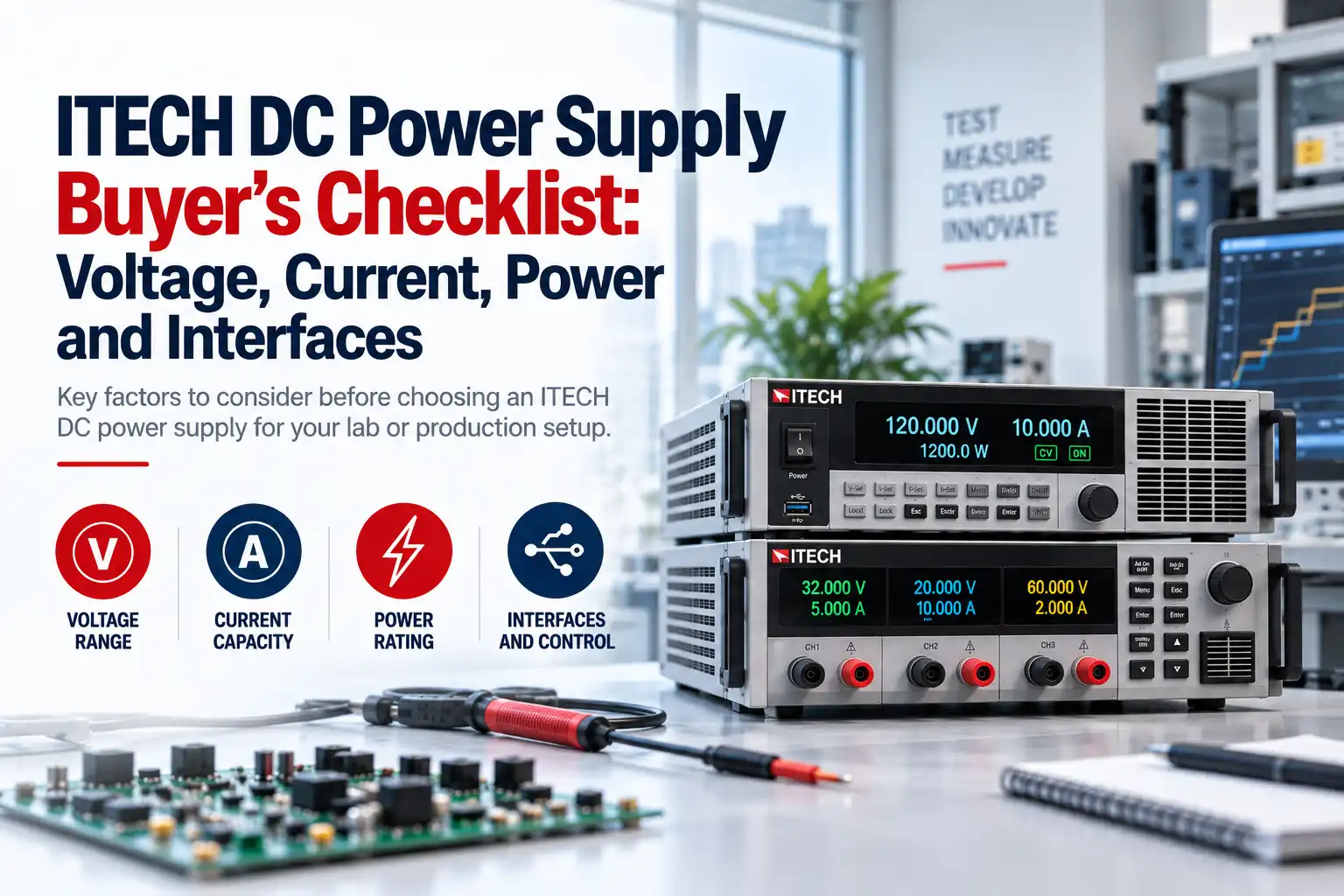
An ITECH DC power supply should fit the tests you run, not just the space available on your bench. A unit may meet your maximum voltage requirement but fall short on current at that voltage. Another may have enough output power but lack the interface your automated test system needs.
Before choosing a model for a Bengaluru R&D lab or production test station, write down the operating points, test sequence and connections you need. Then compare ITECH DC power supplies against that list. This checklist explains what to verify in the datasheet and what to ask for in a quotation.
Start with the device under test
What will the supply power: a circuit board, DC-DC converter, motor driver, charger or another device? Describe how its demand changes during a test. A supply used for careful prototype development may need different features from one installed in a repeatable production station.
Record your normal operating point, your highest expected demand and the conditions at startup. If several products will share one test bench, include each product’s range. This gives the supplier a basis for recommending a model rather than selecting one from a single headline rating.
1. Does the voltage range cover the whole test?
Check the lowest and highest voltage you must apply, including test conditions outside the product’s normal operating voltage. If your procedure includes a voltage dip or ramp, ask whether the proposed model can produce the required sequence and timing.
Maximum voltage is only one part of the decision. Ask how finely the voltage can be set and how accurately the supply maintains it at the operating points that matter to you. Resolution tells you the smallest setting change; accuracy tells you how close the output is to the intended value. They are different specifications.
Also consider the voltage at your device, not only at the supply’s terminals. Leads can introduce voltage drop, particularly at higher current. If that affects your test, ask whether the exact model supports remote sensing and how it should be connected.
2. How much current do you need during steady operation and startup?
List the current your device draws normally and any higher demand during startup or a change in operating mode. Ask the supplier to check both against the proposed model’s limits.
A programmable supply may operate in constant-voltage and constant-current modes. During a test, reaching a current limit can change the behaviour you observe at the device. Confirm how the supply transitions between modes and whether its settings let you protect a current-sensitive prototype.
For repeated tests, ask what happens after an overcurrent event. Does the output remain on under a limit, shut down, or require an operator to reset it? The appropriate behaviour depends on your device and test procedure.
3. Can it deliver the required voltage and current at the same time?
Calculate the power needed at each important operating point:
Power (W) = voltage (V) × current (A).
For example, a test requiring 60 V at 10 A needs 600 W at that point. Checking “60 V maximum” and “10 A maximum” separately is insufficient if the model’s power limit or output operating range prevents those values from being delivered together.
Ask for the model’s voltage-current operating range, then mark your test points on it. Do this for normal operation and the most demanding part of the sequence. If a future product may require more power, discuss that likely requirement now instead of buying capacity without a defined use.
4. How many independent outputs does the lab need?
A multi-channel supply can simplify a bench where different parts of a device need separate power rails. Count the outputs you need at the same time, and specify the voltage, current and power required from each one.
Check each channel’s individual rating. Do not assume that the full supply rating is available on every output. Also ask whether the channels are independently controlled and whether your planned series, parallel or synchronised setup is supported for the exact model.
For example, ITECH describes its IT-N6300 series as a triple-channel supply, but the individual channel limits differ by model. Its model table is a useful reminder to compare the complete model number, not just the series name.
5. Which control and communication interfaces are included?
If an engineer will set the output manually, front-panel operation may be enough. For automated testing, the interfaces and programming documentation become part of the buying decision.
List what your system actually uses: USB, LAN, RS232, CAN, digital I/O or another connection. Then confirm:
- Which ports are built into the quoted model
- Which need an option or a different model suffix
- Whether your required settings and measurements can be controlled remotely
- What programming manual, drivers and software are supplied
- How faults and test data can be read by your system
Interfaces can differ within one series. ITECH’s IT-N6300 model table, for instance, lists USB for certain “A” models and additional interfaces, including LAN and RS232, for certain “B” models. Verify the exact suffix on the quotation before designing an automated test bench around a port.
If automation is essential, ask the supplier to demonstrate one task from your process: set an output, read a measurement, trigger a change and handle a fault. That is more informative than a general product demonstration.
6. What output quality and response does your test require?
For sensitive electronics, ask about ripple, noise, regulation and accuracy at the voltages and currents you will use. For a device whose current demand changes quickly, discuss how the supply responds and what your device will experience during that change.
These specifications need context. A very fast response may be important in one test, while stable, low-noise output matters more in another. Tell the supplier what you need to measure and what result would be unacceptable.
If your procedure uses programmed steps or waveforms, request the limits for those functions on the proposed model. Confirm that the timing, number of steps and control method fit your test plan.
7. Do you need a conventional supply or a bidirectional system?
A conventional DC supply provides power to the device under test. Some advanced ITECH systems can also absorb power. That distinction matters for applications such as battery simulation and other tests in which power flow changes direction.
Do not assume that “programmable” means “bidirectional.” ITECH identifies the IT6600C series specifically as a bidirectional supply that can act as an electronic load and regenerate absorbed energy. If your test needs those functions, ask the supplier to confirm the operating modes, ratings and installation requirements of the exact configuration proposed.
If your lab only needs to source power, a bidirectional system may add complexity you will not use. Choose it because the test calls for it.
8. What protection and installation details matter?
Discuss the protections your device under test needs, such as overvoltage, overcurrent, over-power or overtemperature handling. Ask what each limit does: warn the operator, restrict the output or shut it down.
For a higher-power system, review the complete installation with the supplier. That includes input power, connectors or cabling, grounding, ventilation, rack space and any requirements for regenerative operation. Only use series or parallel configurations that the manufacturer supports for the selected model.
Have your engineering team record these details in the test setup instructions. The safest configuration should not depend on someone remembering a conversation held before the instrument was delivered.
9. What documentation and support come with the quotation?
Request the datasheet and manual for the exact model number, along with an itemised quotation. Confirm what is included: communication options, cables, software, warranty, delivery and any setup assistance.
If your measurements must be documented for customers or a quality system, ask whether calibration is required and what certificate is available for the instrument and parameters involved. Revine Tech publishes information about its calibration lab; confirm the scope and terms relevant to your selected supply rather than assuming every service is included with purchase.
For a Bengaluru lab, also establish the lead time, delivery arrangements and technical-support contact. Revine Tech lists an office in Yeshwanthpur, Bengaluru, India; ask what support can be arranged for your particular model and project.
Get an ITECH Power Supply Quote for Your Bengaluru Lab
A short checklist for your request for quotation
Send these details so the supplier can recommend a configuration you can evaluate:
| Requirement | What to provide |
|---|---|
| Application | Device under test and purpose of the test |
| Voltage | Minimum, normal and maximum test values |
| Current | Normal demand, startup demand and required limit |
| Power | Required voltage-current combinations, not only one maximum figure |
| Outputs | Number of independent channels and each channel’s requirement |
| Performance | Accuracy, ripple, response or sequencing requirements that affect results |
| Automation | Required ports, software environment and data logging |
| Operation | Whether you need to source power only or also absorb it |
| Purchase | Quantity, Bengaluru delivery location and timeline |
Ask the supplier to return a recommended model number with the specifications that support it. If a requirement cannot be met, request that the limitation be stated clearly.
Choose the model from the test requirement
The useful buying question is not “Which ITECH DC power supply has the biggest number on its datasheet?” It is “Which exact model covers our operating points and fits the way our team will run the test?”
Use your voltage-current points, channel requirements and automation plan to shortlist models. Then compare ITECH DC power supplies and request a recommendation tied to those requirements.
FAQs
Is the highest-wattage ITECH DC power supply the best choice?
No. First confirm that a model can deliver the voltage and current combinations your tests require. Then compare its channels, output behaviour, interfaces, size and cost. Extra power is valuable when it supports a defined current or future test requirement.
Why do two supplies in the same ITECH series have different interfaces?
Features can vary by model and suffix. The IT-N6300 series is one example: ITECH’s model table shows different interface combinations across variants. Check the complete part number and included options on the quotation.
Do I need remote sensing?
It may help when voltage drop across the leads affects the voltage delivered to your device under test. Ask whether the exact model supports it and have an engineer check the connection method. It is not a substitute for selecting suitable cables and a correct test setup.
Can an ITECH DC power supply also test battery discharge?
A standard supply and an electronic load perform different jobs. Some specific bidirectional ITECH systems can source and absorb power, but that capability should never be assumed for the whole range. Describe your charge, discharge or simulation procedure before choosing a model.