
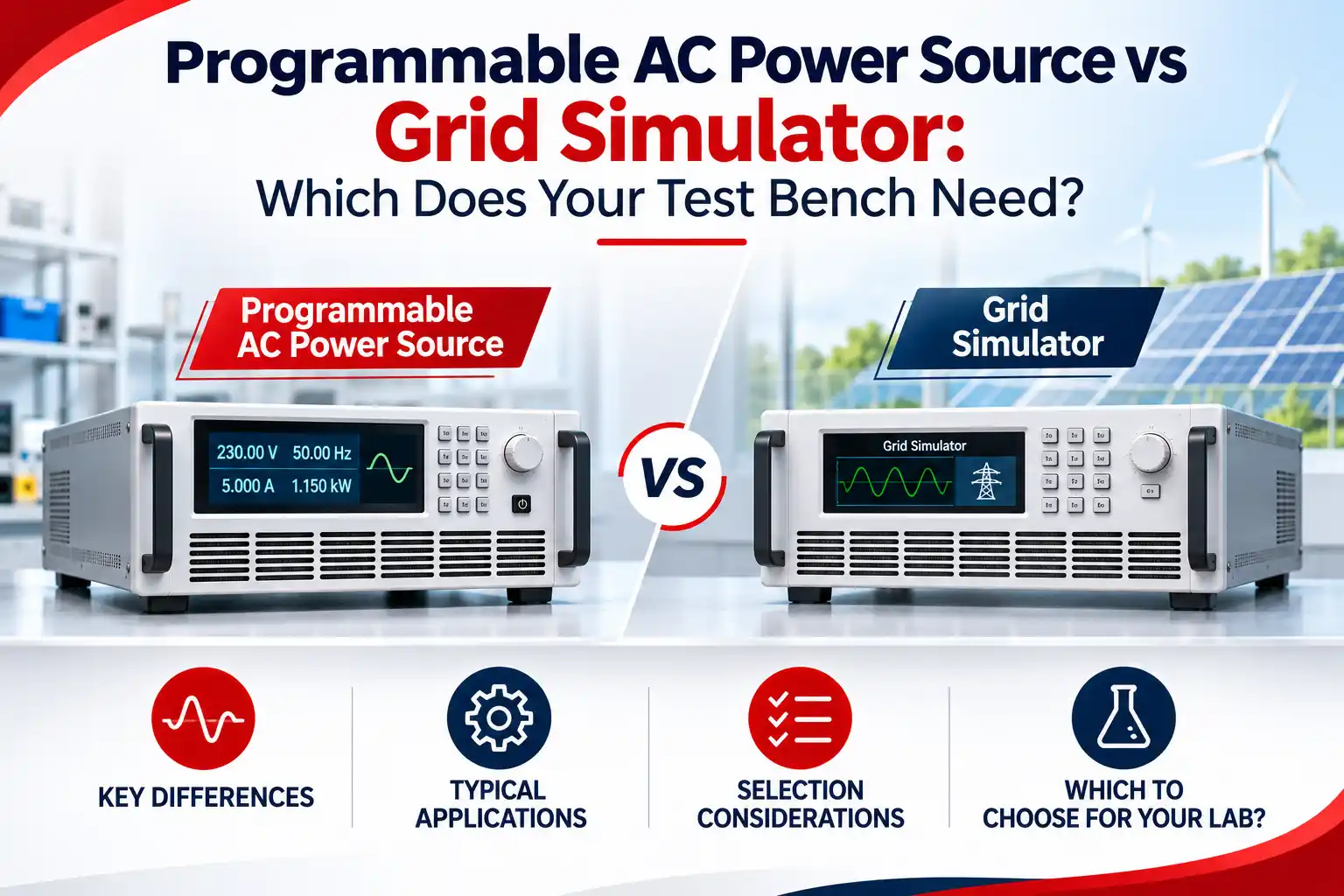
An onboard charger and a grid-connected inverter can both be described as power electronics equipment. Yet they present different jobs to an AC test bench.
An AC-input charger draws power from the AC supply. To test its response to different line conditions, your bench needs an instrument that provides controlled AC power. A grid-connected inverter delivers power to an AC grid. Its test bench may need an instrument that represents the grid and can handle power flowing back from the inverter.
That difference determines whether you should begin with a programmable AC power source or evaluate a regenerative grid simulator.
| Device under test | What the AC-side instrument must do | Equipment to evaluate |
|---|---|---|
| AC-input charger or onboard charger | Supply controlled AC voltage and frequency | Programmable AC power source |
| Grid-connected solar inverter or energy storage converter | Represent the grid and accept exported power | Suitable grid simulator |
| Standalone inverter output | Draw controlled power from the inverter | Suitable AC electronic load |
The complete bench may need instruments on the DC side as well. Specify the entire power path before choosing a model.
What does a programmable AC power source do?
A programmable AC power source provides a controlled AC input to a device under test. Depending on the model, engineers can set voltage and frequency, run programmed changes, and observe how the device responds.
For an AC-input charger, that can help answer practical questions:
- Does the charger start across its permitted input voltage range?
- What happens during a voltage dip or brief interruption?
- Does its input current change as expected when voltage or frequency changes?
- Can the same test sequence be repeated for each design revision?
ITECH’s IT7300 programmable AC supply is described for stable AC output and programmed power-line changes. Its IT7600 series adds functions such as waveform generation and integrated measurement. Functions differ by series and model, so check the exact product against your procedure.
An AC source supplies the charger’s input. If your test also needs to reproduce a battery or draw power from the charger’s DC output, specify that part of the bench separately.
What does a regenerative grid simulator do?
A grid simulator creates controlled electrical conditions at the AC connection of grid-connected equipment. A four-quadrant regenerative model can both supply and absorb power within its ratings. That matters when the device under test sends energy toward what it believes is the grid.
For a grid-connected inverter, a test plan may call for normal grid conditions, changes in voltage or frequency, phase conditions, and selected disturbances. ITECH describes its IT7900 regenerative grid simulator as a four-quadrant instrument for testing grid-connected equipment.
A grid simulator is therefore a different purchase decision from a standard source used to power an AC-input charger. Do not assume that every programmable AC supply can absorb an inverter’s output. Confirm the proposed model’s source and sink capabilities, ratings and installation requirements.
Also distinguish a grid-connected inverter from a standalone inverter. If your immediate task is to draw controlled power from a standalone inverter’s AC output, an AC electronic load may be the equipment to evaluate. Define the inverter’s operating mode before requesting a quote.
How to choose for charger testing
Start with the charger’s AC input specification and the test conditions you must reproduce.
Check voltage, current and apparent power
List the lowest and highest input voltage, normal operating current, startup or peak current, and required test duration. AC sources are often specified in volt-amperes (VA) or kilovolt-amperes (kVA). Check the source’s voltage, current and VA limits together at each planned operating point.
A model’s maximum voltage and maximum current should not be treated as a promise that both are available simultaneously under every condition. Ask for the exact model’s operating limits.
Define the required AC conditions
Does your procedure need a simple voltage and frequency sweep? Or must it reproduce dips, interruptions, unusual waveforms or changing frequency? Write down each condition, its duration and the result you need to measure. This makes it easier to compare a basic programmable source with a more capable series.
Specify the number of phases
A single-phase charger and a three-phase charger do not have the same AC source requirement. State the phase count, voltage configuration and whether you need to create unbalanced conditions.
How to choose for inverter testing
For a grid-connected inverter, begin with the AC interface and the direction of power flow.
- Record the inverter’s AC ratings: Voltage, current, phase count, frequency and maximum output power.
- State whether the test instrument must absorb power: This is essential when the inverter exports energy during the test.
- List the grid conditions to simulate: For example, defined voltage or frequency changes and phase conditions.
- Define measurement and recording needs: Specify the waveforms, electrical values and test events your team needs to retain.
- Describe the DC side: A solar inverter also needs a suitable DC input; an energy storage converter may need a battery simulator or another appropriate source.
Ask the supplier to confirm that the proposed grid simulator supports all required operating points, including regenerative operation. Any standards-based test must follow the applicable procedure; a product’s available test functions alone do not establish compliance.
AC power source vs grid simulator: a buying checklist
Send these details with your enquiry so the recommendation is based on your actual test:
- Device type and operating mode: AC-input charger, onboard charger, grid-connected inverter or standalone inverter
- Direction of power flow at the AC connection
- Single-phase or three-phase requirements
- Minimum, nominal and maximum voltage and frequency
- Continuous current, peak current, VA or kVA, and test duration
- Voltage changes, interruptions, harmonics or other programmed conditions required
- Measurement, automation and data export needs
- Available electrical supply, cooling, space and installation constraints
The ITECH AC power supply range at Revine Tech includes programmable AC supplies and regenerative grid simulators. Compare the specific models, since the functions described in this article are not shared by every instrument in the category.
Start with the direction of power flow
If the device draws AC power, begin by evaluating a programmable AC power source. If a grid-connected device sends power back through its AC connection, evaluate a grid simulator with suitable regenerative capability. Then check ratings, phases, programmed conditions and measurements against the full test procedure.
Planning a charger or inverter test bench? Send Revine Tech your AC voltage, current, phase count, power-flow direction and required test conditions.
Request an ITECH AC Test Equipment Quote
Frequently asked questions
Can a programmable AC power supply replace a grid simulator?
Only if the specific instrument supports the required power flow and grid simulation functions. A standard source may be suitable for supplying an AC-input charger, while a grid-connected inverter test may require a four-quadrant simulator that can absorb exported power. Check the model’s specifications before treating the two as interchangeable. ITECH IT7600 · ITECH IT7900.
Do I need an AC source to test an onboard charger?
An AC source may be needed when you want to provide repeatable input voltage and frequency conditions. The complete setup also depends on what must happen at the charger’s DC output. Describe both sides of the test when selecting equipment.
What determines AC power source price?
The quote depends on the required voltage, current, VA or kVA, phase count, waveform functions, measurement features and accessories. Send a test specification when requesting a price so suppliers can quote a configuration that fits the application.
How can Revine Tech help choose an ITECH AC test instrument?
Share your device type, AC ratings, power-flow direction and test procedure with Revine Tech. The team can help you compare an ITECH programmable AC source with a grid simulator and discuss a suitable model from its AC testing range.