
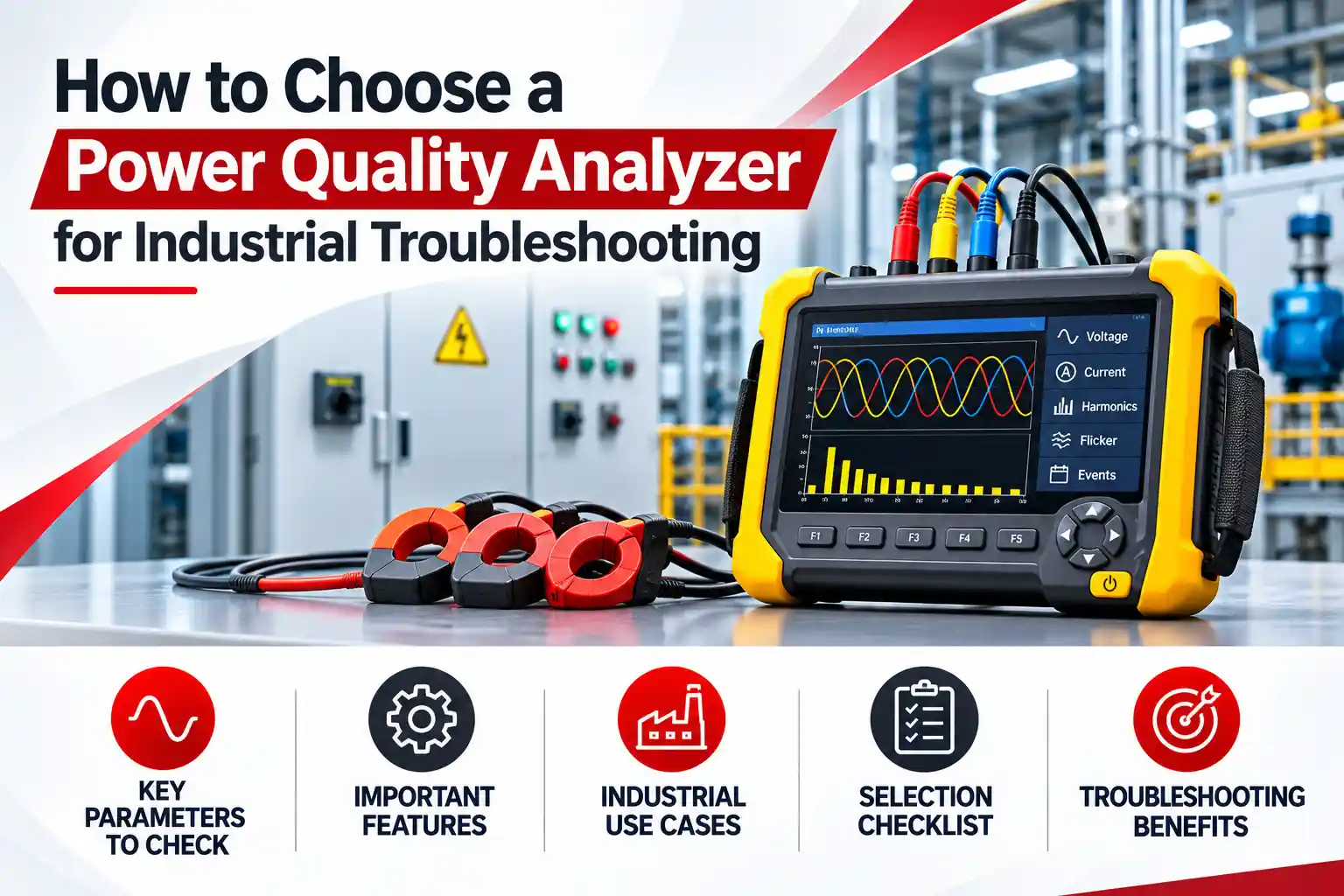
Unexpected machine shutdowns, repeated drive trips, and overheating transformers can interrupt production without leaving an obvious explanation. When the problem is intermittent, a quick voltage measurement may miss the conditions that caused it.
A power quality analyzer helps engineers record electrical conditions over time and investigate disturbances such as voltage sags, harmonics, and phase unbalance. Choosing the right instrument means matching its measurement and recording capabilities to the problem you need to solve.
This guide explains the specifications to compare when selecting a power quality analyzer for industrial maintenance, electrical troubleshooting, and power quality monitoring.
1. Start With the Problem You Need to Investigate
Before comparing models, document what happens when the fault occurs.
Does a production line stop when a large motor starts? Does a variable frequency drive trip during a particular process? Does transformer heating increase during peak production?
These observations help you decide which measurements matter.
| Industrial problem | Measurements to investigate | Features to prioritise |
|---|---|---|
| Equipment resets or control system dropout | Voltage sags and interruptions | Event timestamps, magnitude, duration, and waveforms |
| Problems during motor startup | Inrush current and voltage changes | Simultaneous voltage and current recording |
| Transformer or neutral conductor heating | Harmonic currents, loading, and unbalance | Harmonic analysis and neutral current measurement |
| Suspected switching disturbances | Fast voltage transients | Dedicated transient capture |
| Low power factor | Active power, apparent power, and distortion | True and displacement power factor |
| Uneven three-phase loading | Phase currents and voltage unbalance | Simultaneous measurements across all phases |
These symptoms can guide an investigation, but measurements are needed to establish the cause. Fluke’s power quality troubleshooting guide describes common relationships between electrical disturbances and equipment problems.
2. Match the Analyzer to Your Electrical System
For an industrial three-phase installation, choose an analyzer that supports the wiring configuration at the measurement point.
Check whether your application uses three-phase three-wire delta, three-phase four-wire wye, or another supported arrangement. Confirm the nominal voltage and frequency, voltage input limits, and required number of current channels.
The Fluke 1770 Series Three-Phase Power Quality Analyzers provide a product range to evaluate for industrial power quality investigations. Compare the individual models against your event capture and recording requirements.
If neutral conductor heating is part of the investigation, check whether the selected configuration allows neutral current to be recorded alongside the phase currents.
Also confirm compatibility with any existing current transformers or voltage transformers. Their ratios, accuracy, and frequency response affect the complete measurement system.
3. Choose Current Probes for the Actual Load
Current probes influence measurement quality as much as the analyzer itself.
A probe selected for a large incoming feeder may offer insufficient resolution for a lightly loaded branch circuit. Conversely, a probe with a low current range may be unsuitable for motor startup or other high-current events.
Compare the following:
- Expected operating current and maximum startup current.
- Accuracy and resolution at the currents you need to measure.
- Frequency response for harmonic analysis.
- Conductor size and available installation space.
- Compatibility with the analyzer.
- AC or DC measurement requirements.
Flexible current probes can be useful around large conductors or inside crowded panels. For smaller loads, a suitable clamp may provide a better measurement range.
Specify the probes when requesting a quotation so that competing offers cover equivalent configurations.
4. Check Event Capture for Intermittent Faults
Averages reveal operating trends, but troubleshooting often depends on what happened during a short disturbance.
For voltage sag analysis, look for records that show the event magnitude, duration, timestamp, and associated waveforms. Simultaneous voltage and current measurements can provide clues about whether a disturbance is related to a local load change or originated upstream. Fluke’s service panel guidance explains this approach.
For suspected transient voltage problems, compare dedicated transient recording capabilities.
Check the sampling rate, bandwidth, trigger options, and recording window. Ask whether the instrument stores waveform information from before the trigger, because that context may help explain how the event developed.
When comparing the Fluke 1773, 1775, and 1777 power quality analyzers, review each model’s transient capabilities against the disturbance you expect to investigate.
Request a sample event report before purchasing. It should contain the detail your maintenance team needs to make a decision.
5. Evaluate Harmonic Analysis and Power Factor Measurements
Industrial installations often contain nonlinear loads such as variable frequency drives, UPS systems, switching power supplies, and battery chargers.
For these applications, harmonic distortion analysis can be an essential part of troubleshooting.
Compare the analyzer’s voltage and current total harmonic distortion measurements, individual harmonic spectrum, and supported frequency range. Confirm how THD is defined so that results remain comparable between reports.
Power factor measurements also need attention.
True power factor is the ratio of active power to apparent power and reflects the effects of waveform distortion. Displacement power factor describes the phase relationship between the fundamental voltage and current components.
An analyzer that reports both can help engineers assess whether phase displacement, waveform distortion, or both contribute to a low power factor reading.
Before selecting power factor correction equipment, assess the harmonic conditions and installation requirements.
6. Decide Whether Class A Measurement Is Required
IEC 61000-4-30 defines power quality measurement methods, including Class A and Class S. Class A addresses advanced measurements, while Class S addresses surveys. The standard covers parameters such as supply voltage, dips, swells, interruptions, harmonics, and unbalance. IEC’s standard description explains its scope.
Consider a Class A power quality analyzer when your project requires comparable results between instruments, formal reporting, or measurements shared with a utility or equipment supplier.
Check the manufacturer’s compliance statement for the standard edition and parameters covered. Also confirm the project’s assessment limits before recording begins.
Class A measurement performance and electrical safety ratings describe different characteristics. Both should be evaluated for the intended application.
7. Plan the Recording Period and Reporting Requirements
The recording period should cover the conditions associated with the fault.
A brief inspection may miss a problem that occurs during a weekly process change, generator transfer, or peak production period. Choose a logging duration that captures representative operating conditions.
Check storage capacity, logging intervals, event thresholds, power arrangements, and options for downloading data during a recording session.
Software should make it easy to:
- Compare voltage and current trends.
- Find events by timestamp.
- Review harmonic measurements and waveforms.
- Compare electrical events with equipment fault logs.
- Export raw data and generate readable reports.
Confirm whether the quoted software includes the required features and whether any functions involve additional licences.
Before recording, verify the nominal voltage, wiring configuration, current probe direction, scaling, and instrument clock.
8. Compare the Complete Package and Price
When evaluating a power quality analyzer price, compare the full configuration.
A quotation should identify the analyzer model, current probes, voltage leads, accessories, software, calibration documentation, and warranty terms.
The instrument, probes, leads, and accessories must have suitable voltage and measurement category ratings for the installation. Follow the manufacturer’s instructions and site procedures when planning measurements.
To receive a useful recommendation, provide the supplier with your system voltage, phase configuration, expected current range, suspected disturbance, recording duration, and reporting requirements.
You can explore Revine Tech’s power quality analyzer range when preparing your shortlist.
A Practical Industrial Selection Example
Consider a hypothetical manufacturing line that experiences occasional drive trips when a large compressor starts.
For this investigation, prioritise simultaneous three-phase voltage and current recording, inrush capture, sag event details, and timestamps that can be compared with the drive’s fault log.
Choose current probes that cover both normal operation and expected startup current. Record several compressor starts under relevant production conditions.
The resulting measurements can help determine whether the drive trip coincides with a supply disturbance and guide the next investigation step.
For the investment discussion, read Revine Tech’s guide to evaluating the cost of poor power quality.
Discuss Your Requirements With Revine Tech
Share your electrical system details and troubleshooting requirements with Revine Tech when requesting a quotation. Include any need for Class A measurements, transient capture, harmonic analysis, or extended recording.
Request a Power Quality Analyzer Quote
Frequently Asked Questions
What is the difference between a power quality analyzer and an energy logger?
An energy logger primarily records consumption and load trends. A power quality analyzer provides capabilities for investigating disturbances such as voltage sags, harmonics, unbalance, and transients. Some instruments combine these functions, so compare their actual recording specifications.
How long should an industrial power quality survey run?
The recording period should cover representative operating conditions and the circumstances associated with the problem. Include relevant production shifts, equipment starts, load changes, or transfer events. Infrequent faults may require longer monitoring.
Which power quality analyzer should I discuss with Revine Tech?
You can discuss the Fluke 1770 Series with Revine Tech. Provide your system voltage, wiring configuration, current range, and fault symptoms so the required model, probes, and recording capabilities can be assessed.