
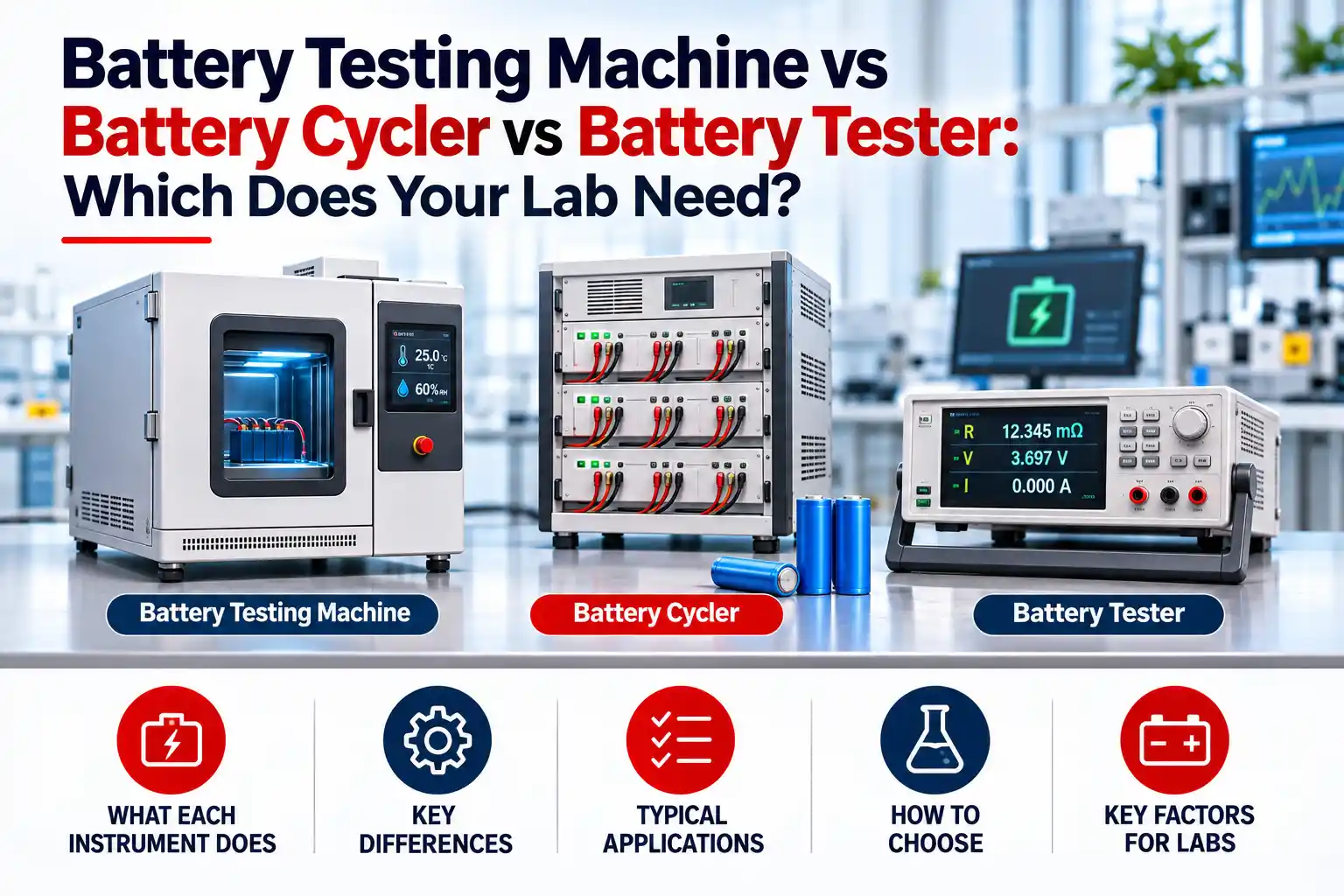
If you search for a battery testing machine, you will find instruments that do very different jobs. One may check voltage and internal resistance in seconds. Another may repeatedly charge and discharge cells for weeks. A larger system may coordinate those tests across many channels while recording temperature and other data.
The right choice starts with the question your lab needs to answer: Are you sorting batteries, measuring capacity, or validating performance over repeated cycles?
| Equipment | Main job | Typical use |
|---|---|---|
| Battery tester | Measures selected properties, such as voltage and internal resistance | Incoming inspection, cell sorting and production checks |
| Battery cycler | Runs controlled charge and discharge sequences | Capacity, performance and cycle-life testing |
| Integrated battery test system | Combines instruments, control software and data collection | Automated cell, module or pack validation |
“Battery testing machine” is a broad search term, not the name of one specific instrument. A battery cycler can be part of a complete battery test system.
When do you need a battery tester?
Choose a battery tester when you need a quick, repeatable check of defined battery properties. For example, an incoming inspection team may compare cell voltage and internal resistance against acceptance limits before those cells enter assembly.
The ITECH IT5100 series measures battery voltage and AC internal resistance using four-terminal sensing. ITECH lists comparator and data functions for inspection and sorting. Revine Tech includes the IT5100 in its ITECH battery tester range.
A resistance reading is not a capacity result. If your acceptance test requires ampere-hours, watt-hours or performance over time, you need a controlled discharge procedure and suitable measurement equipment.
When do you need a battery cycler?
A battery cycler controls charging and discharging according to a programmed procedure. It can help a lab measure delivered capacity, compare performance at different rates, and observe how a cell or pack changes over repeated cycles.
When comparing cyclers, check more than the headline voltage and current ratings. Ask whether the equipment supports your required charge and discharge steps, cutoff conditions, number of channels, recording interval and temperature monitoring. A cell development lab and an EV pack validation lab may need very different configurations.
For an automated example, the ITECH ITS5300 battery charge and discharge test system combines power supplies, electronic loads, measurement equipment and battery test software. Its configuration can be selected around the test requirement; confirm the specifications of the proposed setup before ordering.
What does a complete battery test system add?
A complete system brings the charging, discharging, measurements, protection and records into one managed workflow. That matters when tests must run across many cells or packs, repeat the same steps reliably, or produce data for engineering review.
For an EV battery lab, the purchasing question may include:
- How many cells, modules or packs must run at once?
- What are the maximum voltage, current and power at each test point?
- Must the system record individual cell voltage, pack voltage, temperature and internal resistance?
- What should happen if a limit is exceeded or communication is lost?
- How will engineers export and review the results?
The ITS5300 system listed by Revine Tech is an example of this integrated approach. The final equipment configuration should be matched to the battery and approved test procedure.
Which equipment fits your test?
| Your main requirement | Start by evaluating |
|---|---|
| Sort incoming cells by voltage and internal resistance | Battery resistance tester |
| Measure discharged capacity under a defined procedure | Suitable electronic load or battery cycler |
| Repeat charge and discharge tests over many cycles | Battery cycler |
| Run automated tests across multiple cells or packs | Integrated battery test system |
| Perform discharge tests only | DC electronic load, with its operating range and cutoff functions checked |
A DC electronic load can draw controlled power from a battery during discharge. The load alone does not provide the charging stage of a full cycling test. If discharge testing is your immediate requirement, Revine Tech’s electronic load sizing guide explains the voltage, current and power checks in more detail.
Seven details to send when requesting a quote
A useful equipment recommendation needs a test brief, not just a battery’s nominal voltage. Send the supplier:
- Battery type and test level: Chemistry, and whether you are testing cells, modules or packs.
- Operating limits: Highest and lowest test voltage, required current, and power at each operating point.
- Test purpose: Sorting, capacity measurement, cycle life, production inspection or pack validation.
- Test sequence: Charge and discharge steps, rates, duration and cutoff conditions.
- Throughput: Number of independent channels and tests per day.
- Measurements and records: Required voltage, current, capacity, energy, internal resistance and temperature data.
- Integration and protection: BMS or external signals, alarms, interlocks, data export and software requirements.
Check the proposed instrument’s operating limits across the whole test, particularly at the highest-power point and near the lowest discharge voltage. Use the battery manufacturer’s limits and your approved procedure to define safe test conditions.
Choosing equipment for cell, module or EV pack testing?
Share your battery voltage, current, test goals and required channel count. Revine Tech can help you identify a suitable ITECH tester or test system.
Request a Battery Testing Equipment Quote
Frequently asked questions
Can a battery internal resistance tester measure capacity?
An internal resistance tester measures properties such as resistance and voltage. Capacity requires a defined charge or discharge test with suitable current, endpoint and measurement. Check the specific instrument’s functions before treating a quick inspection result as a capacity measurement.
Is a battery cycler the same as a battery testing machine?
Sometimes. “Battery testing machine” is a general term used for several types of equipment. A cycler is specifically used to run controlled charge and discharge sequences.
Can I use a DC electronic load instead of a battery cycler?
A suitable load can handle a defined discharge test. Repeated charge and discharge cycling also needs a charging source, control, measurements and appropriate protection, whether separate or integrated into a test system.
Where can I request ITECH battery testing equipment in India?
Explore the ITECH battery tester range at Revine Tech, then request a quote. Include your battery type, voltage and current range, test goal, and required channel count so the team can recommend a suitable setup.