
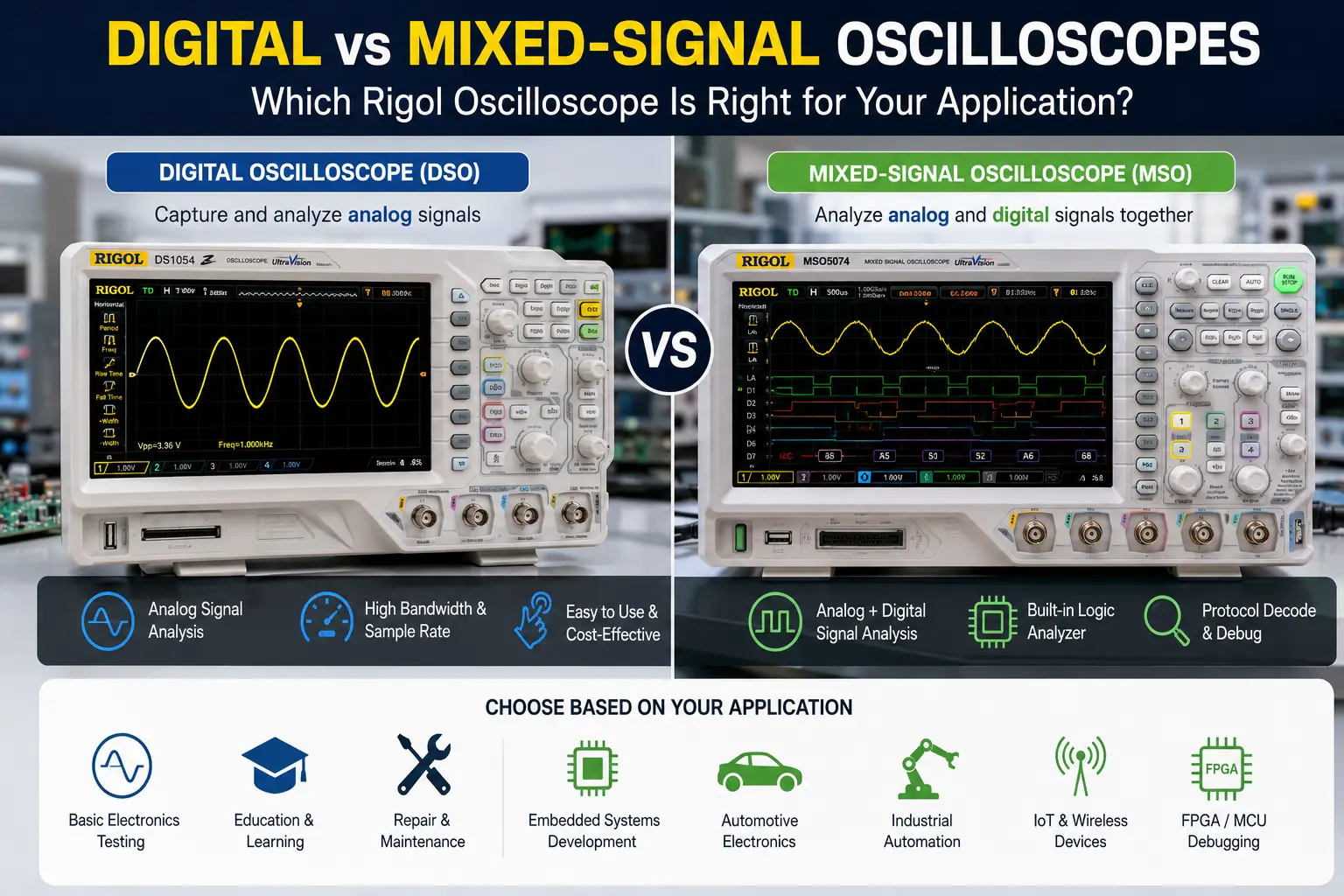
Choosing between digital vs mixed-signal oscilloscopes can be confusing, especially when you are comparing Rigol oscilloscopes for electronics testing, embedded development, automotive electronics, industrial systems, or academic labs in India.
If you are searching for a Rigol oscilloscope in India, digital oscilloscope near me, mixed-signal oscilloscope near me, or test and measurement instruments for your lab, the right choice depends on what kind of signals you need to measure.
A digital oscilloscope is suitable for viewing and analyzing analog signals such as voltage waveforms, frequency, rise time, noise, and signal distortion. A mixed-signal oscilloscope does the same, but it also allows you to analyze digital logic signals along with analog waveforms.
For engineers, technicians, R&D teams, and educational institutions, this difference matters. Choosing the wrong oscilloscope can lead to limited debugging capability, unnecessary cost, or missed signal problems. This guide explains the difference between digital and mixed-signal oscilloscopes and helps you decide which Rigol oscilloscope is right for your application.
Digital vs Mixed-Signal Oscilloscopes: What Is the Main Difference?
The main difference between a digital oscilloscope and a mixed-signal oscilloscope is the type of signals they can analyze.
A digital oscilloscope, also called a DSO, captures and displays analog electrical signals. It helps you see how voltage changes over time. This makes it useful for checking waveform shape, voltage levels, signal timing, noise, distortion, and frequency.
A mixed-signal oscilloscope, also called an MSO, combines the functions of a digital oscilloscope with digital logic analysis. It allows you to view analog signals and digital signals together on the same screen. This is useful when you need to understand how analog circuit behavior is related to digital control signals.
In simple terms, a digital oscilloscope is best for analog waveform analysis, while a mixed-signal oscilloscope is best for systems where analog and digital signals work together.
What Is a Digital Oscilloscope?
A digital oscilloscope is one of the most commonly used test and measurement instruments in electronics labs. It captures voltage signals, converts them into digital data, and displays the waveform on a screen.
Rigol digital oscilloscopes are widely used by electronics engineers, repair technicians, students, product developers, and lab teams for day-to-day testing. They are suitable for applications where the main requirement is to measure and analyze analog signals.
A digital oscilloscope can help you measure:
Voltage
Frequency
Duty cycle
Rise time
Fall time
Pulse width
Signal noise
Waveform distortion
Timing differences between channels
For many users in India, a digital oscilloscope is the practical starting point. It offers strong functionality for general testing without adding unnecessary complexity.
When Should You Choose a Rigol Digital Oscilloscope?
A Rigol digital oscilloscope is a good choice when your work mainly involves analog signal testing or basic electronics troubleshooting.
You should consider a digital oscilloscope if you are working with:
Power supply testing
Audio circuits
Sensor signals
Amplifier circuits
PWM waveforms
Basic microcontroller output signals
Electronic repair work
Engineering college lab experiments
General R&D bench testing
Production quality checks
For example, if you are checking whether a power supply output is stable, a digital oscilloscope can show ripple, noise, and voltage behavior over time. If you are testing an amplifier, it can help you inspect waveform distortion. If you are working in an educational lab, it can help students understand real-time signal behavior.
A digital oscilloscope is also a strong choice for buyers who are searching for an affordable Rigol oscilloscope in India or a digital oscilloscope near me for basic lab use.
What Is a Mixed-Signal Oscilloscope?
A mixed-signal oscilloscope includes analog channels and digital logic channels. This makes it useful for modern electronic systems that combine analog circuits, digital control, microcontrollers, communication buses, and power management.
Many electronic products today are not purely analog or purely digital. A simple IoT device, for example, may include a sensor, microcontroller, voltage regulator, wireless module, communication interface, and digital control lines. To troubleshoot such a system properly, engineers often need to see both analog and digital activity at the same time.
That is where a mixed-signal oscilloscope becomes valuable.
A Rigol mixed-signal oscilloscope can help engineers analyze timing relationships between analog waveforms and digital signals. This is especially useful when debugging embedded systems, communication errors, control signals, and intermittent faults.
When Should You Choose a Rigol Mixed-Signal Oscilloscope?
A Rigol mixed-signal oscilloscope is the better choice when your application involves both analog and digital signals.
You should consider a mixed-signal oscilloscope if you work with:
Embedded systems
Microcontrollers
FPGA or CPLD designs
IoT devices
Automotive electronics
EV electronics
Industrial control boards
Communication protocols
Digital timing analysis
Serial bus debugging
Sensor-based systems
Firmware and hardware interaction
For example, suppose you are debugging a microcontroller-based board. A sensor may send an analog signal to the microcontroller, and the microcontroller may respond through a digital output, PWM signal, or communication bus. A mixed-signal oscilloscope allows you to see these events together.
This makes it easier to answer questions such as:
Did the digital output change at the right time?
Is the microcontroller responding correctly to the analog input?
Is the SPI, I2C, UART, CAN, or LIN communication signal behaving as expected?
Is the issue caused by hardware, firmware, timing, or noise?
For Indian electronics companies, automotive suppliers, EV startups, industrial automation teams, and R&D labs, a mixed-signal oscilloscope can reduce debugging time and improve test accuracy.
Digital Oscilloscope vs Mixed-Signal Oscilloscope for Embedded Systems
Embedded systems often include both analog and digital sections. This makes oscilloscope selection especially important.
A digital oscilloscope may be enough if you only need to check basic voltage levels, clock signals, or simple output waveforms. However, if your project includes multiple digital signals, communication protocols, or timing-sensitive events, a mixed-signal oscilloscope is usually the better option.
For embedded engineers, an MSO can be useful for checking:
GPIO timing
Reset signals
Clock behavior
SPI communication
I2C communication
UART data
PWM control signals
Sensor trigger timing
Power-up sequencing
Microcontroller response time
This is why many embedded development teams prefer mixed-signal oscilloscopes. They provide a clearer view of how the complete system behaves.
Digital Oscilloscope vs Mixed-Signal Oscilloscope for Automotive Electronics
Automotive electronics require accurate signal testing because systems often include sensors, control units, communication buses, actuators, and power electronics.
A digital oscilloscope can help test analog waveforms, power rails, ignition signals, sensor outputs, and PWM signals. However, a mixed-signal oscilloscope is usually more useful when digital communication and timing analysis are involved.
For automotive and EV applications, a mixed-signal oscilloscope can help with:
ECU testing
CAN bus signal analysis
LIN bus testing
Sensor signal validation
PWM motor control testing
Battery management system testing
Power rail monitoring
Timing between analog and digital events
In India, automotive electronics, EV systems, and industrial mobility solutions are growing rapidly. For teams working in these areas, choosing a Rigol mixed-signal oscilloscope can provide better flexibility for present and future testing needs.
Digital Oscilloscope vs Mixed-Signal Oscilloscope for Educational Labs
For educational institutions, the right oscilloscope depends on the lab curriculum.
A digital oscilloscope is usually suitable for basic electronics, analog circuits, power electronics fundamentals, and general waveform analysis. It is easier for students to learn and more cost-effective when a college or training institute needs multiple units.
A mixed-signal oscilloscope is useful for advanced electronics labs, embedded systems courses, digital electronics, communication labs, robotics, IoT labs, and project-based learning.
For engineering colleges, polytechnic institutes, and technical training centers in India, the best choice may be a mix of both. Digital oscilloscopes can be used for foundational learning, while mixed-signal oscilloscopes can support advanced projects and research work.
Key Specifications to Check Before Buying a Rigol Oscilloscope
Before choosing between a digital and mixed-signal oscilloscope, check the specifications carefully. The right model depends on your signal type, speed, accuracy needs, and future applications.
Bandwidth
Bandwidth determines the range of signal frequencies the oscilloscope can measure accurately. If your signal frequency is high, you need higher bandwidth. For basic electronics, lower bandwidth may be enough. For embedded, automotive, RF-related, or high-speed digital work, higher bandwidth is usually better.
Number of Channels
Most oscilloscopes come with two or four analog channels. Two channels may be suitable for simple testing, but four channels give you more flexibility. If you often compare input, output, clock, and power signals together, a 4-channel oscilloscope is a better choice.
Sample Rate
Sample rate affects how accurately the oscilloscope captures fast-changing signals. A higher sample rate gives better waveform detail. This is important for digital signals, pulses, switching waveforms, and high-speed events.
Memory Depth
Memory depth determines how much waveform data the oscilloscope can store. Deeper memory helps when you need to capture long signal events or intermittent problems without losing detail.
Digital Channels
If you need to monitor logic signals, choose a mixed-signal oscilloscope with digital channel support. This is one of the most important features for embedded systems, digital electronics, and protocol debugging.
Protocol Decoding
Protocol decoding helps engineers read communication signals more easily. Depending on your application, you may need decoding support for interfaces such as I2C, SPI, UART, CAN, LIN, or other protocols.
Probes and Accessories
Do not ignore probes and accessories. Your measurement quality depends not only on the oscilloscope but also on the probes you use. Check whether you need passive probes, active probes, differential probes, current probes, or logic probes.
Which Rigol Oscilloscope Is Right for Your Application?
Choose a Rigol digital oscilloscope if your main work includes analog waveform testing, electronics repair, education, basic R&D, power supply testing, and general lab measurements.
Choose a Rigol mixed-signal oscilloscope if your work includes embedded development, microcontroller debugging, digital communication, automotive electronics, industrial control systems, IoT devices, EV electronics, or timing analysis.
For a small repair lab or beginner electronics setup, a digital oscilloscope may be enough. For a professional R&D team or product development lab, a mixed-signal oscilloscope can be a better long-term investment.
If your current projects are simple but future projects may include digital buses, firmware debugging, or communication protocols, it is worth considering a mixed-signal model from the beginning.
Buying Rigol Oscilloscopes in India: What Should You Check?
When buying a Rigol oscilloscope in India, do not select a model only by price. The lowest price may not always be the best value if the model does not match your application.
Before buying, check:
Required bandwidth
Number of analog channels
Need for digital channels
Protocol decoding requirements
Probe compatibility
Memory depth
Sample rate
Warranty support
Application guidance
Availability of accessories
Supplier experience in test and measurement instruments
GST billing and documentation
Technical support after purchase
For users searching for Rigol oscilloscope near me, digital oscilloscope near me, oscilloscope supplier in India, or test and measurement instruments in India, it is better to choose a supplier that understands engineering applications and can help you select the right model.
Why Buy Rigol Oscilloscopes from RevineTech?
RevineTech supports customers looking for test and measurement instruments across India. Whether you need a Rigol digital oscilloscope for general electronics testing or a Rigol mixed-signal oscilloscope for embedded and automotive applications, the right technical guidance can make selection easier.
A reliable supplier should help you compare models based on real application needs, not just specifications on paper. This is important for engineering teams, labs, manufacturing units, R&D centers, startups, universities, and service centers.
RevineTech can help users evaluate oscilloscope requirements based on signal type, bandwidth, channel count, application area, and testing goals.
The choice between digital vs mixed-signal oscilloscopes depends on how you plan to use the instrument.
A digital oscilloscope is a practical choice for analog waveform testing, basic electronics, education, repair, and general lab measurements. It is cost-effective, easy to use, and suitable for many everyday applications.
A mixed-signal oscilloscope is the better choice when you need to analyze analog and digital signals together. It is especially useful for embedded systems, microcontrollers, automotive electronics, IoT devices, industrial control boards, and communication protocols.
If you are comparing Rigol oscilloscopes in India, think about both your current and future testing needs. The right oscilloscope should support your application, improve debugging speed, and give reliable measurement confidence.
Looking for the right Rigol oscilloscope in India?
Explore RevineTech’s range of Rigol digital and mixed-signal oscilloscopes for electronics labs, R&D teams, embedded engineers, automotive testing, industrial applications, and educational institutions.
Visit: https://revinetech.com/all-products/all-rigol-oscilloscopes
FAQs
1. What is the difference between a digital oscilloscope and a mixed-signal oscilloscope?
A digital oscilloscope measures and displays analog waveforms. A mixed-signal oscilloscope measures analog waveforms and digital logic signals together. An MSO is better for embedded systems, microcontroller debugging, and digital communication testing.
2. Which is better, a digital oscilloscope or a mixed-signal oscilloscope?
Neither is better for every user. A digital oscilloscope is better for analog testing and basic lab work. A mixed-signal oscilloscope is better for applications that involve both analog and digital signals.
3. Do I need a mixed-signal oscilloscope for embedded systems?
Yes, a mixed-signal oscilloscope is highly useful for embedded systems because it helps analyze analog signals, logic signals, GPIO timing, and communication protocols such as I2C, SPI, and UART.
4. Is a digital oscilloscope enough for electronics repair?
For most electronics repair work, a digital oscilloscope is usually enough. It can help test power supplies, amplifier circuits, control boards, sensor signals, and general waveforms.
5. Which Rigol oscilloscope is suitable for engineering colleges in India?
For basic electronics labs, a Rigol digital oscilloscope is usually suitable. For advanced embedded systems, IoT, robotics, and digital electronics labs, a Rigol mixed-signal oscilloscope may be a better choice.
6. Can a mixed-signal oscilloscope be used as a normal digital oscilloscope?
Yes. A mixed-signal oscilloscope can be used like a normal digital oscilloscope for analog waveform testing. It also provides digital logic analysis features when needed.
7. What should I check before buying a Rigol oscilloscope in India?
Check bandwidth, sample rate, memory depth, number of channels, digital channel support, protocol decoding, probe compatibility, warranty, and supplier support before buying.
8. Where can I buy Rigol oscilloscopes in India?
You can explore Rigol oscilloscopes in India through RevineTech. The product range includes options for electronics testing, embedded systems, R&D labs, industrial applications, and educational institutions.