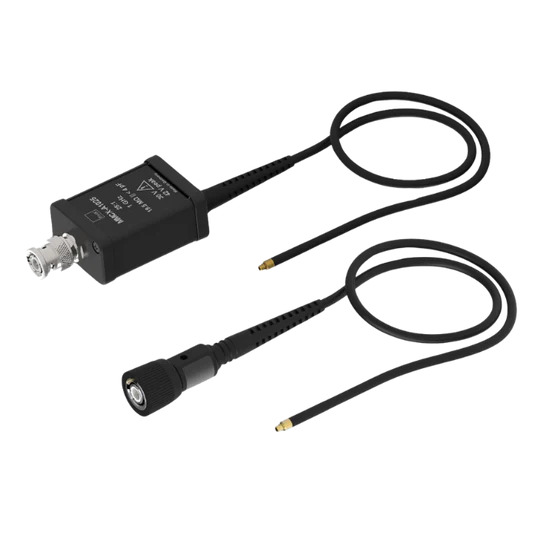
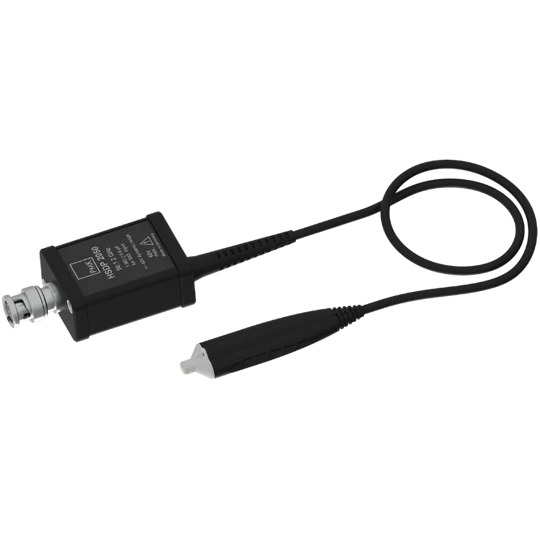
PMK High-Speed Probes: Precision Measurement for Single-Ended and Differential Signals
Welcome to Revinetech's elite category for PMK...
PMK High-Speed Probes: Precision Measurement for Single-Ended and Differential Signals
Welcome to Revinetech's elite category for PMK High-Speed Probes. In the demanding fields of digital design, high-frequency telecommunications, and high-speed power electronics, the quality of your oscilloscope measurement is entirely dependent on the integrity of the signal captured by the probe. PMK specializes in creating precision, wide-bandwidth probes—both differential and single-ended—that ensure minimal signal distortion, low input capacitance, and reliable signal transfer to the oscilloscope's input.
You are seeking robust, high-bandwidth probes that offer clean signal acquisition, flexibility across various measurement types, and superior fidelity for analyzing fast digital edges or differential analog signals. Our selection features the complete range of PMK high-speed solutions, including active differential probes, high-bandwidth passive probes, and specialized power probes. Trust Revinetech to provide the genuine PMK probe that delivers certified performance, superior transient response, and the essential diagnostic accuracy required for validating your cutting-edge electronic designs.
Why PMK High-Speed Probes are Critical for Modern Electronics
As device speeds increase (e.g., GHz clocks, nanosecond rise times), standard low-cost probes introduce significant measurement errors, such as signal reflections, loading, and bandwidth limitations. PMK probes are engineered to eliminate these sources of error.
Mastering Signal Integrity and Bandwidth
The core strength of PMK high-speed probes is their commitment to preserving the fidelity of the measured signal:
-
Wide Bandwidth: Probes are designed to support extremely wide frequency bandwidths, accurately capturing the fastest switching edges and highest harmonic content without rounding or distortion.
-
Low Input Capacitance: Active and passive probes feature ultra-low input capacitance (often sub-picofarad). This minimizes the probe's loading effect on the delicate, high-impedance circuit nodes, ensuring the device under test (DUT) operates under true electrical conditions.
-
Superior Transient Response: Optimized designs ensure the probe accurately follows rapid voltage changes, providing precise measurements of rise times and transient events crucial for digital timing analysis and power electronics.
Versatility in Measurement Types
PMK provides specialized probe types to handle the two most common high-speed measurement scenarios:
-
Active Differential Probes: Essential for measuring the precise voltage difference between two points that are not referenced to ground. They provide high Common Mode Rejection Ratio (CMRR), suppressing noise common to both lines, vital for high-speed serial data buses (like USB, Ethernet, PCIe) and power measurements.
-
High-Impedance Active Single-Ended Probes: Used for measuring a signal referenced to ground. These probes contain active amplification to achieve extremely low input capacitance, which is mandatory for probing sensitive, high-frequency circuit nodes with minimal loading.
-
Passive High-Bandwidth Probes: Offering a cost-effective solution for general-purpose high-frequency debugging, often with interchangeable tips and accessories.
Exploring the PMK High-Speed Probe Categories
Our catalogue features the specialized lines of PMK high-speed probes, categorized by their operation mode, voltage rating, and bandwidth requirements.
Active Differential Probes (Floating Measurements)
These probes are the benchmark for differential signaling and power integrity analysis:
-
High CMRR: Optimized for maximum rejection of common-mode noise, guaranteeing that the oscilloscope displays the true differential data signal.
-
High Voltage Isolation: Specialized probes (including optically isolated models) provide the necessary safety and isolation for floating measurements in high-voltage power converters (SiC/GaN).
High-Impedance Single-Ended Probes (Low Loading)
These active probes are crucial for sensitive ground-referenced measurements:
-
Extremely Low Capacitance: Designed for probing clocks, oscillators, and sensitive signal paths where the slightest capacitive load could degrade signal quality or prevent the circuit from functioning correctly.
-
Wide Dynamic Range: Providing the necessary voltage range and linearity for general-purpose digital and analog debugging tasks.
Specialized Probes and Accessories
PMK offers various specialized probe types to enhance flexibility and connectivity:
-
Power Measurement Accessories: Tips and accessories designed for robust, safe connection to busbars and terminals in power electronics test setups.
-
Probe Tips and Solder-In Heads: A wide selection of accessories, including fine-pitch tips and solder-in adapters, ensures secure, low-inductance connection to small surface-mount test points (SMT).
Integrated Features for Reliable Measurement
PMK probes incorporate features that streamline workflow, improve safety, and ensure accurate data acquisition.
-
Automatic Probe Identification: Select probes feature an automatic identification system that communicates the attenuation ratio and power status to compatible oscilloscopes, guaranteeing correct scaling and readout.
-
Integrated Powering: Probes often feature power options such as USB power or direct connection via a compensated oscilloscope interface, providing stable power to the active internal electronics.
-
Robust Construction: Built with durable enclosures and high-quality materials suitable for rigorous, daily use in demanding laboratory environments.
Partner with Revinetech for PMK High-Speed Assurance
Selecting the ideal PMK High-Speed Probe requires assessing the required bandwidth (GHz), the operating mode (differential vs. single-ended), and the maximum voltage rating. Revinetech is your authorized source for the complete PMK probe portfolio. Our technical specialists are ready to assist you in matching the certified performance, low loading characteristics, and safety features of the right PMK probe to your specific digital, RF, and power electronics debugging demands.
Capture the fastest signals with absolute fidelity. Browse our catalogue of PMK High-Speed Probes today, and contact us for expert advice and a personalized quote.
Frequently Asked Questions (FAQs)
What is the difference between a high-speed differential probe and a high-impedance single-ended probe?
A differential probe measures the voltage difference between two points, neither of which is ground, and is used for high-speed buses (like USB). A high-impedance single-ended probe measures a signal relative to ground and is used to probe sensitive circuit nodes with minimal capacitive loading.
Why is low input capacitance critical for a high-speed probe?
Low input capacitance is critical because capacitance acts as a load on the circuit, especially at high frequencies. Low capacitance ensures the PMK probe does not alter the performance or waveform of the measured signal (e.g., clock frequency, rise time) and prevents circuit malfunction.
What is the significance of the probe's bandwidth rating (e.g., 4 GHz)?
The bandwidth rating indicates the maximum frequency the probe can accurately pass to the oscilloscope. For clean measurement of a digital signal's rise time, the probe's bandwidth should generally be five times the clock frequency or match the formula $0.35/\text{Rise Time}$.
How does CMRR relate to a PMK high-speed differential probe?
CMRR (Common Mode Rejection Ratio) is a measure of the differential probe's ability to reject noise or voltages common to both lines. High CMRR is essential for high-speed differential signaling because it ensures the probe ignores external noise and focuses only on the true data signal difference.
Can PMK high-speed probes be used for power supply ripple measurements?
Yes. Active differential probes are excellent for measuring power supply ripple and noise because they allow the technician to measure the ripple directly across the power rails (positive to ground, or positive to negative rail) with high accuracy and high bandwidth, minimizing noise pickup.