
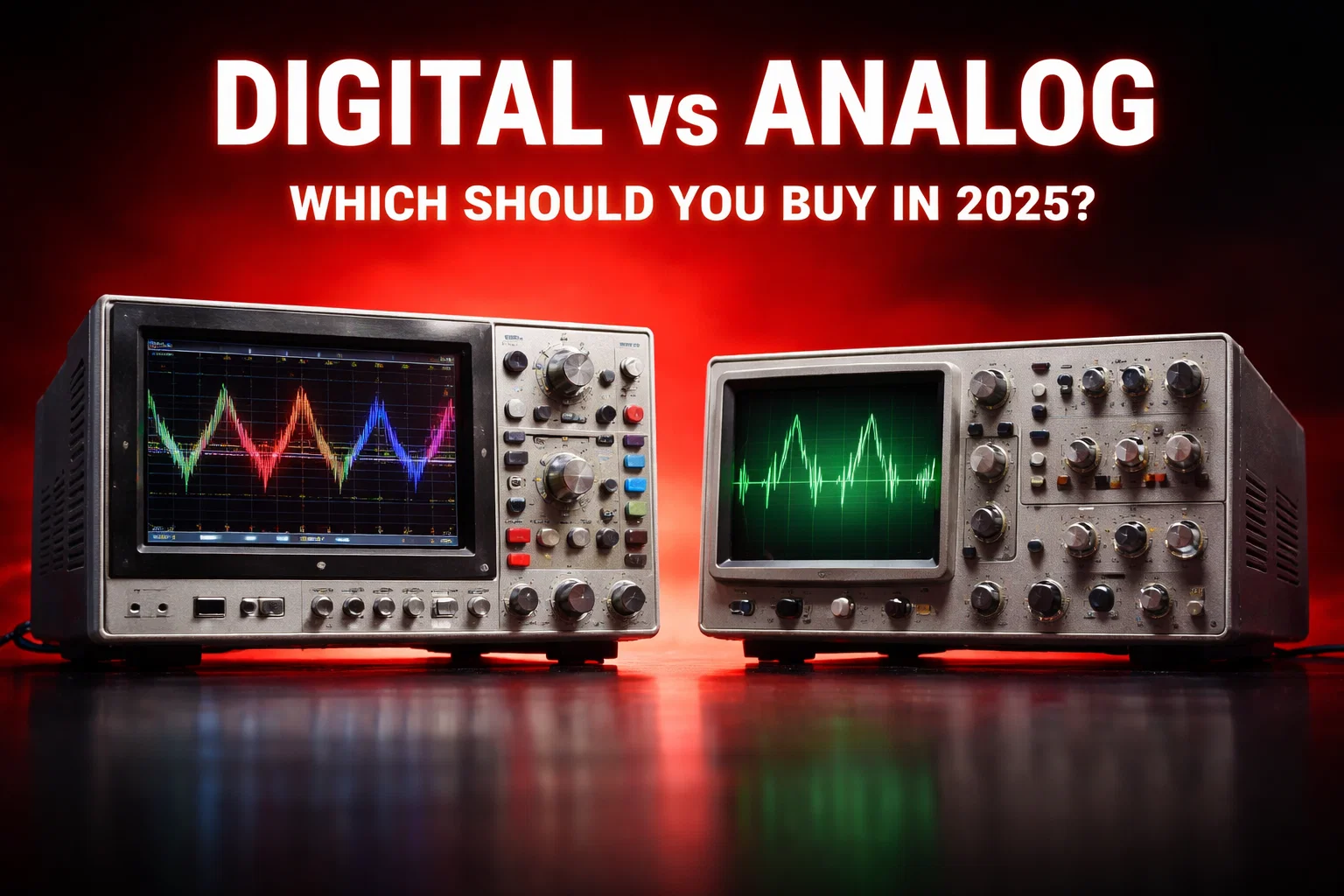
Digital vs Analog Oscilloscope: Which Should You Buy in 2025?
Oscilloscopes are one of the most essential tools in electronics, electrical engineering, and embedded systems. Whether you are a student learning the basics of signals, a hobbyist building DIY projects, or a professional engineer troubleshooting complex circuits, choosing the right oscilloscope can significantly impact your work.
In 2025, buyers are often confused between digital oscilloscopes and analog oscilloscopes. While analog scopes were once the industry standard, digital oscilloscopes now dominate the market with advanced features, better accuracy, and long-term usability. However, that doesn’t mean analog oscilloscopes are completely obsolete.
This guide will give you a clear, practical, and up‑to‑date comparison of digital vs analog oscilloscopes so you can confidently decide which one you should buy in 2025.
What Is an Oscilloscope?
An oscilloscope is an electronic test instrument used to visualize electrical signals. It displays voltage on the vertical axis and time on the horizontal axis, allowing users to see how a signal changes over time.
Oscilloscopes are widely used to:
-
Analyze waveforms
-
Measure voltage, frequency, and timing
-
Debug electronic circuits
-
Test power supplies and communication signals
Depending on how signals are processed and displayed, oscilloscopes are broadly classified into analog and digital types.
What Is an Analog Oscilloscope?
An analog oscilloscope directly displays an electrical signal using analog circuitry. The input signal is amplified and sent straight to a cathode-ray tube (CRT), where the waveform is drawn in real time.
Key Characteristics of Analog Oscilloscopes
-
Real-time signal display
-
No signal sampling or digital processing
-
Smooth waveform appearance
-
Limited measurement and storage capabilities
Advantages of Analog Oscilloscopes
-
True Real-Time Display
Analog oscilloscopes show signals exactly as they occur, without sampling delays. -
Smooth Waveforms
For repetitive analog signals, waveforms often look cleaner and more continuous. -
Simple Operation
Fewer menus and settings make them easier for basic learning. -
Low Cost (Used Market)
Many analog scopes are available at very low prices in the second-hand market.
Limitations of Analog Oscilloscopes
-
Cannot store or save waveforms
-
No advanced measurements or math functions
-
Limited bandwidth and accuracy
-
Bulky and power-hungry
-
Mostly discontinued by manufacturers
In 2025, analog oscilloscopes are rarely used in professional environments but may still be found in educational labs or among enthusiasts.
What Is a Digital Oscilloscope?
A digital oscilloscope converts incoming signals into digital data using an analog-to-digital converter (ADC). The waveform is then processed, analyzed, and displayed on a digital screen.
Most modern digital oscilloscopes are Digital Storage Oscilloscopes (DSOs), which can store, analyze, and manipulate waveforms.
Key Characteristics of Digital Oscilloscopes
-
Signal sampling and digital processing
-
Waveform storage and recall
-
Automated measurements
-
Compact design with LCD displays
Advantages of Digital Oscilloscopes
-
Waveform Storage & Analysis
You can capture, save, and review signals at any time. -
Advanced Measurements
Automatic measurements for frequency, rise time, duty cycle, RMS voltage, and more. -
Higher Accuracy
Digital processing reduces measurement errors. -
Connectivity
USB, LAN, and PC connectivity for data transfer and remote access. -
Protocol Decoding
Many digital oscilloscopes support I2C, SPI, UART, CAN, and other protocols. -
Compact & Energy Efficient
No CRT, smaller footprint, and lower power consumption.
Limitations of Digital Oscilloscopes
-
Higher initial cost compared to analog scopes
-
Learning curve due to menus and settings
-
Sampling limitations if not configured properly
Despite these limitations, digital oscilloscopes are the industry standard in 2025.
Digital vs Analog Oscilloscope: Key Differences
| Feature | Analog Oscilloscope | Digital Oscilloscope |
|---|---|---|
| Signal Processing | Fully analog | Digital sampling |
| Waveform Storage | Not possible | Yes |
| Measurement Accuracy | Moderate | High |
| Advanced Features | Very limited | Extensive |
| Size & Portability | Large, heavy | Compact |
| Learning Curve | Low | Moderate |
| Availability in 2025 | Rare | Widely available |
Performance Comparison in 2025
Bandwidth & Sample Rate
Analog oscilloscopes are limited by analog circuitry, while digital oscilloscopes offer much higher bandwidth and sample rates suitable for modern high-speed electronics.
Debugging Capability
Digital oscilloscopes excel in debugging complex circuits thanks to trigger modes, memory depth, and zoom features.
Long-Term Use
Digital oscilloscopes receive firmware updates, new features, and ongoing manufacturer support, making them future-proof.
Which Oscilloscope Should You Buy in 2025?
Choose an Analog Oscilloscope If:
-
You are learning basic electronics
-
You work only with low-frequency analog signals
-
You find a reliable used unit at a very low price
-
You want a simple, distraction-free learning tool
Choose a Digital Oscilloscope If:
-
You work with microcontrollers, embedded systems, or communication protocols
-
You need waveform storage and analysis
-
You want accurate and repeatable measurements
-
You plan long-term professional or educational use
For most users in 2025, a digital oscilloscope is the clear winner.
Popular Digital Oscilloscope Brands in 2025
Some of the most trusted oscilloscope brands include:
-
Rigol
-
Keysight
-
Tektronix
-
Siglent
-
Rohde & Schwarz
Among these, Rigol oscilloscopes are especially popular due to their balance of performance, reliability, and price. You can explore the full range of Rigol models suitable for beginners and professionals on RevineTech.
Cost Comparison
Analog oscilloscopes are usually cheaper only in the used market. Digital oscilloscopes have a higher upfront cost but provide significantly more value and longevity.
In 2025, entry-level digital oscilloscopes are affordable enough that buying an analog scope rarely makes financial sense.
Final Verdict
The debate between digital and analog oscilloscopes is largely settled in 2025. While analog oscilloscopes played a crucial role in the history of electronics, digital oscilloscopes are the better choice for almost everyone today.
They offer superior accuracy, advanced features, storage capabilities, and long-term support. Unless you have a very specific reason to choose analog, investing in a quality digital oscilloscope will give you better results, greater flexibility, and future-ready performance.
If you’re planning to buy an oscilloscope in 2025, going digital is the smartest decision.