
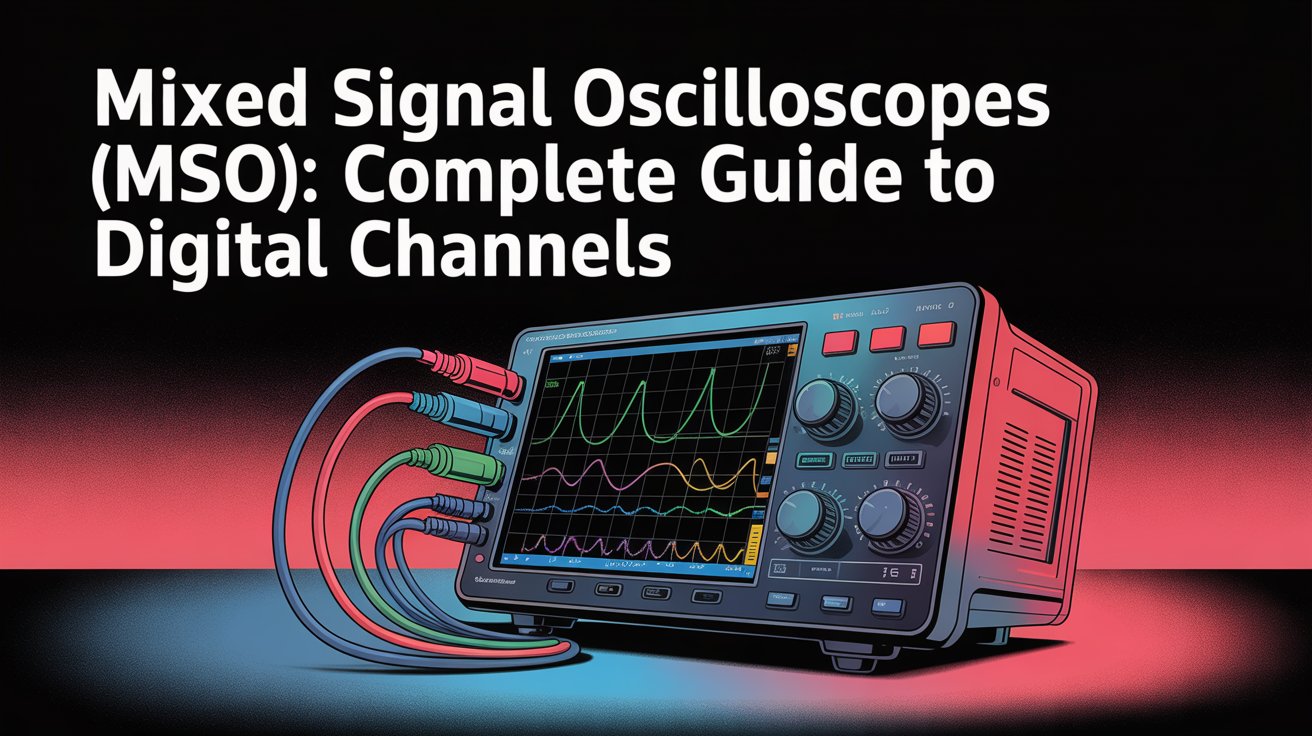
In modern electronics, designs are no longer purely analog. Most systems combine analog signals with digital logic, microcontrollers, communication buses, and embedded processors. This is where a Mixed Signal Oscilloscope becomes extremely important.
A Mixed Signal Oscilloscope (MSO) combines traditional analog waveform viewing with multiple digital input channels. It allows engineers to see analog and digital signals together, time-aligned on the same screen. This is extremely useful for debugging embedded systems, power electronics with control logic, automotive ECUs, IoT boards, and communication devices.
If you are already familiar with basic Oscilloscopes, understanding digital channels inside an MSO will take your debugging capability to the next level.
What Is a Mixed Signal Oscilloscope (MSO)?
A Mixed Signal Oscilloscope is an oscilloscope that includes:
Analog input channels (typically 2 or 4)
Digital input channels (commonly 8, 16, or more)
Advanced triggering and protocol decoding features
Unlike a traditional Digital Storage Oscilloscope (DSO), an MSO allows you to monitor logic states (High/Low) on multiple lines simultaneously while also observing analog waveforms.
For embedded system engineers, this means you can:
View SPI clock and data lines
Check I2C transactions
Monitor UART communication
Correlate analog sensor output with digital control signals
This combined visibility significantly reduces debugging time.
Understanding Digital Channels in an MSO
Digital channels in an MSO function similarly to a logic analyzer but are fully integrated into the oscilloscope.
How Digital Channels Work
Digital inputs detect logic levels instead of continuous voltage waveforms. Each channel interprets signals as:
Logic High (1)
Logic Low (0)
The MSO compares the input voltage to a configurable threshold voltage. If the signal is above the threshold, it is considered logic high. If below, logic low.
This makes digital channels ideal for:
Microcontroller GPIO lines
Address and data buses
Control signals
Communication protocols
Unlike analog channels that show waveform shape, digital channels show state transitions over time.
Threshold Voltage and Logic Families
One critical concept in digital channels is threshold voltage.
Different logic families operate at different voltage levels:
| Logic Type | Typical Voltage | Recommended Threshold |
|---|---|---|
| TTL | 5V | ~1.4V |
| CMOS 5V | 5V | ~2.5V |
| CMOS 3.3V | 3.3V | ~1.65V |
If the threshold is incorrectly set, you may see false triggering or unstable digital readings.
When working with embedded systems and power rails tested using Power Supplies, always verify the logic voltage before configuring thresholds.
Timing Correlation with Analog Channels
One of the biggest advantages of an MSO is time alignment.
Example scenario:
An embedded board reads an analog temperature sensor.
The microcontroller converts it using ADC.
Then sends data through SPI.
With an MSO, you can:
Observe analog sensor waveform on Channel 1
View SPI clock and MOSI/MISO lines on digital channels
Check if timing is correct between analog conversion and digital transmission
This correlation is not possible with separate instruments like standalone Logic Analyzers unless you manually synchronize them.
MSO vs Logic Analyzer
Many engineers ask whether they need a logic analyzer if they already have an MSO.
Here is a comparison:
| Feature | MSO | Logic Analyzer |
|---|---|---|
| Analog + Digital together | Yes | No |
| High channel count | Moderate (8–16) | High (32–100+) |
| Deep protocol analysis | Good | Very Advanced |
| Analog waveform visibility | Yes | No |
If your debugging involves mixed analog-digital interaction, an MSO is more practical.
If you only need high-channel digital bus capture, a dedicated logic analyzer may be better.
For most embedded labs, an MSO combined with proper Probes is sufficient.
Protocol Decoding on Digital Channels
Modern MSOs support built-in serial protocol decoding, such as:
I2C
SPI
UART
CAN
LIN
Instead of manually decoding bit patterns, the MSO overlays decoded data directly on the waveform.
For example, in SPI:
You can see clock pulses
MOSI data
Chip select
Decoded hex value
This saves huge debugging time in firmware validation and hardware bring-up.
When validating RF modules controlled via SPI, you may also correlate data with signals generated by RF Signal Generators for complete system testing.
Practical Applications of MSO Digital Channels
Embedded System Debugging
When microcontroller code fails, digital channels help verify:
Clock signals
Reset lines
Interrupt signals
Bus communication
This reduces dependency on firmware assumptions.
Power Electronics with Digital Control
In SMPS or inverter systems:
Analog channels show switching waveform
Digital channels show PWM control logic
You can verify whether incorrect switching is due to control firmware or analog power stage.
Testing becomes more reliable when combined with stable lab Power Supplies.
Automotive and Industrial Systems
Automotive ECUs use CAN, LIN, SPI, and sensor feedback.
With an MSO:
Monitor communication bus
Check analog sensor output
Verify timing accuracy
This is extremely useful in validation and QA labs.
EMI and Signal Integrity Debugging
Digital lines can produce noise or ringing.
By observing:
Digital edge timing
Analog waveform distortion
You can identify cross-talk or grounding issues. This is especially important when working with high-speed designs that may also require Spectrum Analyzers for frequency-domain analysis.
Common Mistakes When Using MSO Digital Channels
Many engineers misuse MSOs due to misunderstanding digital inputs.
Incorrect threshold setting
Using wrong probe type
Ignoring ground reference
Overloading digital input voltage range
Not checking sample rate
Remember that digital channels also depend on sampling rate and memory depth. If your time base is too wide, you may miss short glitches.
When precise waveform measurement is required, always verify with analog channels as well.
Choosing the Right MSO for Your Lab
When selecting a Mixed Signal Oscilloscope, consider:
Bandwidth based on signal frequency
Sample rate
Number of digital channels
Memory depth
Protocol decoding options
Trigger capabilities
For embedded development, 4 analog channels with 16 digital channels are generally ideal.
For advanced validation labs handling RF and high-speed systems, integration with tools like Function Generators and Data Acquisition Systems can further improve workflow efficiency.
How MSO Improves Lab Workflow
Instead of using:
One oscilloscope
One logic analyzer
One protocol decoder
An MSO integrates everything into one instrument.
This:
Reduces bench clutter
Improves time synchronization
Speeds up debugging
Enhances reporting accuracy
In structured QA and validation environments, MSOs are becoming standard equipment alongside Digital Multimeters and programmable power instruments.
Final Thoughts
Mixed Signal Oscilloscopes are no longer optional in modern electronics labs. As digital control increasingly interacts with analog hardware, engineers need tools that visualize both domains simultaneously.
Digital channels inside an MSO allow:
Accurate timing analysis
Protocol debugging
Logic state monitoring
Correlation with analog waveforms
For embedded systems, power electronics, automotive testing, and industrial validation, an MSO significantly improves debugging efficiency and accuracy.
Understanding digital channel configuration, threshold levels, and triggering techniques will help you extract maximum performance from your instrument.
FAQ
What is the difference between MSO and DSO?
A DSO measures only analog signals. An MSO includes additional digital input channels for monitoring logic signals.
How many digital channels are typically available in an MSO?
Most MSOs offer 8 to 16 digital channels. Higher-end models may support more.
Can MSO replace a logic analyzer?
For mixed analog-digital debugging, yes. For very high channel count digital bus analysis, a dedicated logic analyzer may still be preferred.
Why is threshold setting important in digital channels?
Incorrect threshold settings can cause false logic detection, unstable triggering, and incorrect decoding.
Do digital channels affect sampling rate?
Yes. Digital channels share system resources, so sample rate and memory depth must be configured properly for accurate capture.
If you want, I can now optimize this further for higher SEO ranking by strengthening keyword placement and improving internal link strategy.