Home DNV Motor Test Solution Electric Motor Emulator (EME) – For Motor Drive Inverter Testing
DNV Motor Test Solution

Electric Motor Emulator (EME) – For Motor Drive Inverter Testing

A lab-safe, standalone electronic dynamometer alternative that emulates electric motors for inverter design validation, endurance testing, and high-volume production. Supports 48 V, 350 V and 800 V vehicle platforms with integrated battery emulation and scalable high-power architecture..

  • Detail
  • Special Features
  • Specification

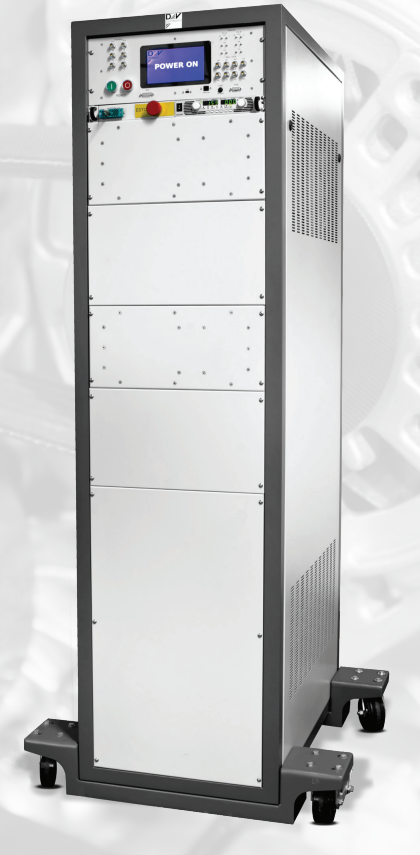
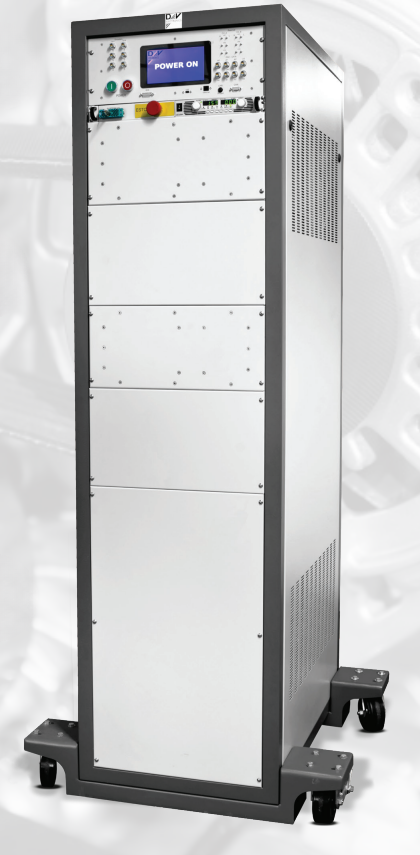
The Electric Motor Emulator replicates true 4-quadrant motor behavior, including torque generation, BEMF, impedance, and temperature-dependent reactions. It allows accurate inverter testing even before a physical motor prototype exists, reducing project timelines and risks.

Engineers can test switching strategies such as SVM, sine-triangle or DPWM, while monitoring transient events without the mechanical hazards of a spinning motor. The emulator is designed to handle demanding EV inverter tests, including rapid acceleration, sudden load changes and long overload cycles.

Multiple configurations support upgrading from single-motor to dual-motor testing and parallel stacking for high current and multi-phase platforms. Voltage levels are selectable to match different EV architectures (48 / 350 / 800 V), making it ideal for current and next-gen e-powertrain development.

A PC-based GUI and automation-friendly CAN interface allow complete control of both the emulator and the unit under test. When combined with real-time simulation, the platform delivers a full HIL/P-HIL setup for advanced inverter development.

  • Internal HV & LV battery emulators for complete inverter testing without real batteries

  • Configurable motor models with drive-cycle simulation and P-HIL compatibility

  • Circulates AC/DC power between inverter and emulator, reducing facility power to only ~25% of system rating

  • Flexible 3-phase or 6-phase operation, scalable up to 1.1 MW by paralleling multiple units

  • Safe validation of extreme conditions such as overspeed, burst and locked rotor

  • No moving parts, minimal maintenance, and compact footprint with caster mobility

  • 70+ DAC outputs provide motor parameters that real machines cannot easily expose

Category Specification
Motor Emulation Synchronous PM or Induction, 3-phase or 6-phase
Number of Motors 1 or 2 per system depending on model
Continuous Power 150 kW to 275 kW per emulator (up to 550 kW combined)
AC Current 350 Arms continuous, 550 Arms peak (scalable to 1400 Arms)
Voltage Capability 0–365 VAC L-L or 0–700 VAC L-L
Frequency Range DC to 1500 Hz
Torque & Rotation Forward and reverse torque control
Motor Poles 2 to 40
Position Sensor Emulation Resolver (2–24 lobes) / Encoder (up to 80 pulses per revolution)
Phase Resistance 0–1000 mΩ
Phase Inductance 30 µH – 2000 µH
LV Battery Emulation 8–30 VDC, up to 25 A
Interface PC GUI, CAN automation, P-HIL fiber interface
Cooling Water-based cooling system
Footprint & Size Standard cabinet ~23" x 39", height ~75-86"
Weight Approx. 820–1800 kg depending on configuration


Model Motors Voltage Platform Max Continuous Power
150500-1 1 500 V 150 kW
250500-2 2 500 V 250 kW combined
275960-1 1 960 V 275 kW
550960-2 2 960 V 550 kW combined