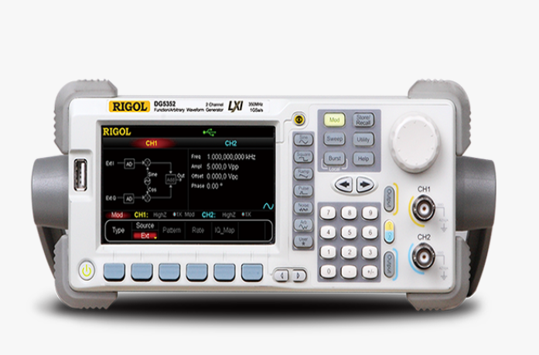
The RIGOL DG5000 Pro Series Function/Arbitrary Waveform Generator is designed for engineers, research laboratories, electronics manufacturers and production-test teams that need multiple synchronised signal sources in one compact instrument.
The series combines the functions of a:
- Function generator
- Arbitrary waveform generator
- Pulse generator
- Noise generator
- Harmonic generator
- Analog and digital modulator
- PRBS generator
- Sequence generator
- Pattern generator
- Multi-pulse generator
- Multitone generator
- IQ waveform generator
With 2-channel, 4-channel and 8-channel configurations, the DG5000 Pro can replace several individual waveform generators in multi-channel test systems. RIGOL states that the eight-channel design can reduce occupied bench or rack space by up to two-thirds compared with using four separate dual-channel instruments.
Available Models
The DG5000 Pro Series includes nine models:
| Maximum Frequency |
2 Channels |
4 Channels |
8 Channels |
| 250 MHz |
DG5252 Pro |
DG5254 Pro |
DG5258 Pro |
| 350 MHz |
DG5352 Pro |
DG5354 Pro |
DG5358 Pro |
| 500 MHz |
DG5502 Pro |
DG5504 Pro |
DG5508 Pro |
All models provide:
- 2.5 GSa/s maximum sample rate
- 16-bit vertical resolution
- 64 Mpts standard arbitrary waveform memory per channel
- Optional memory expansion to 128 Mpts per channel
- Ground-isolated outputs
- Channel-to-channel synchronisation accuracy of ±500 ps
- Adjustable channel skew from −200 ns to +200 ns
- 10.1-inch HD touchscreen
- USB, LAN and HDMI interfaces
- Web Control functionality
-
Multi-Channel Signal Generation
The DG5000 Pro is designed for applications that require several time-correlated signals.
Depending on the selected model, it provides:
- Two output channels
- Four output channels
- Eight output channels
Multi-channel generation is useful for:
- Multi-phase motor-control signals
- Battery management system simulation
- Automotive ECU testing
- Power converter control signals
- Phased-array development
- Multi-sensor simulation
- Industrial automation testing
- Parallel digital interface stimulation
- Multi-channel communication testing
Each channel can generate standard or arbitrary waveforms with individually configured frequency, amplitude, offset, phase and timing parameters.
Precise Channel Synchronisation
The series provides channel-to-channel synchronisation accuracy of ±500 ps and adjustable channel skew from −200 ns to +200 ns with ±200 ps setting precision.
These timing controls support:
- Phase-coherent waveform generation
- Propagation-delay simulation
- Multi-channel clock generation
- Phased-array testing
- Motor-drive signal simulation
- Synchronous converter testing
- Timing-margin analysis
- Multi-channel sensor stimulation
-
Grouped-Isolation Architecture
All output channels are isolated from chassis ground, with a maximum isolated DC voltage of ±42 Vpk.
Channel-to-channel isolation depends on the model:
- Two-channel models: CH1 and CH2 are not isolated from each other
- Four-channel models: CH1/CH2 form one group and CH3/CH4 form another isolated group
- Eight-channel models: CH1/CH2, CH3/CH4, CH5/CH6 and CH7/CH8 form four separate isolated groups
Channels within each pair share a reference, while different pairs are isolated from one another. This design helps reduce ground-loop interference in multi-circuit and power-electronics testing.
Arbitrary Waveform Generation
The DG5000 Pro provides:
- 2.5 GSa/s maximum sample rate
- 16-bit vertical resolution
- 64 Mpts standard waveform memory per channel
- 128 Mpts optional waveform memory per channel
- Arbitrary waveform output up to 100 MHz
- SiFi II signal-generation technology
- Built-in and stored waveform support
The deep memory allows users to reproduce long and detailed waveform records, including:
- Sensor output patterns
- Communication signals
- Automotive waveforms
- Power converter control signals
- Biomedical signals
- Recorded fault conditions
- Multi-event test sequences
- Irregular pulse patterns
RIGOL specifies typical arbitrary waveform rise and fall time of 3.5 ns or less and typical RMS jitter of 200 ps under the stated conditions.
Standard Waveform Generation
Continuous waveform types include:
- Sine
- Square
- Ramp
- Pulse
- Noise
- DC
- Arbitrary
- Harmonic
The available maximum frequency depends on the waveform and model.
For DG5500 Pro models:
- Sine: up to 500 MHz in continuous mode
- Square: up to 170 MHz
- Ramp: up to 5 MHz
- Pulse: up to 120 MHz
- Arbitrary: up to 100 MHz
- Harmonic: up to 250 MHz
The maximum 500 MHz rating applies to sine-wave output. Modulated and burst sine-wave frequency limits can be lower.
High-Speed Square and Pulse Generation
All DG5000 Pro models support square-wave generation up to 170 MHz with fast transition enabled.
Square-wave rise time can be set from approximately:
- 800 ps to 1 ns with fast transition enabled
- 1.4 ns or less with fast transition disabled
Pulse output supports:
- Frequencies up to 120 MHz
- Minimum pulse width of 4.2 ns
- Pulse-width resolution of 100 ps or five digits
- Adjustable rise and fall time from 1.4 ns to 1 second
- Duty cycle from 0.01% to 99.99%, subject to the pulse period
-
Multi-Pulse Generation
The optional multi-pulse function supports editable pulse groups containing 2 to 30 pulses.
It is particularly useful for:
- Double-pulse testing
- MOSFET switching analysis
- IGBT switching analysis
- SiC device testing
- GaN device testing
- Gate-driver validation
- Converter switching tests
- Dynamic power semiconductor characterisation
-
Sequence Generation
The optional sequence function supports up to 512 waveform steps.
A sequence can combine multiple waveform events into one automated signal profile, reducing the need to change settings manually during a test.
Sequence generation is suitable for:
- Automotive operating-condition simulation
- Power-state transitions
- Sensor test profiles
- Production validation
- Communication signal sequences
- Fault-condition reproduction
- Multi-stage control signals
The datasheet specifies a total sequence waveform length of up to 64 Mpts per channel as standard or 128 Mpts per channel with the memory option.
Multitone Generation
The optional multitone function can combine up to 16 individual tones.
The amplitude and phase of each tone can be configured independently.
This function supports:
- Intermodulation distortion testing
- Amplifier linearity analysis
- Filter evaluation
- Communication-system simulation
- Audio and RF response testing
- Nonlinear device characterisation
-
PRBS and Pattern Output
PRBS output is included as a standard advanced function. Optional pattern generation supports:
- PRBS2 to PRBS32
- User-defined digital patterns
- Data rates up to 300 Mbaud
- High-speed receiver stimulation
- Eye-diagram testing
- Bit-error-rate test preparation
- Digital interface validation
-
Harmonic Generation
The integrated harmonic generator supports up to the 20th harmonic.
Users can set the amplitude and phase of individual harmonic orders.
Applications include:
- Filter performance testing
- Amplifier distortion analysis
- Power-quality signal simulation
- Audio-system testing
- Harmonic detector validation
- Measurement instrument verification
-
Modulation Functions
The DG5000 Pro supports:
- AM
- FM
- PM
- SUM
- ASK
- FSK
- PSK
- PWM
Internal and external modulation sources are supported for applicable modes.
The instrument can therefore be used for:
- Communication education
- Receiver testing
- Carrier modulation
- Motor-control signal generation
- Switching-power testing
- Analog and digital modulation experiments
-
Sweep and Burst Functions
Sweep modes include:
Burst modes include:
These functions support filter response testing, amplifier bandwidth analysis, resonance identification, triggered waveform generation and transient circuit stimulation.
Output Amplitude
Output amplitude into 50 Ω depends on frequency:
| Frequency Range |
Maximum Output Amplitude |
| Up to 100 MHz |
10 Vpp |
| Above 100 MHz to 250 MHz |
5 Vpp |
| Above 250 MHz to 350 MHz |
2 Vpp |
| Above 350 MHz to 500 MHz |
1 Vpp |
The minimum output amplitude is 1 mVpp. The combined AC and DC offset range is up to ±5 Vpk into 50 Ω.
10.1-Inch HD Touchscreen
The DG5000 Pro includes a 10.1-inch capacitive touchscreen with 1280 × 800 resolution.
The large display allows users to:
- Configure several channels from one screen
- Compare channel parameters
- Edit waveform settings
- Configure modulation
- Create sequence profiles
- Manage files
- Monitor instrument status
- Operate the instrument using touch gestures
-
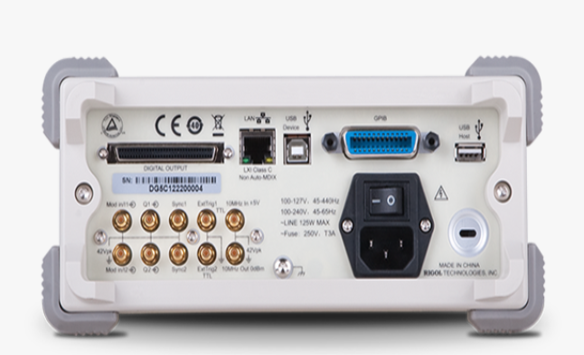
Connectivity and Remote Operation
Available interfaces include:
- USB Host
- USB Device
- LAN
- HDMI
- Web Control
These interfaces support:
- Browser-based remote operation
- PC control
- Automated test integration
- External display connection
- Waveform file transfer
- Screenshot and data storage
- Shared laboratory operation
-
Applications:
- Embedded-system development
- Digital circuit testing
- Power semiconductor testing
- Double-pulse testing
- MOSFET, IGBT, SiC and GaN analysis
- DC-DC converter testing
- Inverter testing
- Wireless power testing
- Battery management system simulation
- Automotive ECU testing
- Motor-drive development
- Industrial automation
- PLC testing
- Phased-array research
- Multi-sensor simulation
- Amplifier and filter testing
- Communication-system development
- Consumer electronics testing
- Biomedical signal simulation
- Scientific research
- Production-line validation
-
Why Buy from Revine Tech:
Revine Tech supplies function generators, oscilloscopes, probes and automated test equipment for industrial, laboratory and research applications.
Technical selection support can include:
- 250 MHz, 350 MHz or 500 MHz model selection
- Two, four or eight-channel configuration
- Channel-isolation requirements
- Timing and synchronisation requirements
- Arbitrary waveform memory selection
- Sequence generation
- Multi-pulse testing
- Multitone generation
- Pattern and PRBS generation
- IQ waveform requirements
- Remote-control integration
- Rack-mounting
- Calibration and documentation
The final RIGOL DG5000 Pro price depends on the selected bandwidth, number of channels, memory upgrade, software functions, accessories and calibration requirements.