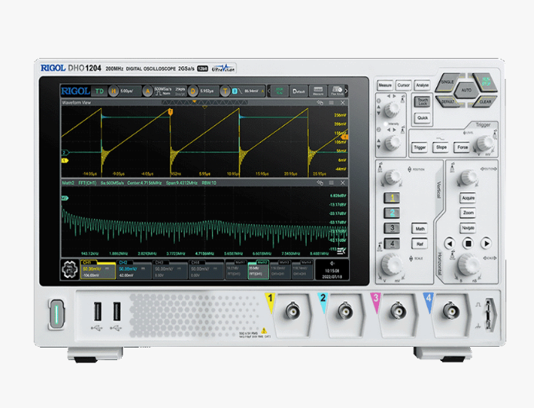
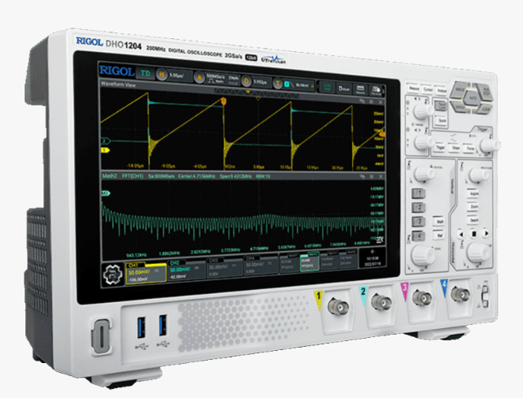
The RIGOL DHO1000 Series Digital Oscilloscope is developed for engineers, technicians, electronics manufacturers, educational institutions and research laboratories that require accurate waveform capture and dependable everyday measurement performance.
The series combines a 12-bit analogue-to-digital converter, low-noise front end, deep acquisition memory, fast waveform capture and a large touch interface. It is suitable for measuring analogue circuits, digital timing, sensor outputs, power rails, serial communication buses and intermittent signal faults.
Available Models
The DHO1000 Series includes six models:
- DHO1072: 70 MHz bandwidth and two analogue channels
- DHO1074: 70 MHz bandwidth and four analogue channels
- DHO1102: 100 MHz bandwidth and two analogue channels
- DHO1104: 100 MHz bandwidth and four analogue channels
- DHO1202: 200 MHz bandwidth and two analogue channels
- DHO1204: 200 MHz bandwidth and four analogue channels
Every model also includes one external trigger input. All models provide 12-bit vertical resolution, up to 2 GSa/s sampling and UltraAcquire waveform capture.
12-Bit High-Resolution Acquisition
The DHO1000 uses a 12-bit analogue-to-digital converter with 4,096 vertical quantisation levels.
A conventional 8-bit oscilloscope provides 256 levels. The 12-bit architecture therefore provides 16 times more vertical levels, helping engineers observe smaller voltage changes and separate closely spaced signal amplitudes.
This is useful for:
- Power-rail ripple measurement
- Sensor signal analysis
- Low-level analogue testing
- Reference-voltage validation
- Noise investigation
- Audio signal testing
- Power electronics
- Precision amplitude measurement
High Resolution mode can increase effective processing resolution to as much as 16 bits, although bandwidth and sample-rate performance may be reduced in higher-resolution modes.
Low-Noise Signal Measurement
The DHO1000 uses a low-noise analogue front end and provides vertical sensitivity from 500 μV/div to 10 V/div.
At 500 μV/div, RIGOL specifies typical noise-floor values of approximately:
- 62 μVrms for 70 MHz models
- 66 μVrms for 100 MHz models
- 75 μVrms for 200 MHz models
These values depend on acquisition settings, bandwidth, sample rate, memory depth and time base.
The low-noise input system supports measurements such as:
- Voltage regulator ripple
- Power-supply noise
- Sensor output variation
- Low-amplitude control signals
- Audio signals
- Analogue reference voltages
- Small embedded-system signals
-
Up to 2 GSa/s Real-Time Sampling
The DHO1000 provides a maximum real-time sample rate of up to 2 GSa/s.
For two-channel models:
- 2 GSa/s with one channel active
- 1 GSa/s with both channels active
For four-channel models:
- 2 GSa/s with one channel active
- 1 GSa/s in half-channel mode
- 500 MSa/s with three or four channels active
The sample rate depends on the number of enabled channels because acquisition resources are shared across channel groups.
High-speed sampling supports detailed observation of:
- Digital clock signals
- Pulse edges
- Switching waveforms
- Overshoot and ringing
- Communication data
- Timing relationships
- Intermittent glitches
- Short-duration events
-
UltraAcquire Waveform Capture
The DHO1000 supports:
- Up to 50,000 wfms/s in Vector mode
- Up to 1,500,000 wfms/s in UltraAcquire mode
UltraAcquire is a time-lapse acquisition mode designed to reduce dead time and improve the probability of capturing uncommon signal events.
It is useful for detecting:
- Rare glitches
- Runt pulses
- Signal dropouts
- Timing violations
- Abnormal transitions
- Intermittent noise
- Unstable clock behaviour
- Occasional communication faults
-
Deep Acquisition Memory
The DHO1000 provides 50 Mpts standard maximum memory, with an optional upgrade to 100 Mpts.
Memory allocation depends on the model and active-channel configuration.
For two-channel models:
- 50 Mpts standard with one channel active
- 25 Mpts standard with both channels active
- 100 Mpts optional with one channel active
- 50 Mpts optional with both channels active
For four-channel models:
- 50 Mpts standard with one channel active
- 25 Mpts standard in half-channel mode
- 12.5 Mpts standard with three or four channels active
- 100 Mpts optional with one channel active
- 50 Mpts optional in half-channel mode
- 25 Mpts optional with three or four channels active
The product page should therefore state up to 100 Mpts optional, rather than 100 Mpts available simultaneously on every channel.
Deep memory is useful for:
- Long serial bus captures
- Power-up sequence analysis
- Communication packet testing
- Intermittent fault investigation
- Embedded-system debugging
- Long-duration waveform recording
- Detailed waveform zooming
-
Hardware Waveform Recording
The DHO1000 supports hardware waveform recording and playback of up to 500,000 frames.
Waveform recording allows engineers to:
- Capture a sequence of signal events
- Replay acquired waveforms
- Review individual frames
- Compare normal and abnormal behaviour
- Locate intermittent faults
- Analyse changes after a long test
- Perform unattended monitoring
Peak Detect mode can capture glitches as narrow as approximately 2 ns under supported conditions.
Automatic Measurements
The oscilloscope supports 41 automatic waveform measurements, with up to 14 results displayed simultaneously.
Measurement categories include:
- Frequency
- Period
- Peak-to-peak voltage
- Maximum and minimum voltage
- RMS voltage
- Average voltage
- Rise and fall time
- Pulse width
- Duty cycle
- Overshoot
- Preshoot
- Phase
- Channel delay
Measurement statistics help users evaluate variation across repeated acquisitions.
Serial Bus Triggering and Decoding
The DHO1000 supports serial bus triggering and decoding for common embedded and automotive interfaces.
Supported protocols include:
- RS232/UART
- I2C
- SPI
- CAN
- LIN
- Parallel bus
The instrument can decode RS232/UART signals up to 20 Mb/s, CAN signals up to 5 Mb/s and LIN signals up to 20 Mb/s under supported conditions.
Protocol analysis helps identify:
- Incorrect addresses
- Invalid data
- Missing acknowledgements
- Timing errors
- Bus interruptions
- Frame errors
- Communication faults
Protocol availability and included licences should be confirmed for the supplied regional configuration.
Advanced Trigger Functions
The series provides trigger functions for isolating specific waveform conditions.
Trigger types include:
- Edge
- Pulse width
- Slope
- Video
- Pattern
- Duration
- Timeout
- Runt
- Window
- Delay
- Setup and hold
- Nth edge
- Serial bus trigger
These trigger modes help engineers capture the relevant fault instead of reviewing large numbers of normal acquisitions.
Waveform Mathematics and FFT
The DHO1000 supports mathematical and frequency-domain waveform analysis.
Available functions include:
- Addition
- Subtraction
- Multiplication
- Division
- Integration
- Differentiation
- FFT
- Logical operations
- Digital filtering
- Trend analysis
FFT analysis is useful for examining:
- Harmonics
- Oscillation
- Switching frequencies
- Noise components
- Signal distortion
- Power-supply interference
-
Mask and Pass/Fail Testing
Pass/fail testing compares acquired waveforms with a user-defined mask.
This function can be used for:
- Production validation
- Quality inspection
- Component comparison
- Reliability testing
- Long-duration monitoring
- Repetitive design verification
The oscilloscope records successful tests, failed tests and total test count.
Digital Voltmeter and Counter
The DHO1000 includes additional measurement functions:
- Digital voltmeter
- Precision frequency counter
- 48-bit totalizer
The digital voltmeter supports DC, AC RMS and AC+DC RMS measurements.
The frequency counter can measure frequency and period using an analogue input or the external trigger input.
10.1-Inch HD Touchscreen
The series includes a 10.1-inch capacitive multi-touch display with 1280 × 800 resolution.
The touchscreen supports:
- Waveform dragging
- Horizontal and vertical zoom
- Cursor positioning
- Menu navigation
- Measurement selection
- Split-screen viewing
- Result-table display
- Gesture-based control
Physical controls remain available for conventional oscilloscope operation.
Flex Knobs and Photoelectric Encoders
The front panel includes dual multifunction Flex Knobs that reduce the need to repeatedly switch one control between several functions.
Photoelectric encoder controls are designed for extended service life in laboratories, production environments and educational institutions.
These controls support:
- Fast parameter adjustment
- Menu navigation
- Waveform positioning
- Cursor control
- Measurement selection
- Efficient channel setup
-
Connectivity and Remote Operation
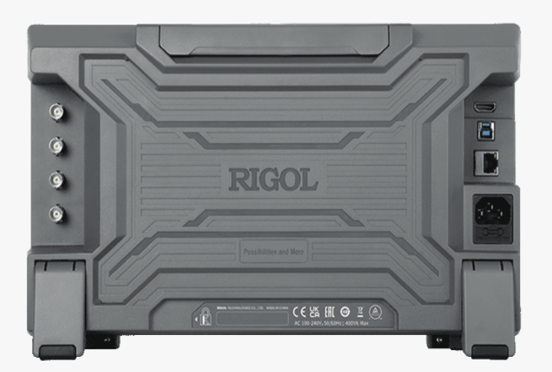
Standard connectivity includes:
- Two USB 3.0 Host ports
- One USB 3.0 Device port
- Gigabit LAN
- LXI-C support
- HDMI output
- AUX output
- 10 MHz reference input
- 10 MHz reference output
- Web Control
- SCPI remote programming
Web Control allows users to access the oscilloscope interface through a compatible browser over the network.
Applications:
- Electronic circuit design
- Embedded-system debugging
- Microcontroller testing
- Analogue signal analysis
- Digital timing measurements
- Serial bus analysis
- Power-supply testing
- Voltage regulator ripple measurement
- Sensor signal testing
- Automotive electronics
- Industrial control systems
- Audio electronics
- Production validation
- Quality-control testing
- Research and development
- Educational laboratories
- Service and repair laboratories
-
Why Buy from Revine Tech:
Revine Tech provides professional oscilloscopes, probes and electronic test equipment for engineering, laboratory, industrial and educational applications.
Technical selection support can include:
- 70 MHz, 100 MHz or 200 MHz bandwidth selection
- Two-channel or four-channel model selection
- Memory-depth upgrade
- Serial bus analysis
- Low-level signal measurement
- Passive probe selection
- High-voltage probe selection
- Differential probe requirements
- Current probe requirements
- External display configuration
- Remote-control integration
- Calibration and documentation
The final RIGOL DHO1000 price depends on the selected model, bandwidth, memory configuration, probes, accessories and calibration requirements.