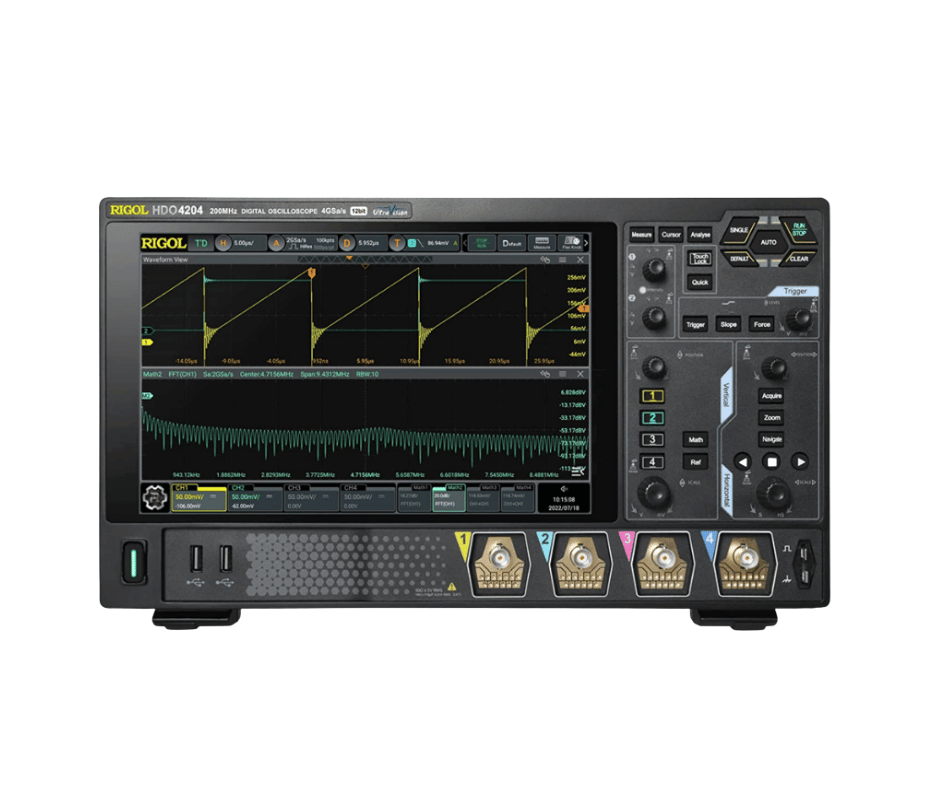
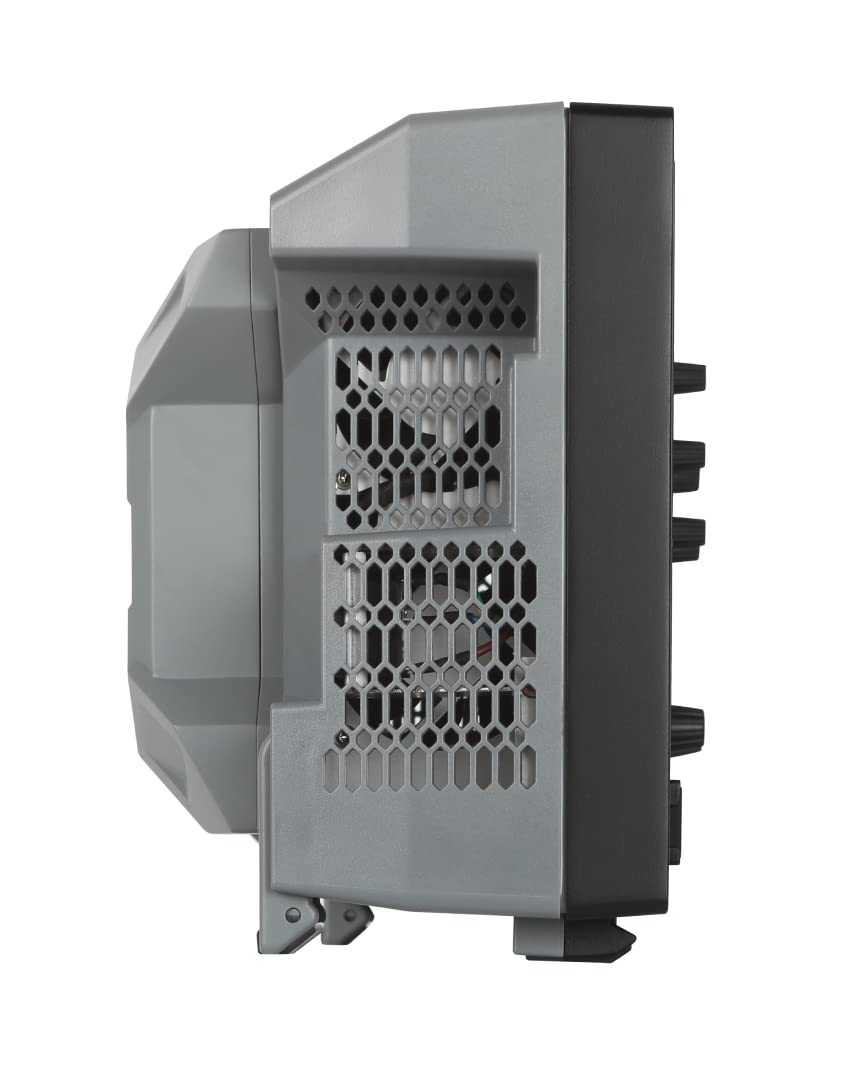
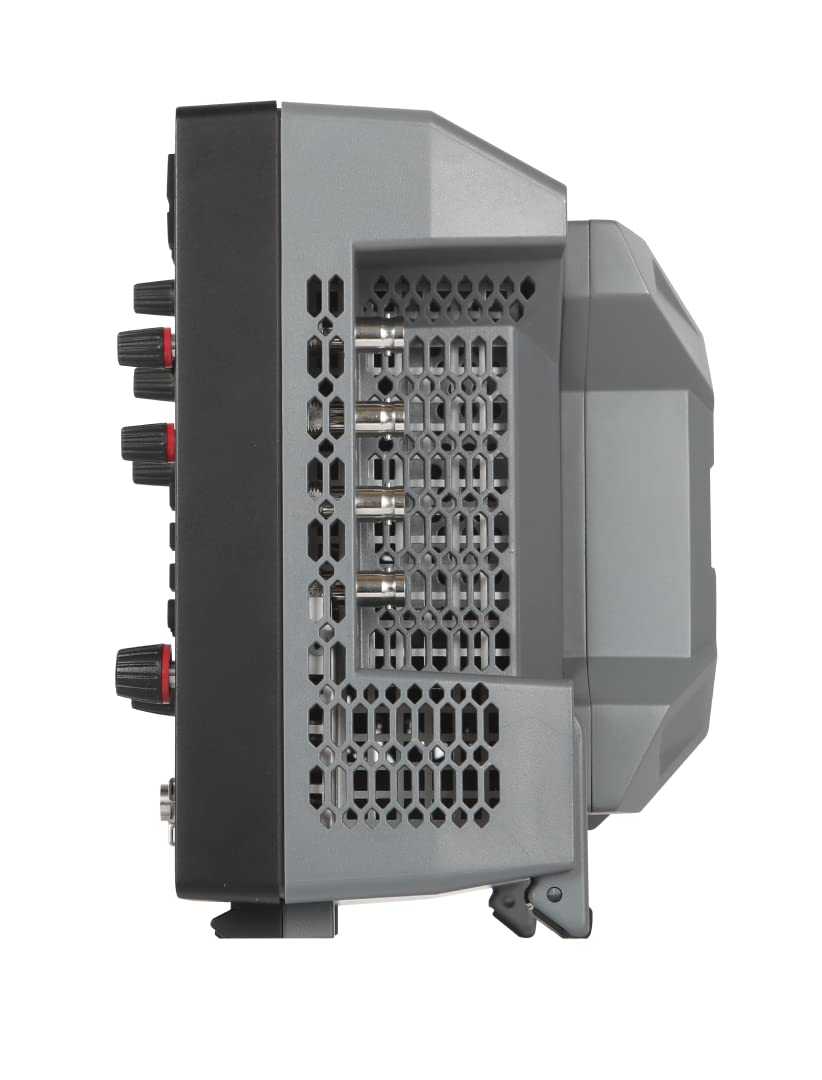
The RIGOL DHO4804 Digital Oscilloscope is the highest-bandwidth model in the DHO4000 Series. It provides four analogue channels, 800 MHz bandwidth and a maximum real-time sampling rate of 4 GSa/s for engineers who need to capture fast signals while retaining greater amplitude detail.
Built on RIGOL’s UltraVision III platform and second-generation Centaurus chipset, the DHO4804 uses a native 12-bit analogue-to-digital converter. A 12-bit acquisition system provides 4,096 vertical quantisation levels, compared with 256 levels from a conventional 8-bit oscilloscope. This helps reveal small waveform variations, ripple, noise, overshoot and distortion.
High-Bandwidth Four-Channel Measurements
The DHO4804 provides:
- 800 MHz analogue bandwidth
- Four analogue input channels
- One external trigger input
- Up to 4 GSa/s real-time sampling
- 12-bit native vertical resolution
- Typical rise time of approximately 437 ps
- Selectable 1 MΩ and 50 Ω input impedance
- Vertical sensitivity down to 100 µV/div
Its four-channel configuration supports simultaneous analysis of related signals such as:
- Clock and data lines
- Voltage and current waveforms
- High-side and low-side gate-drive signals
- Input and output power rails
- Sensor and controller outputs
- Differential communication signals
- Multi-rail start-up sequences
The 800 MHz bandwidth is included as standard on the DHO4804. No bandwidth upgrade is required to reach its rated bandwidth.
Native 12-Bit Vertical Resolution
The DHO4804 is designed for applications where signal detail is as important as bandwidth. Its 12-bit acquisition architecture improves the visibility of low-amplitude information within larger waveforms.
Typical applications include:
- Power-supply ripple analysis
- Power integrity measurements
- Low-noise analogue design
- Switching power-supply analysis
- Sensor interface testing
- Reference-voltage measurements
- Audio electronics
- Semiconductor characterisation
- Battery-management system testing
- Fast transient analysis
High-resolution acquisition modes can provide enhanced resolution under supported sample-rate and bandwidth conditions.
Low-Noise Signal Acquisition
The DHO4000 platform provides a typical minimum noise floor of approximately 18 µVrms under specified test conditions. Combined with vertical sensitivity down to 100 µV/div, this supports detailed analysis of small electrical signals.
This is useful when measuring:
- Low-level sensor outputs
- Power-rail ripple
- Amplifier noise
- Reference-voltage stability
- Converter output noise
- Small AC signals on DC levels
- Precision analogue circuits
Actual noise performance depends on vertical scale, bandwidth limit, input impedance, probe loading and acquisition settings.
Channel-Dependent Sampling Rate
The DHO4804 provides up to 4 GSa/s real-time sampling. Sampling performance varies according to the number of active analogue channels:
- One active channel: up to 4 GSa/s
- Two active channels: up to 2 GSa/s per channel
- Four active channels: up to 1 GSa/s per channel
Engineers should consider this allocation when performing high-frequency measurements across several channels.
For measurements near 800 MHz, overall performance also depends on the probe bandwidth, connection method, signal rise time and source impedance.
Deep Acquisition Memory
The DHO4804 provides up to 250 Mpts standard memory in single-channel operation. An optional licence expands the maximum memory depth to 500 Mpts.
Standard memory allocation:
- 250 Mpts with one active channel
- 125 Mpts per channel with two active channels
- 62.5 Mpts per channel with four active channels
Optional memory allocation:
- 500 Mpts with one active channel
- 250 Mpts per channel with two active channels
- 125 Mpts per channel with four active channels
Deep memory allows engineers to capture longer time periods while retaining a useful sample rate. This benefits:
- Serial bus debugging
- Converter start-up analysis
- Long control sequences
- Intermittent fault investigation
- Power sequencing
- Communication packet analysis
- Motor-drive testing
- Long-duration waveform monitoring
-
UltraAcquire Waveform Capture
The DHO4804 supports UltraAcquire mode with waveform capture rates up to 1,500,000 waveforms per second. Fast waveform acquisition improves the probability of finding rare or intermittent signal events.
It can help detect:
- Short glitches
- Runt pulses
- Timing violations
- Signal dropouts
- Unstable clock edges
- Switching abnormalities
- Intermittent communication errors
- Power disturbances
Intensity-graded waveform displays distinguish frequently occurring waveform behaviour from less frequent anomalies.
Waveform Recording and Playback
Hardware waveform recording allows engineers to monitor signal behaviour over extended test periods.
Users can:
- Record successive waveform events
- Replay captured frames
- Review events individually
- Compare normal and abnormal waveforms
- Perform post-acquisition measurements
- Identify the events preceding a fault
This is useful when signal problems occur only under specific load, timing or temperature conditions.
Advanced Trigger Functions
The DHO4804 provides a comprehensive trigger system for isolating specific waveform conditions.
Trigger modes include:
- Edge
- Pulse width
- Slope
- Video
- Pattern
- Duration
- Timeout
- Runt
- Window
- Delay
- Setup and hold
- Nth edge
- Serial bus triggering
These trigger functions help locate abnormal pulses, timing errors, voltage-level violations and specific communication events.
Serial Bus Triggering and Decoding
The DHO4804 includes standard serial analysis for common embedded communication buses.
Standard protocol support includes:
- RS232 and UART
- I2C
- SPI
- CAN
- Parallel bus decoding
Optional protocol packages are available for:
- CAN FD
- LIN
- FlexRay
- I2S
- MIL-STD-1553
Protocol decoding displays interpreted bus data beside the electrical waveform, allowing engineers to correlate logical errors with physical-layer problems.
Optional protocol functions should be listed separately in the quotation unless the required licences are already installed.
FFT and Frequency-Domain Analysis
The integrated FFT function converts acquired time-domain waveforms into frequency-domain information.
Typical uses include:
- Harmonic analysis
- Switching-frequency analysis
- Clock-spectrum evaluation
- Noise-source identification
- EMI troubleshooting
- Oscillation detection
- Power-converter analysis
Deep acquisition memory provides a larger waveform record for detailed frequency-domain evaluation.
Automatic Measurements and Statistics
The DHO4804 provides automated measurements for voltage, timing, frequency and pulse parameters.
Typical measurements include:
- Peak-to-peak voltage
- Maximum and minimum voltage
- Average voltage
- RMS voltage
- Frequency
- Period
- Rise and fall time
- Positive and negative pulse width
- Duty cycle
- Overshoot and preshoot
- Phase
- Delay
Measurement statistics help evaluate minimum, maximum, average and variation across repeated acquisitions.
Power Electronics Testing
The combination of 800 MHz bandwidth, 12-bit resolution, low-noise acquisition and four analogue channels makes the DHO4804 suitable for advanced power electronics testing.
Typical applications include:
- SiC and GaN power-device testing
- Switching power-supply analysis
- AC-DC and DC-DC converter testing
- Inverter measurements
- Motor-drive development
- Gate-drive signal analysis
- Switching-node measurements
- Power-rail ripple testing
- Start-up and shutdown analysis
- Battery-management system validation
Optional power-analysis software can automate selected power measurements. High-voltage differential, optical-isolated and current probes must be chosen according to voltage, current, bandwidth, common-mode voltage and safety requirements.
Signal-Integrity Testing
The DHO4804’s 800 MHz bandwidth supports examination of high-speed digital waveform behaviour.
Typical measurements include:
- Clock quality
- Rise and fall time
- Overshoot and undershoot
- Ringing
- Pulse-width variation
- Setup and hold timing
- Crosstalk
- Jitter trends
- PCB signal-integrity problems
The complete measurement system, including the probe, adapter, cable and connection method, must provide sufficient bandwidth for the application.
Connectivity and Remote Control
The DHO4804 can be integrated into laboratory networks, automated test systems and production environments.
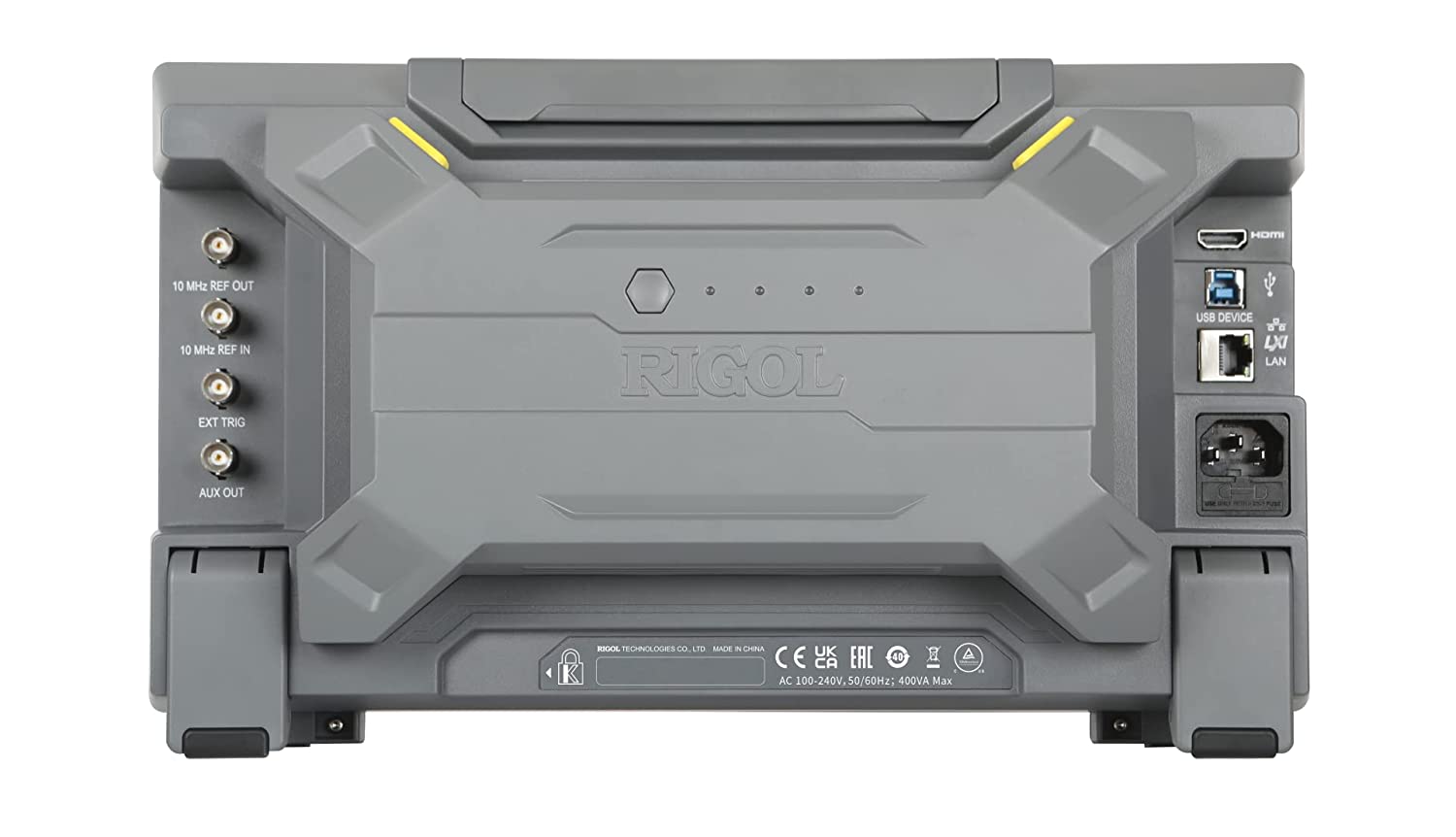
Available interfaces include:
- USB Host
- USB Device
- Gigabit LAN
- LXI support
- HDMI output
- AUX output
- Web Control
- SCPI remote programming
- Optional USB-to-GPIB connectivity
Web Control allows the instrument interface to be operated through a compatible browser. SCPI commands support automated measurement and validation workflows.
Optional Battery Operation
The DHO4000 Series supports battery-powered operation using compatible optional battery accessories.
Battery operation is useful for:
- Automotive field testing
- Industrial maintenance
- Mobile laboratory work
- Remote equipment inspection
- On-site troubleshooting
- Locations without convenient mains power
Battery packs and the battery holder should be quoted separately.
Applications
The RIGOL DHO4804 is suitable for:
- High-speed embedded-system development
- FPGA and microcontroller debugging
- Signal-integrity testing
- Power electronics testing
- SiC and GaN device analysis
- Automotive electronics validation
- CAN and CAN FD testing
- Industrial control-system testing
- Power-rail and ripple analysis
- Semiconductor testing
- Sensor and analogue circuit development
- EMI troubleshooting
- Production testing
- Research and development
- Engineering laboratories
- Automated test integration
-
Why Buy from RevineTech?
RevineTech supplies professional test and measurement equipment for electronics development, industrial testing, research and production applications.
Technical selection support can cover:
- DHO4804 configuration
- Memory-depth upgrade
- Passive probe selection
- Active high-bandwidth probes
- High-voltage differential probes
- Optical-isolated probes
- Current probes
- Serial protocol licences
- Power-analysis software
- Battery accessories
- Calibration requirements
- Automated test integration