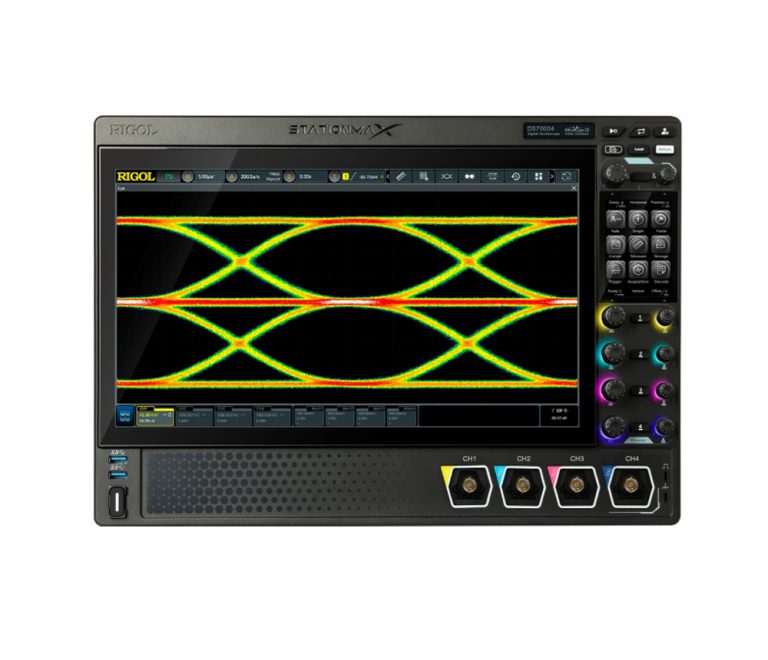
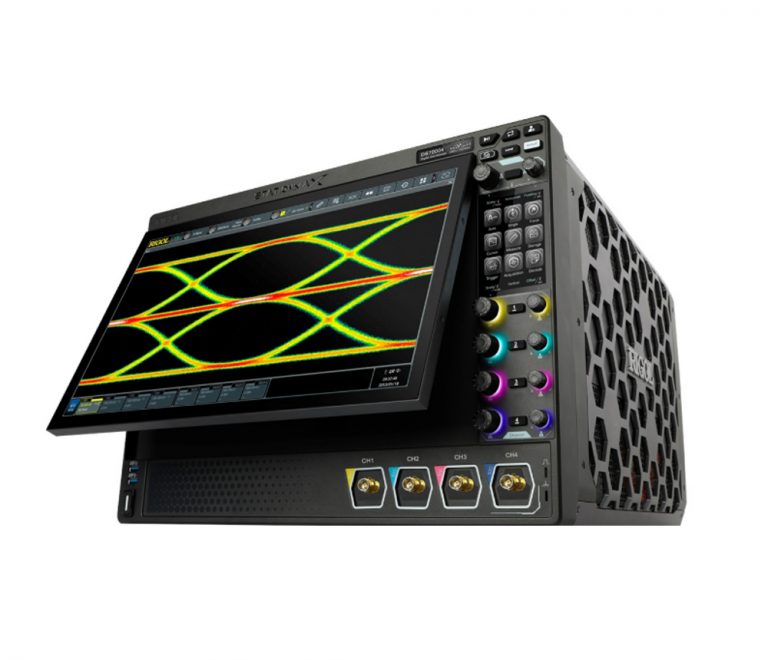
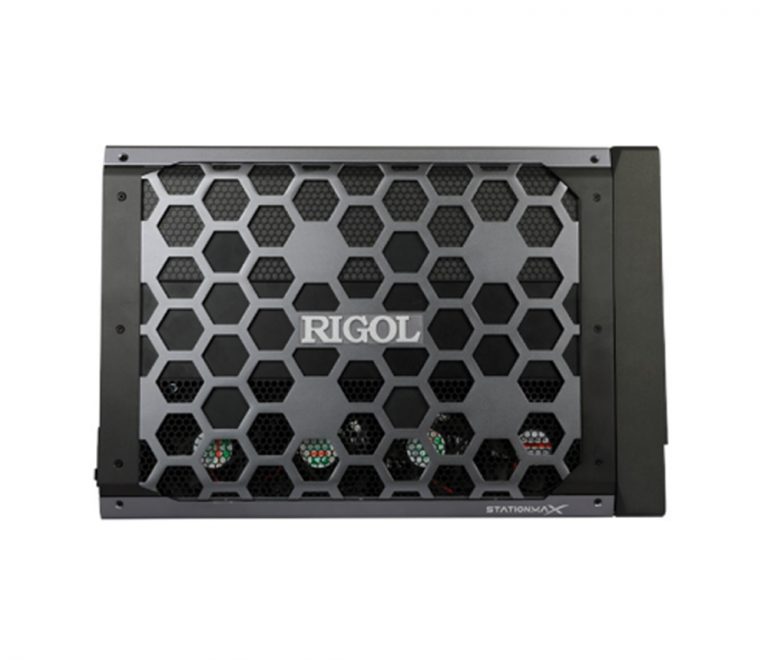
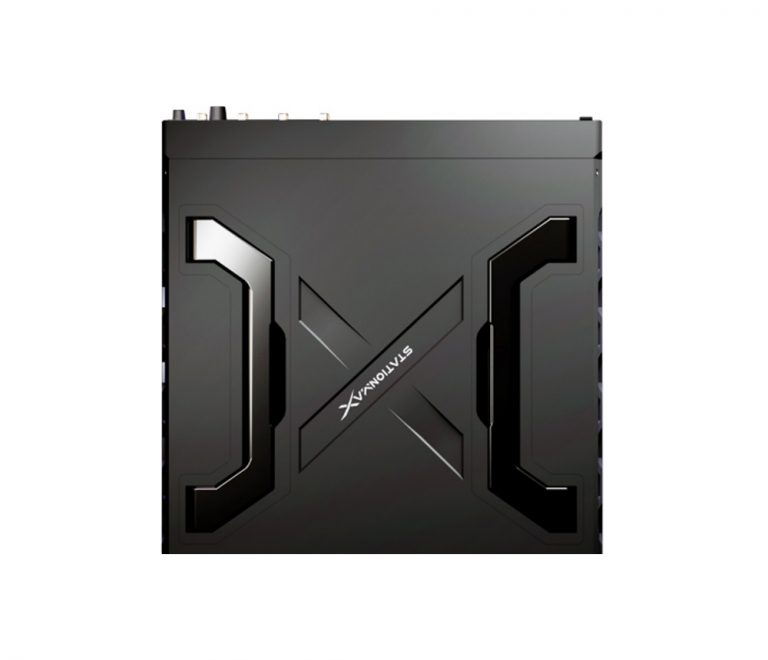
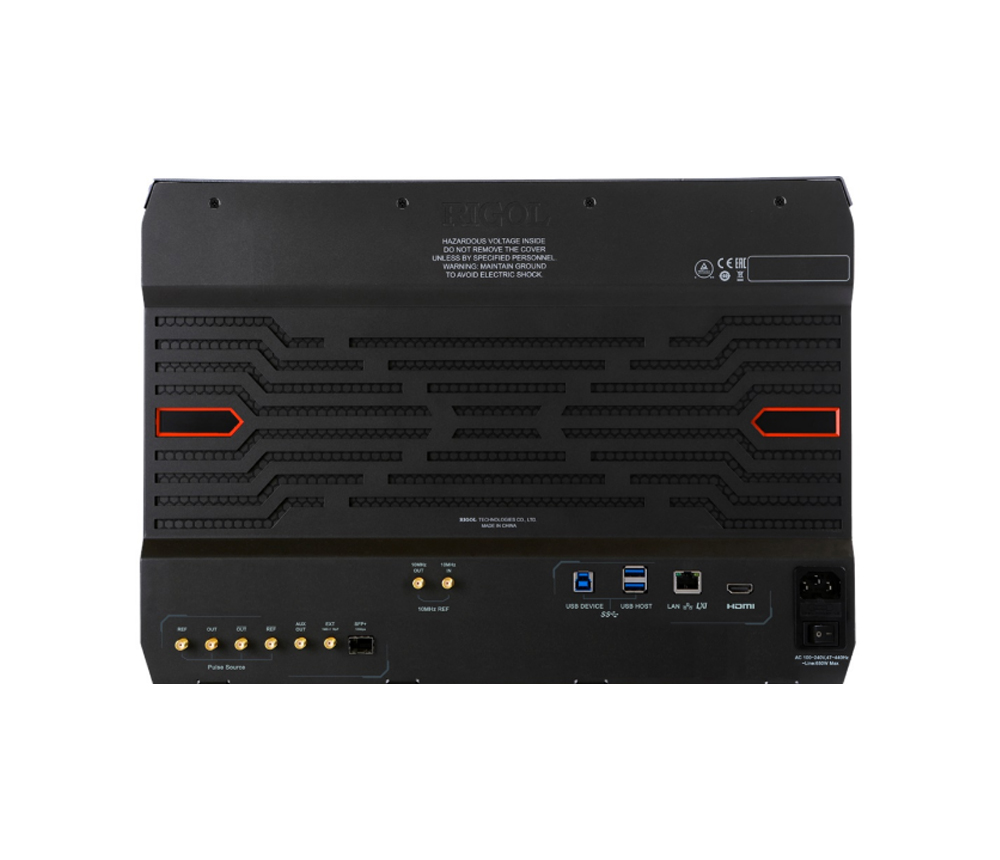
The RIGOL DS70504 Digital Oscilloscope is the highest-bandwidth model in the DS70000 Series. It is designed for engineers and laboratories working with high-speed digital interfaces, communication systems, semiconductor devices and complex timing-sensitive electronics.
The oscilloscope combines:
- 5 GHz maximum analogue bandwidth
- Four analogue input channels
- One external trigger input
- Up to 20 GSa/s real-time sampling
- 500 Mpts standard acquisition memory
- Optional memory expansion up to 2 Gpts
- Up to 1,000,000 wfms/s waveform capture
- Up to 2,000,000 waveform-recording frames
- Selectable 8-bit to 16-bit vertical resolution
- Up to 10,000 FFT calculations per second
- Optional UltraReal real-time spectrum analysis
- Optional protocol and compliance applications
- 15.6-inch Full HD motorised touchscreen
- Secondary 3.5-inch configurable touch display
RIGOL positions the DS70000 Series as a combined time-domain and frequency-domain platform using UltraVision III oscilloscope technology and UltraReal spectrum-analysis technology.
5 GHz Analogue Bandwidth
The DS70504 provides up to 5 GHz analogue bandwidth through its 50 Ω signal path.
At the 1 MΩ input setting, the maximum bandwidth is 500 MHz.
The 5 GHz bandwidth is suitable for:
- High-speed serial data analysis
- Signal-integrity testing
- DDR memory debugging
- FPGA and processor validation
- Fast clock measurements
- Semiconductor characterisation
- Communication-system development
- High-speed pulse analysis
- Compliance preparation
- Transmission-line troubleshooting
The calculated rise time at 5 GHz is approximately 70 ps, although the applicable official rise-time limit should be used for formal verification and procurement documentation.
Four Analogue Channels
The DS70504 includes:
- Four analogue measurement channels
- One dedicated external trigger input
Four channels allow engineers to acquire multiple related signals in the same time-correlated record.
Typical measurements include:
- Clock and data
- Differential signal pairs
- Read and write data lanes
- Multiple high-speed clocks
- Input and output timing
- Power and control signals
- Reference and trigger signals
- Parallel bus activity
-
Up to 20 GSa/s Real-Time Sampling
The maximum real-time sample rate depends on the active-channel arrangement.
| Acquisition Configuration |
Maximum Sample Rate |
| Single-channel operation |
20 GSa/s |
| Half-channel operation |
20 GSa/s |
| All four channels active |
10 GSa/s per channel |
The product should therefore be described as providing up to 20 GSa/s, rather than 20 GSa/s independently on every channel in all acquisition modes.
High sample density improves waveform reconstruction when examining:
- Fast signal edges
- Narrow pulses
- Jitter
- Overshoot and ringing
- Serial data transitions
- Clock stability
- Setup and hold timing
- Intermittent glitches
-
Deep Acquisition Memory
The DS70504 includes 500 Mpts standard memory and can be upgraded to a maximum of 2 Gpts.
The official RIGOL product page states that the optional memory enables a 100 ms acquisition at the maximum 20 GSa/s sample rate.
Typical maximum memory allocation is:
| Acquisition Configuration |
Maximum Optional Memory |
| Single-channel mode |
2 Gpts |
| Half-channel mode |
1 Gpts |
| All-channel mode |
1 Gpts |
Deep memory allows engineers to capture long signal intervals while retaining detailed sample information.
It is especially useful for:
- Long serial communication records
- DDR command and data captures
- Power-up and shutdown sequences
- Intermittent fault investigation
- Long packet analysis
- Multi-cycle jitter testing
- Detailed waveform zooming
- Extended timing measurements
The specification should be written as up to 2 Gpts, because the available depth depends on the active-channel configuration.
Up to 1,000,000 wfms/s Capture Rate
The DS70504 provides a waveform capture rate of up to 1,000,000 waveforms per second.
Fast waveform capture reduces acquisition dead time and increases the probability of detecting:
- Rare glitches
- Runt pulses
- Timing violations
- Signal dropouts
- Intermittent noise
- Unstable clock behaviour
- Abnormal transitions
- Infrequent serial-link faults
RIGOL lists one million waveforms per second as a core capability of the DS70000 Series.
Up to 2,000,000 Recording Frames
The segmented waveform-recording system can store up to 2,000,000 frames.
This allows engineers to:
- Capture triggered events over extended tests
- Replay acquisitions
- Review individual frames
- Compare normal and abnormal signals
- Search for intermittent conditions
- Analyse faults after an unattended test
- Reduce storage of inactive waveform intervals
RIGOL confirms that the deep memory can be segmented to record up to two million frames.
Selectable 8-Bit to 16-Bit Resolution
The DS70504 supports selectable acquisition resolution.
Available settings include:
- 8-bit standard acquisition
- 9-bit High Resolution
- 10-bit High Resolution
- 12-bit High Resolution
- 14-bit High Resolution
- 16-bit High Resolution
Higher-resolution acquisition reduces visible noise and improves the separation of small amplitude variations.
It is useful for:
- Power-rail ripple measurement
- Low-level analogue signals
- Precision amplitude analysis
- Sensor measurements
- Power-integrity testing
- Audio and analogue circuitry
- Small signals riding on larger waveforms
Maximum available bandwidth decreases as the selected vertical resolution increases. RIGOL describes the system as directly selectable up to 16-bit resolution.
Phoenix Chipset and UltraVision III Platform
The DS70504 is based on RIGOL’s Phoenix chipset and UltraVision III architecture.
The platform supports:
- High-speed waveform acquisition
- Deep memory processing
- Hardware-accelerated measurements
- Fast FFT analysis
- Advanced triggering
- Multi-window analysis
- Waveform recording
- Optional real-time spectrum analysis
UltraVision III is designed to maintain responsive operation even when analysing large waveform records.
Up to 10,000 FFTs per Second
The DS70504 can perform up to 10,000 FFT calculations per second using hardware acceleration.
This is useful for:
- Harmonic analysis
- Switching-frequency measurement
- Oscillation detection
- Clock-spur analysis
- Noise investigation
- Frequency-domain troubleshooting
- Filter evaluation
- Power electronics
RIGOL describes the resulting frequency-domain experience as similar to real-time spectrum analysis.
Optional UltraReal Real-Time Spectrum Analysis
The DS70504 can be upgraded with RIGOL’s UltraReal real-time spectrum-analysis capability.
The option allows the oscilloscope to perform frequency-domain analysis of time-varying signals.
Possible functions include:
- Real-time spectrum display
- Spectrogram
- Waterfall analysis
- Frequency-versus-time analysis
- RF interference investigation
- Transient spectrum analysis
- EMI troubleshooting
- Harmonic and spur detection
This combined time-domain and frequency-domain platform can reduce the need for a separate spectrum analyser during many debugging tasks.
The spectrum-analysis capability is optional and should not be described as standard.
Real-Time Eye Diagram Analysis
With the applicable jitter and eye-analysis licence, the DS70504 supports real-time eye diagrams across the analogue channels.
Available eye measurements include:
- Eye height
- Eye width
- Eye amplitude
- Crossing percentage
- Q factor
- Timing margin
- Amplitude margin
Eye diagrams help engineers evaluate:
- Serial-link quality
- Receiver margin
- Transmitter performance
- Inter-symbol interference
- Noise margin
- Timing closure
- Compliance readiness
-
Clock Recovery
The eye and jitter applications support multiple clock-recovery methods:
- Constant clock recovery
- Automatic
- Semi-automatic
- Manual
- First-order PLL
- Second-order PLL
- Explicit clock
Clock recovery is required when analysing serial data streams that do not provide a separate reference clock.
Jitter Analysis
The optional jitter package supports detailed timing analysis of serial clocks, data streams and parallel buses.
Measurements can include:
- Period jitter
- Cycle-to-cycle jitter
- Time interval error
- Jitter trend
- Jitter histogram
- Jitter spectrum
- Deterministic jitter
- Random jitter
- Total jitter
- Duty-cycle distortion
- Periodic jitter
Jitter analysis helps engineers identify whether timing variation is caused by random noise, periodic interference, data-dependent behaviour or other deterministic sources.
Protocol Triggering and Decoding
Optional protocol applications support common embedded, automotive, audio and aerospace interfaces.
Depending on the installed licences, supported buses can include:
- RS232/UART
- I²C
- SPI
- CAN
- CAN FD
- LIN
- FlexRay
- I²S
- MIL-STD-1553
- USB 2.0
Protocol decoding displays data packets alongside the underlying electrical waveform.
This helps identify:
- Incorrect addresses
- Invalid data
- Missing acknowledgements
- Frame errors
- Timing violations
- Electrical signal distortion
- Intermittent communication failures
-
Compliance Analysis
The DS70000 platform supports optional compliance solutions for selected high-speed interfaces.
Applications may include:
- USB 2.0
- Ethernet
- Automotive Ethernet
- MIPI D-PHY
- Other supported serial interfaces
Compliance applications can automate:
- Test configuration
- Signal acquisition
- Parameter calculation
- Mask testing
- Limit comparison
- Pass/fail evaluation
- Report generation
The required oscilloscope software, test fixture, probe and cable depend on the standard under test.
Advanced Trigger Functions
The DS70504 includes multiple trigger modes for isolating specific waveform conditions.
Trigger types include:
- Zone
- Edge
- Pulse
- Slope
- Video
- Pattern
- Duration
- Timeout
- Runt
- Window
- Delay
- Setup and hold
- Nth edge
- Serial bus trigger
Zone triggering allows engineers to draw a region directly on the screen and capture waveforms that enter or avoid that area.
Full-Memory Measurements
The DS70504 supports hardware measurements across the full acquisition record.
This means measurement results are not restricted to the waveform section currently displayed.
Full-memory measurement is useful for:
- Long clock records
- Multi-cycle high-frequency signals
- Extended serial data
- Deep-memory timing statistics
- Complete packet captures
- Long-duration jitter analysis
-
Waveform Mathematics and Filtering
Available mathematical and analysis functions include:
- Addition
- Subtraction
- Multiplication
- Division
- Integration
- Differentiation
- FFT
- Square root
- Absolute value
- Logarithmic functions
- Exponential functions
- Logical operations
- Low-pass filtering
- High-pass filtering
- Band-pass filtering
- Band-stop filtering
These tools support both time-domain and frequency-domain troubleshooting.
15.6-Inch Motorised Main Display
The main interface uses a 15.6-inch capacitive multi-touch display with 1920 × 1080 Full HD resolution.
The screen supports:
- Gesture navigation
- Waveform dragging
- Horizontal and vertical zoom
- Multi-window analysis
- Measurement tables
- Spectrum views
- Eye diagrams
- Jitter results
- Protocol decoding
The display angle can be adjusted electronically using a one-button motorised tilt function. RIGOL confirms the auto-tilt 15.6-inch primary touchscreen and secondary control display.
3.5-Inch Secondary Touch Display
A separate 3.5-inch, 480 × 320 touchscreen acts as a configurable intelligent control panel.
It can be used for:
- Shortcut menus
- Frequently used controls
- Function selection
- Extended information display
- Touch feedback
- Customised workflows
Separating common controls from the main screen preserves more space for waveform analysis.
Photoelectric Encoders
The front-panel knobs use photoelectric encoders designed for extended service life.
RIGOL specifies more than:
- 100,000 pressing operations
- 1,000,000 rotations
This makes the controls suitable for shared laboratories, training environments and high-use validation benches.
Electronic Product Label
The DS70504 includes an electronic label that displays the model and installed configuration.
The label:
- Retains information while powered off
- Can store the information for up to 20 years
- Updates after instrument upgrades
- Helps identify installed bandwidth and options
- Supports laboratory asset management
RIGOL confirms that the electronic label automatically refreshes its displayed performance parameters after upgrades.
Connectivity and Remote Control
Available interfaces include:
- USB 3.0 Host
- USB 3.0 Device
- LAN
- LXI
- HDMI
- AUX output
- 10 MHz reference input
- 10 MHz reference output
- Optional USB-to-GPIB adapter
- Web Control
- SCPI programming
- FTP file access
These interfaces support:
- Browser-based operation
- Automated test systems
- Remote waveform capture
- External monitor display
- Screenshot transfer
- Waveform export
- Instrument synchronisation
- Laboratory network integration
-
Applications
The RIGOL DS70504 is suitable for:
- High-speed digital design
- Signal-integrity analysis
- DDR memory debugging
- FPGA and processor validation
- Semiconductor testing
- Serial-link analysis
- Clock and jitter measurement
- Eye-diagram analysis
- Protocol compliance testing
- Ethernet testing
- Automotive Ethernet
- Communication-system development
- Power-integrity measurement
- Research and development
- Production validation
- Automated test systems
-
Why Buy from Revine Tech
Revine Tech supplies RIGOL high-bandwidth oscilloscopes, active probes, protocol software, compliance fixtures and calibration services for advanced engineering laboratories.
Technical selection support can include:
- DS70304 versus DS70504 model selection
- 3 GHz versus 5 GHz bandwidth assessment
- Memory-upgrade selection
- Active differential probe selection
- Jitter and eye-analysis options
- Real-time spectrum-analysis configuration
- Protocol-decoding licences
- Compliance-test fixtures
- DDR probing accessories
- High-voltage and current probes
- Automated test integration
- Calibration and documentation