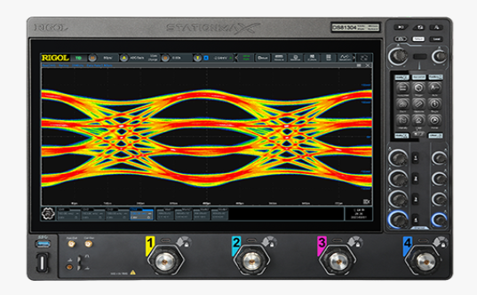
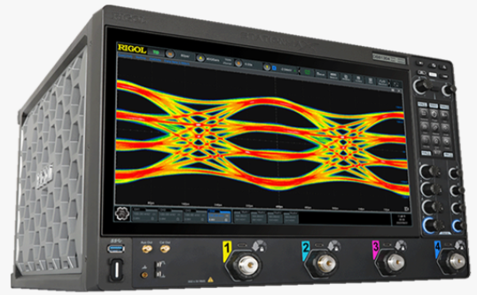
The RIGOL DS80000 Series Digital Oscilloscope is designed for engineers, semiconductor developers, communication-system manufacturers and research laboratories that need accurate acquisition and analysis of high-speed electronic signals.
Built on RIGOL’s StationMAX II hardware platform and UltraVision III acquisition and analysis platform, the series combines high analog bandwidth, independent high-speed sampling, deep acquisition memory and advanced signal-integrity tools in a four-channel instrument.
The DS80000 Series is suitable for:
- High-speed digital design
- DDR memory debugging
- PCI Express testing
- Ethernet compliance testing
- USB interface testing
- Signal-integrity analysis
- Clock and data validation
- Semiconductor device testing
- Communication-system development
- Eye diagram and jitter analysis
- High-speed bus compliance testing
- Research and development
-
Available Models
The RIGOL DS80000 Series includes four models:
- DS80604: 6 GHz analog bandwidth
- DS80804: 8 GHz analog bandwidth
- DS81004: 10 GHz analog bandwidth
- DS81304: 13 GHz analog bandwidth
All models provide:
- Four independent analog channels
- One external trigger input
- 40 GSa/s real-time sampling per channel
- 160 GSa/s total system sampling
- 500 Mpts standard memory depth
- Optional memory expansion to 2 Gpts or 4 Gpts
- Up to 250,000 wfms/s waveform capture
- Up to 2,000,000 waveform recording frames
- Adjustable 8-bit to 16-bit vertical resolution
- SmartProbe 2.0 interface
- 15.6-inch capacitive touchscreen
- Secondary 3.5-inch touch control display
Unlike oscilloscopes that share acquisition resources between channel pairs, each DS80000 analog channel can operate independently at the maximum 40 GSa/s sample rate. This allows engineers to capture four time-correlated high-speed signals without reducing the maximum sample rate when additional channels are enabled.
Up to 13 GHz Analog Bandwidth
The DS81304 provides the highest bandwidth in the series at 13 GHz.
Available bandwidth classes allow engineers to select an instrument according to the signal frequency, edge speed and interface under test.
Typical applications include:
- High-speed clock analysis
- Multi-gigabit serial communication
- Fast rise-time characterisation
- Processor and memory interface testing
- Transmission-line analysis
- High-frequency semiconductor validation
- Signal-integrity troubleshooting
The DS81304 provides a typical 10% to 90% rise time of approximately 33 ps. Lower-bandwidth models provide rise-time performance appropriate to their respective bandwidth classes.
40 GSa/s Sampling on Every Channel
Each analog channel supports a maximum real-time sampling rate of 40 GSa/s, even when all four channels are active.
This provides:
- High sample density across fast transitions
- Detailed waveform reconstruction
- Improved timing measurements
- Accurate pulse-width measurement
- Better observation of overshoot and ringing
- Detailed serial data analysis
- Time-correlated four-channel acquisition
The total sampling capability across the four independent analog channels is 160 GSa/s.
Deep Acquisition Memory
The DS80000 includes 500 Mpts standard memory depth, with optional upgrades to:
Deep acquisition memory allows engineers to maintain high sample rates across longer time intervals.
This is useful for:
- Long serial communication records
- DDR command and data analysis
- Intermittent fault investigation
- Long packet capture
- Startup sequence testing
- Multi-cycle timing analysis
- High-speed protocol debugging
- Detailed waveform zooming
- Long-duration jitter analysis
The 4 Gpts memory option helps preserve signal fidelity when capturing extended events at high sampling rates.
Up to 250,000 wfms/s Capture Rate
The DS80000 provides a maximum waveform capture rate of up to 250,000 waveforms per second.
A faster waveform capture rate reduces acquisition dead time and improves the probability of detecting:
- Rare glitches
- Timing violations
- Runt pulses
- Signal dropouts
- Unstable clock behaviour
- Intermittent noise
- Abnormal waveform transitions
- Protocol-related signal faults
-
Hardware Waveform Recording
The hardware waveform recording and playback system supports up to 2,000,000 frames.
Engineers can use waveform recording to:
- Capture intermittent events
- Replay long test sequences
- Review individual waveform frames
- Compare normal and abnormal signals
- Locate faults after an unattended test
- Analyse changes over time
- Search for specific waveform conditions
Segmented acquisition records events that satisfy the selected trigger conditions while reducing storage of inactive intervals.
Adjustable 8-Bit to 16-Bit Resolution
The DS80000 provides selectable vertical resolution from 8 bits to 16 bits.
High-resolution operating modes allow users to balance bandwidth, noise performance and vertical detail according to the application.
Typical high-resolution bandwidths include:
- 9-bit mode: approximately 4 GHz
- 10-bit mode: approximately 2 GHz
- 12-bit mode: approximately 800 MHz
- 14-bit mode: approximately 500 MHz
- 16-bit mode: approximately 200 MHz
Higher-resolution modes are useful for:
- Power-integrity measurements
- Low-level ripple analysis
- Small-signal measurements
- Noise analysis
- Precision amplitude measurements
- Detailed waveform characterisation
-
SmartProbe 2.0 Interface
The DS80000 uses RIGOL’s SmartProbe 2.0 interface.
It supports direct connection through a 3.5 mm high-frequency interface and provides automatic communication with compatible active probes.
SmartProbe 2.0 can support:
- Automatic probe identification
- Probe power delivery
- Attenuation-factor recognition
- Probe-status communication
- Automatic unit configuration
- High-bandwidth signal connection
- Improved probe integration
RIGOL probe adapters also allow compatible earlier-generation probes and conventional BNC-connected probes to be used.
Available adapters include:
- 50 Ω BNC input adapter
- High-impedance probe adapter
-
Eye Diagram Analysis
Optional real-time eye diagram analysis helps engineers evaluate the quality of high-speed serial signals.
Eye diagram measurements can include:
- Eye height
- Eye width
- Eye amplitude
- Crossing percentage
- Noise margin
- Timing margin
- Rise and fall time
- Inter-symbol interference
- Mask-test results
Eye diagram analysis is useful for:
- Receiver and transmitter validation
- Serial bus debugging
- Compliance preparation
- Clock and data quality analysis
- PCB signal-integrity testing
- Cable and connector evaluation
-
Advanced Jitter Analysis
The optional jitter-analysis package supports statistical and frequency-domain evaluation of timing variation.
Available analysis can include:
- Time interval error
- Period jitter
- Cycle-to-cycle jitter
- Jitter histogram
- Jitter trend
- Jitter spectrum
- Random jitter
- Deterministic jitter
- Total jitter
- Duty-cycle distortion
- Periodic jitter
Jitter decomposition helps engineers identify whether timing problems are associated with random noise, periodic interference, data-dependent effects or other deterministic sources.
Clock Recovery
Clock recovery tools extract an embedded timing reference from high-speed serial data.
This supports:
- Eye diagram generation
- Jitter analysis
- Serial data validation
- Receiver testing
- Timing-margin evaluation
- Compliance measurement workflows
The clock recovery configuration should be matched to the data rate and protocol under test.
Protocol Compliance Testing
The DS80000 supports optional compliance-analysis applications for high-speed communication standards.
Current RIGOL compliance workflows include:
- USB 2.0
- PCI Express
- 10BASE-T1L Industrial Ethernet
- 10BASE-T1S Automotive Ethernet
- 100M Ethernet
- 1000M Ethernet
- 100M Automotive Ethernet
- 1000M Automotive Ethernet
- 10GBASE-T Ethernet
- MIPI D-PHY
Compliance analysis can automate:
- Test configuration
- Signal acquisition
- Parameter calculation
- Mask testing
- Limit comparison
- Pass or fail evaluation
- Report generation
Required software, test fixtures, cables, probes and compliance accessories depend on the standard being tested.
DDR Debugging
The combination of high bandwidth, 40 GSa/s sampling and deep memory makes the DS80000 suitable for DDR system development and debugging.
Typical DDR applications include:
- Clock and data timing analysis
- Read and write burst capture
- Command and address analysis
- Setup and hold testing
- Eye diagram analysis
- Jitter measurement
- Overshoot and undershoot analysis
- Signal-integrity troubleshooting
- Long memory-event capture
Appropriate high-bandwidth differential probes and specialised probing accessories are required for accurate DDR measurements.
Serial Bus Triggering and Decoding
Optional serial bus triggering and decoding support includes:
- RS232/UART
- I2C
- SPI
- CAN
- CAN FD
- LIN
- FlexRay
- I2S
- MIL-STD-1553
- USB 2.0
Up to four protocol decode channels can be displayed.
Protocol decoding allows engineers to correlate communication data with the electrical waveform and identify:
- Invalid packets
- Timing errors
- Incorrect addresses
- Missing acknowledgements
- Bus faults
- Data corruption
- Intermittent communication failures
Advanced Trigger Functions
The DS80000 provides multiple trigger modes for isolating specific waveform conditions.
Trigger types include:
- Zone
- Edge
- Pulse
- Slope
- Video
- Pattern
- Duration
- Timeout
- Runt
- Window
- Delay
- Setup and hold
- Nth edge
- Serial bus trigger
Zone triggering allows users to define an area directly on the waveform display and capture signals that enter or avoid that region.
Full-Memory Hardware Measurement
The DS80000 supports hardware-based measurement across the complete acquisition record.
This means measurement results are not limited to the section currently visible on the display.
Full-memory measurement is useful for:
- Multi-cycle high-frequency signals
- Long communication records
- Extended clock measurements
- Complete packet analysis
- Timing statistics
- Deep-memory acquisitions
The oscilloscope supports automatic measurement of up to 41 waveform parameters.
Waveform Mathematics and FFT
Available waveform-analysis functions include:
- Addition
- Subtraction
- Multiplication
- Division
- Integration
- Differentiation
- Square root
- Absolute value
- Logarithmic functions
- Exponential functions
- Logical operations
- Low-pass filtering
- High-pass filtering
- Band-pass filtering
- Band-stop filtering
- FFT analysis
Built-in peak-search functions help identify important frequency components during FFT analysis.
Digital Voltmeter and Frequency Counter
The DS80000 integrates additional measurement functions, including:
- Digital voltmeter
- Eight-digit frequency counter
- Totalizer
These functions allow basic voltage, frequency and event-count measurements without a separate instrument.
Display and User Interface
The DS80000 includes two displays.
Main Display
- 15.6-inch capacitive multi-touch screen
- 1920 × 1080 Full HD resolution
- One-button electronic tilt
- Multi-pane window support
- Touch-based waveform navigation
Secondary Display
- 3.5-inch capacitive touchscreen
- 480 × 320 resolution
- Configurable shortcut menu
- Quick-response touch control
- Vibration feedback
The secondary screen provides rapid access to common controls while preserving the main display for waveform and measurement analysis.
Photoelectric Encoder Controls
The DS80000 uses photoelectric encoder controls designed for extended operating life.
RIGOL specifies:
- More than 100,000 pressing operations
- Approximately 1,000,000 rotational operations
This improves durability in shared laboratories and high-use validation environments.
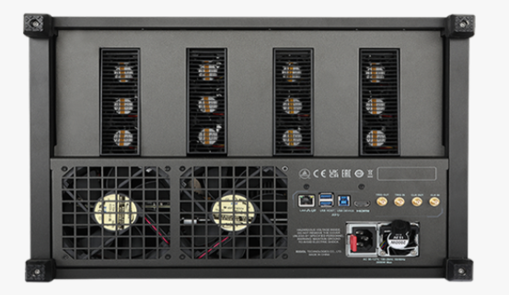
Connectivity and Remote Control
Available connectivity includes:
- USB Host
- USB Device
- LAN
- LXI
- HDMI
- AUX output
- Web Control
- Remote SCPI programming
These interfaces support:
- PC-based control
- Browser-based remote operation
- Automated test integration
- External monitor connection
- Data transfer
- Screenshot storage
- Waveform export
- Compliance software integration
-
Applications:
- High-speed digital design
- Signal-integrity testing
- DDR memory debugging
- PCI Express validation
- Ethernet compliance testing
- Automotive Ethernet testing
- USB interface testing
- MIPI D-PHY testing
- Clock and data analysis
- Eye diagram testing
- Jitter analysis
- Semiconductor characterisation
- Processor and memory interface validation
- Communication-system development
- High-speed component testing
- Cable and connector testing
- Research and development
- Compliance laboratories
- Production validation
-
Why Buy from Revine Tech:
Revine Tech supplies high-bandwidth oscilloscopes, active probes, compliance software and test fixtures for advanced electronic and communication applications.
Our technical team can assist with:
- Bandwidth selection
- Memory-depth configuration
- High-resolution acquisition requirements
- SmartProbe 2.0 probe selection
- Active differential probe selection
- Eye diagram and jitter-analysis software
- Clock recovery requirements
- DDR probing requirements
- PCI Express testing
- Ethernet compliance testing
- USB and MIPI compliance testing
- Automated test-system integration
- Calibration and documentation
The final RIGOL DS80000 price depends on the selected bandwidth, memory configuration, software licences, probes, fixtures, accessories and calibration requirements.