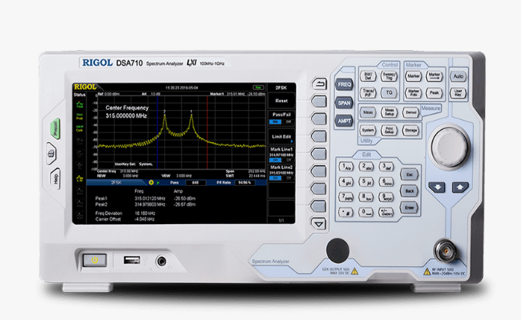
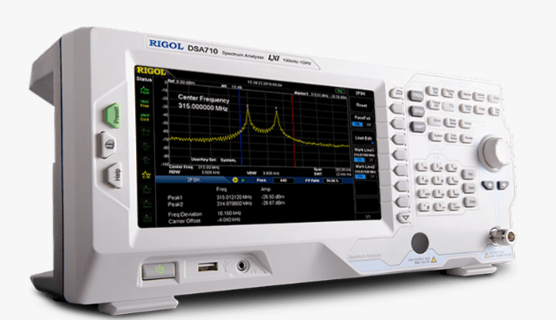
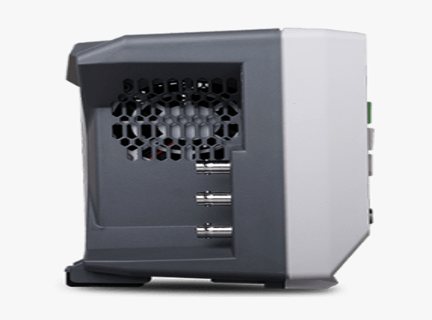
The RIGOL DSA700 Series Spectrum Analyzer provides an accessible platform for engineers, technicians, students, radio developers and service laboratories that need to inspect signals in the frequency domain.
The series uses an all-digital intermediate-frequency architecture to improve filter accuracy, amplitude stability and signal discrimination. It is suitable for analysing carrier frequency, signal power, harmonics, interference, modulation and occupied spectrum in RF systems operating below 1 GHz.
Two models are available:
- DSA705: 100 kHz to 500 MHz
- DSA710: 100 kHz to 1 GHz
The DSA710 is the appropriate configuration for applications requiring measurement coverage across the full 1 GHz range. The DSA705 provides the same core analysis platform with a lower maximum frequency.
All-Digital IF Technology
The DSA700 uses digital intermediate-frequency processing rather than a conventional analogue IF design.
This architecture supports:
- Stable resolution-bandwidth filtering
- Better discrimination between closely spaced signals
- Reduced measurement variation caused by filter switching
- More consistent amplitude readings
- Improved hardware reliability
- Efficient sweep performance
With a minimum resolution bandwidth of 100 Hz, the analyzer can separate signals with relatively small frequency spacing when their amplitudes and test conditions permit.
Weak-Signal Detection
The DSA700 includes a standard preamplifier with nominal gain of 20 dB.
With the preamplifier enabled, the instrument provides a typical displayed average noise level down to −130 dBm under the specified measurement conditions. This helps users detect low-level emissions, harmonics and interference that could otherwise be hidden by the analyzer’s noise floor.
Weak-signal applications include:
- Harmonic investigation
- RF leakage detection
- Low-power transmitter testing
- Near-field EMI troubleshooting
- Wireless-module evaluation
- Interference hunting
-
Frequency and Amplitude Measurements
The analyzer supports standard frequency-domain measurements using markers, traces and peak-search functions.
Users can perform:
- Carrier-frequency measurement
- Signal-level measurement
- Peak identification
- Harmonic observation
- Spur analysis
- Bandwidth evaluation
- Noise-floor inspection
- Frequency comparison
- Multi-trace analysis
The instrument provides a frequency-counter resolution selectable from 1 Hz to 100 kHz and a frequency-span range from zero span to the maximum frequency of the selected model.
Resolution and Video Bandwidth
The standard resolution bandwidth range is:
- 100 Hz to 1 MHz, using a 1-3-10 sequence
The video bandwidth range is:
- 1 Hz to 3 MHz, using a 1-3-10 sequence
Narrower RBW settings help separate adjacent signals and reduce the displayed noise floor, while wider settings allow faster sweeps and observation of broader signals.
Trace and Detector Functions
The DSA700 supports multiple trace and detector functions for different RF measurement conditions.
Available detectors include:
- Normal
- Positive peak
- Negative peak
- Sample
- RMS
- Voltage average
- Quasi-peak with the optional EMI package
Trace functions include:
- Clear and write
- Maximum hold
- Minimum hold
- Average
- View
- Blank
Up to three standard traces and one mathematical trace can be displayed.
AM and FM Demodulation
AM and FM demodulation are included as standard functions.
These functions can be used to:
- Monitor modulated RF signals
- Evaluate transmitter operation
- Listen to recovered audio
- Troubleshoot communication signals
- Examine modulation behaviour in zero-span mode
Demodulation support makes the series useful for radio education, basic transmitter testing and wireless troubleshooting.
Optional ASK and FSK Signal Capture
The optional SSC-DSA signal-capture function supports capture and analysis of ASK and FSK signals.
RIGOL lists 1.5 MHz real-time capture capability for signals such as FSK when this option is installed. The built-in 2FSK measurement function can help obtain parameters such as centre frequency, signal power and frequency offset.
This capability is useful for:
- Remote-control transmitters
- Tire-pressure monitoring systems
- Low-power wireless modules
- Keyless-entry systems
- Basic telemetry devices
- ASK/FSK educational experiments
The DSA700 remains a swept spectrum analyzer. The optional signal-capture mode does not convert it into a wide-bandwidth real-time spectrum analyzer.
Optional EMI Pre-Compliance Testing
The optional EMI kit adds:
- Quasi-peak detector
- CISPR-style 6 dB resolution bandwidths
- 200 Hz EMI filter
- 9 kHz EMI filter
- 120 kHz EMI filter
- Pass/fail testing
When combined with compatible near-field probes, a line impedance stabilisation network and suitable PC software, the analyzer can support preliminary conducted and radiated emission investigation before formal compliance testing.
Typical uses include:
- Locating PCB emission sources
- Comparing design revisions
- Troubleshooting power-supply noise
- Investigating cable radiation
- Checking emission trends
- Preparing for EMC laboratory testing
It is an EMI pre-compliance tool and does not replace a certified compliance receiver or accredited test laboratory.
Optional Advanced Measurement Kit
The optional advanced measurement package provides additional automated RF measurements, including:
- Channel power
- Adjacent-channel power
- Occupied bandwidth
- Emission bandwidth
- Carrier-to-noise ratio
- Time-domain power
- Harmonic distortion
- Third-order intermodulation
- Pass/fail evaluation
These functions simplify repetitive wireless and communication measurements by calculating common RF parameters directly on the instrument.
Display and Operation
The DSA700 uses an 8-inch TFT colour display with a resolution of 800 × 480 pixels.
The interface provides:
- Spectrum trace display
- Marker readouts
- Peak table
- Measurement menus
- Multi-trace comparison
- Demodulation controls
- Limit-line display
- Status and setup information
The front-panel numeric keypad, rotary control and dedicated measurement keys support direct operation without a computer.
Connectivity and Remote Control
Standard communication interfaces include:
- USB Host
- USB Device
- LAN
- LXI support
GPIB connectivity is available through an optional USB-to-GPIB converter.
These interfaces support:
- Trace and screenshot storage
- PC-based instrument control
- Data transfer
- Remote programming
- Automated measurements
- Integration with laboratory systems
RIGOL UltraSigma provides instrument communication, while optional UltraSpectrum software supports PC-based spectrum display, control and data analysis.
Applications:
- RF circuit testing
- IoT device development
- Radio transmitter analysis
- Wireless module validation
- Interference troubleshooting
- Harmonic and spur measurement
- Basic EMI pre-compliance testing
- Near-field PCB investigation
- ASK and FSK signal analysis
- Keyless-entry system testing
- TPMS signal testing
- Industrial RF maintenance
- Educational RF laboratories
- Amateur radio measurements
- Production verification
- Service and repair laboratories
-
Why Buy from Revine Tech:
Revine Tech supplies RF and electronic test equipment for engineering, industrial, educational and research applications.
Technical selection support can include:
- DSA705 or DSA710 model selection
- Frequency-range assessment
- EMI option selection
- ASK/FSK capture requirements
- Advanced measurement package selection
- Near-field probe selection
- RF cable and adapter selection
- Attenuator selection
- PC software requirements
- Remote-control integration
- Calibration and documentation requirements
The final RIGOL DSA700 price depends on the selected model, software licences, accessories and calibration requirements. Availability should be confirmed because regional stock and support status may vary.