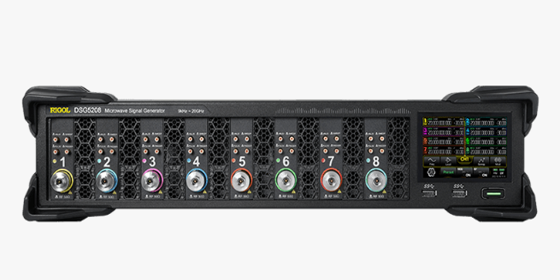
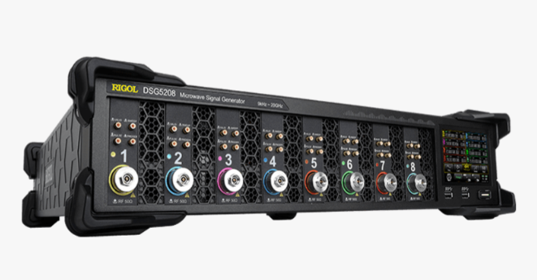
The RIGOL DSG5000 Series Microwave Signal Generator is designed for engineers, RF laboratories, research institutions and production teams that need several stable and phase-coherent microwave signals from one instrument.
The series combines up to eight independent RF channels inside a compact 2U full-rack-width chassis. This high channel density reduces the need to synchronise multiple standalone microwave signal generators and simplifies the cabling, timing and rack space required for complex multi-channel test systems.
The DSG5000 family supports two maximum-frequency ranges:
- DSG5120 models: 9 kHz to 12 GHz
- DSG5200 models: 9 kHz to 20 GHz
Both ranges are available with 2, 4, 6 or 8 output channels. Each channel can be independently configured for frequency, amplitude, phase and supported modulation functions.
Available Models
The RIGOL DSG5000 Series includes:
- DSG5122: 12 GHz, 2 channels
- DSG5124: 12 GHz, 4 channels
- DSG5126: 12 GHz, 6 channels
- DSG5128: 12 GHz, 8 channels
- DSG5202: 20 GHz, 2 channels
- DSG5204: 20 GHz, 4 channels
- DSG5206: 20 GHz, 6 channels
- DSG5208: 20 GHz, 8 channels
The DSG5208 is the highest-frequency and highest-channel-count configuration, providing eight independent RF outputs from 9 kHz to 20 GHz.
Multi-Channel Coherent Signal Generation
A key advantage of the DSG5000 Series is its ability to generate multiple phase-related microwave signals from a single platform.
Each RF channel can be independently controlled while maintaining stable phase relationships between channels. RIGOL specifies channel-to-channel phase stability below 1° at 10 GHz and phase adjustment resolution of 0.01°.
This capability supports:
- Coherent multi-channel receiver testing
- Phased-array system testing
- Beamforming experiments
- MIMO communication testing
- Radar channel simulation
- Quantum control experiments
- Multi-antenna system verification
- Phase-sensitive device characterisation
Using a common internal reference reduces the synchronisation complexity commonly encountered when several independent signal generators are used.
Frequency and Amplitude Control
The DSG5000 provides frequency resolution down to 0.01 Hz and amplitude-setting resolution of 0.01 dB.
The instrument supports an output-level setting range extending from very low signal levels up to +25 dBm, subject to frequency, channel configuration and installed options.
This broad output range allows the same instrument to support:
- Receiver sensitivity testing
- Amplifier gain testing
- Mixer characterisation
- Non-linear device testing
- High-power RF stimulation
- Low-level signal injection
- Communication receiver validation
The specified amplitude-performance range varies across the operating frequency range, so the required power level should be checked against the selected model and carrier frequency.
Low Phase Noise
The DSG5000 provides typical single-sideband phase noise below -133 dBc/Hz at a 1 GHz carrier with a 10 kHz offset.
Low phase noise improves signal purity and supports accurate measurements in applications such as:
- Radar testing
- Receiver sensitivity analysis
- Local oscillator substitution
- Frequency-converter testing
- Communication system development
- Phase-noise-sensitive component testing
- Quantum control and measurement
An optional oven-controlled crystal oscillator can provide improved reference stability and enhanced close-in phase-noise performance.
Modulation Capabilities
The DSG5000 supports the following modulation types:
- Amplitude modulation
- Frequency modulation
- Phase modulation
- Pulse modulation
Analog modulation and pulse functions may require optional licences.
The modulation source can be internal or external, depending on the selected function. An external modulation input is provided for applying a user-supplied modulation waveform.
These functions support:
- Radar pulse generation
- Receiver demodulation testing
- Communication signal simulation
- Amplifier response testing
- RF system validation
- Pulse-response measurement
- Modulated carrier generation
-
Pulse Modulation and Pulse Train Generation
Optional pulse-modulation capability allows the RF output to be gated according to programmed timing parameters.
An optional pulse train generator supports more complex pulse sequences. This can be used to reproduce:
- Radar pulse patterns
- Burst signals
- Communication timing sequences
- Repetitive pulse trains
- Triggered microwave events
- Custom pulse timing profiles
Pulse performance and available timing parameters depend on the installed pulse options.
Frequency, Phase and Amplitude Sweeps
The series supports sweep functions that can vary signal parameters over a programmed range.
Sweep testing can be used for:
- Filter response evaluation
- Amplifier gain testing
- Receiver frequency-response analysis
- Device bandwidth testing
- Frequency-converter characterisation
- Automated production validation
Sweep parameters can be controlled from the touchscreen interface or through remote SCPI commands.
Phase-Coherent Channel Control
Each channel supports precise phase adjustment. This enables users to create controlled phase differences between RF outputs.
Phase control is particularly useful for:
- Antenna-array testing
- Beam steering simulation
- Phase-comparison measurements
- Multi-channel calibration
- Coherent receiver testing
- IQ and quadrature-related research
- Quantum bit control systems
-
Signal Purity and Isolation
The DSG5000 is designed to provide clean microwave signals with low phase noise, controlled harmonics and good channel-to-channel isolation.
Typical channel-to-channel isolation exceeds 80 dB, while typical harmonic performance is below -50 dBc at 10 GHz under specified conditions.
Good channel isolation helps prevent one RF channel from affecting another during simultaneous multi-channel operation.
Touchscreen Operation
The DSG5000 uses an Android-based operating system and a touchscreen-focused interface. Apart from the power button, instrument functions are controlled through the touch display.
The interface allows users to:
- Select individual channels
- Set frequency and amplitude
- Adjust phase
- Configure modulation
- Set sweep parameters
- Control RF output state
- Save and recall configurations
- Monitor all active channels
The interface is especially useful when configuring six-channel or eight-channel systems where several outputs must be monitored simultaneously.
Remote Control and Test-System Integration
The instrument supports:
- USB Host
- USB Device
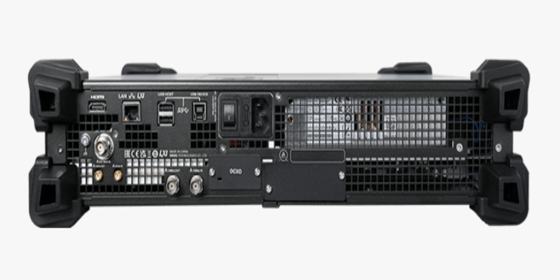
- LAN
- HDMI
- Web Control
- SCPI programming
- External keyboard and mouse
- External display connection
Web Control allows users to operate the instrument through a compatible browser over a network.
SCPI command support enables integration into:
- Automated RF test systems
- Production validation platforms
- Research automation
- Remote laboratories
- Multi-instrument test benches
- System-level calibration setups
The HDMI output can be connected to an external display, projector or monitor for a larger user interface.
Reference Clock Interfaces
The DSG5000 provides reference-clock connections for synchronising the generator with other equipment.
Reference interfaces include:
- 10 MHz reference input
- 10 MHz reference output
- 4.8 GHz reference input
- 4.8 GHz reference output
These reference connections support synchronisation between multiple instruments and help maintain coherent timing in expanded RF test systems.
Applications:
The RIGOL DSG5000 Series is suitable for:
- MIMO communication-system testing
- Radar signal generation
- Phased-array radar development
- Beamforming system testing
- Superconducting quantum-computing research
- Qubit control-signal generation
- Electromagnetic susceptibility testing
- RF receiver sensitivity testing
- Amplifier characterisation
- Mixer and frequency-converter testing
- Local oscillator substitution
- Antenna-array testing
- Satellite communication testing
- Microwave component validation
- Multi-channel coherent signal testing
- Research and development
- Production-line RF testing
- Educational microwave laboratories
- Automated test-system integration
-
Why Buy from Revine Tech:
Revine Tech provides RF and microwave test equipment for research, communication, aerospace, defence, semiconductor and industrial applications.
Our technical team can help customers determine:
- Required maximum frequency
- Number of RF output channels
- Output power requirements
- Phase-coherence requirements
- Modulation options
- Pulse-generation requirements
- Reference-clock requirements
- OCXO requirements
- Rack integration
- Remote-control interfaces
- RF cables and accessories
- Calibration requirements
The final RIGOL DSG5000 price depends on the selected frequency range, number of channels, modulation licences, pulse options, high-stability reference option and accessories.