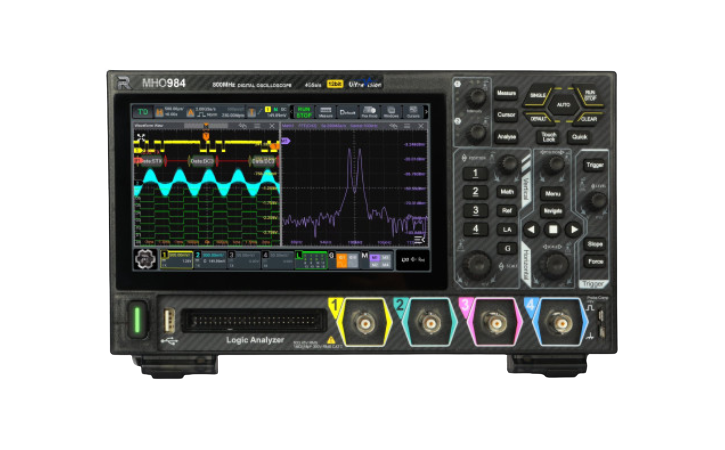
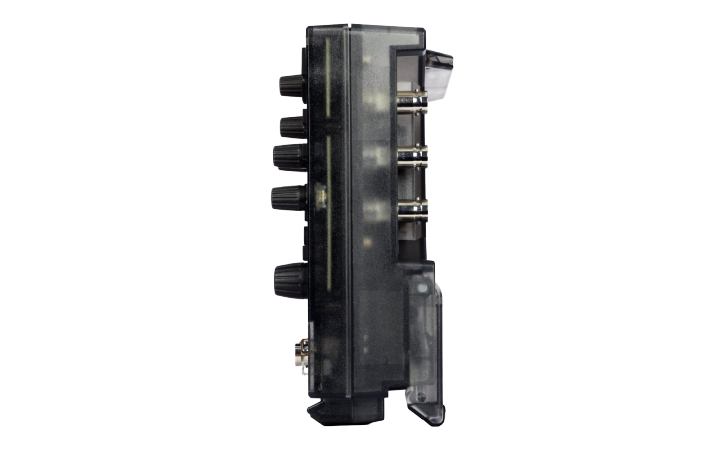
The RIGOL MHO984 Oscilloscope is the highest-bandwidth model in the MHO900 Series. It is developed for engineers who need a compact instrument capable of analysing fast analogue signals, digital logic activity and serial communication buses.
Its 12-bit analogue-to-digital converter provides 4,096 vertical quantisation levels. This gives the MHO984 16 times more vertical levels than a conventional 8-bit oscilloscope, helping engineers identify small waveform variations, noise, ripple, overshoot and timing abnormalities more clearly.
The MHO984 combines:
- Four analogue input channels
- Up to 800 MHz analogue bandwidth
- Up to 4 GSa/s real-time sampling
- 100 Mpts standard memory
- Optional memory up to 500 Mpts
- Up to 1,000,000 wfms/s waveform capture
- 16 digital channels with the PLA2216 probe
- Standard embedded and automotive bus decoding
- Optional dual-channel 50 MHz or 100 MHz AFG
- Bode plot analysis with the AFG option
- 7-inch capacitive touchscreen
The compact MHO900 platform is suitable for benchtop laboratories, classrooms, field engineering, production debugging and space-limited test stations.
800 MHz Analogue Bandwidth
The MHO984 provides up to 800 MHz analogue bandwidth when operating through its 50 Ω input path in single-channel or half-channel mode.
Actual bandwidth depends on the input impedance and number of enabled channels:
- 50 Ω, one or two channels: 800 MHz
- 50 Ω, three or four channels: 400 MHz
- 1 MΩ, one or two channels: 500 MHz
- 1 MΩ, three or four channels: 400 MHz
This distinction is important when testing signals close to the oscilloscope’s maximum rated bandwidth.
The 800 MHz bandwidth mode is suitable for:
- Fast embedded-system clocks
- FPGA and processor interfaces
- High-speed pulse measurements
- Communication circuit debugging
- Fast switching analysis
- Signal-integrity investigations
- High-speed analogue circuits
- Semiconductor testing
At 50 Ω, the MHO984 has a calculated typical rise time of approximately 437 ps.
Four Analogue Channels
The four analogue channels allow engineers to observe several related signals in one time-correlated acquisition.
Typical measurements include:
- Clock, data, enable and reset signals
- Input and output waveforms
- Multiple power rails
- Gate, drain, source and current signals
- Sensor and actuator responses
- Transmit and receive lines
- Multi-phase power-converter signals
- Analogue and digital interface timing
The oscilloscope supports both 1 MΩ and 50 Ω input impedance, enabling it to work with conventional passive probes and direct 50 Ω signal connections.
12-Bit Vertical Resolution
The MHO984 uses a 12-bit ADC with 4,096 quantisation levels.
Compared with an 8-bit oscilloscope, this provides finer amplitude resolution for observing:
- Low-level ripple
- Small signal variations
- Analogue noise
- Overshoot and undershoot
- Power-rail disturbances
- Sensor outputs
- Audio signals
- Reference voltages
- Switching-device behaviour
The MHO984 also supports High Resolution processing up to 16 bits. Available bandwidth and sample rate may be reduced when higher-resolution processing is selected.
RIGOL specifies a typical effective number of bits of approximately 8 for the MHO984 under its stated test conditions.
Channel-Dependent Sampling Rate
The maximum real-time sample rate depends on the number of enabled analogue channels:
- One analogue channel: 4 GSa/s
- Two analogue channels: 2 GSa/s
- Three or four analogue channels: 1 GSa/s
The product should therefore be described as providing up to 4 GSa/s, rather than 4 GSa/s simultaneously on all four channels.
High sampling rates help preserve detail when analysing:
- Fast waveform edges
- Narrow pulses
- Timing relationships
- Serial communication
- Switching transitions
- Overshoot and ringing
- Clock instability
- Intermittent glitches
-
Deep Acquisition Memory
The MHO984 provides 100 Mpts standard maximum acquisition memory.
Standard memory allocation is:
- Single-channel mode: 100 Mpts
- Half-channel mode: 50 Mpts
- All-channel mode: 25 Mpts
With the optional MHO900-RLU-05 memory upgrade:
- Single-channel mode: 500 Mpts
- Half-channel mode: 250 Mpts
- All-channel mode: 125 Mpts
In RIGOL terminology:
- Single-channel mode means one analogue channel is enabled.
- Half-channel mode means any two analogue channels are enabled.
- All-channel mode means three or four analogue channels are enabled.
Deep memory is useful for:
- Long serial-bus acquisitions
- Power-up sequence testing
- Intermittent fault investigation
- Extended signal monitoring
- Long communication packets
- Detailed waveform zooming
- Multi-cycle timing analysis
- Embedded software debugging
The product page should state 100 Mpts standard and up to 500 Mpts optional, while also explaining the channel-dependent allocation.
Fast Waveform Capture
The MHO984 provides:
- Up to 30,000 wfms/s in Vector mode
- Up to 1,000,000 wfms/s in fast recording mode
The maximum 1,000,000 wfms/s rate applies under specified conditions, including single-channel operation, fast recording mode, 20 ns/div time base and 1 kpts or automatic memory depth.
Fast waveform capture improves the probability of identifying:
- Rare glitches
- Signal dropouts
- Runt pulses
- Timing violations
- Unstable clock behaviour
- Intermittent noise
- Abnormal transitions
- Infrequent protocol faults
The digital phosphor display uses 256-level intensity grading to distinguish frequently occurring waveforms from less frequent events.
Hardware Waveform Recording
The MHO984 supports hardware waveform recording and playback of up to 500,000 frames.
Recorded waveforms can be:
- Played frame by frame
- Played continuously
- Measured after recording
- Decoded after recording
- Compared for abnormal behaviour
- Used for intermittent fault investigation
Waveform recording is particularly useful when a failure appears only after extended operation.
Peak Detect acquisition can capture glitches as narrow as approximately 500 ps under supported conditions.
Mixed-Signal Operation
The MHO984 supports 16 digital channels using the optional PLA2216 logic analyser probe.
The digital channels become selectable after the logic probe is connected. The PLA2216 provides up to 200 MHz digital-channel bandwidth.
Mixed-signal operation allows users to display analogue and digital activity on a common time base.
This supports:
- Microcontroller debugging
- FPGA validation
- Parallel bus analysis
- ADC and DAC testing
- Embedded control systems
- State-machine debugging
- Digital power testing
- Analogue-to-digital timing correlation
The platform supports digital channels, but the PLA2216 probe must be purchased separately.
Standard Serial Bus Decoding
The MHO984 includes standard decoding for:
- Parallel bus
- RS232/UART
- I²C
- SPI
- LIN
- CAN
Up to four protocol decoders can be enabled simultaneously.
Standard protocol capabilities include:
- RS232/UART decoding up to 20 Mb/s
- CAN decoding up to 5 Mb/s
- LIN protocol version 1.X and 2.X analysis
- SPI data decoding from 4 to 32 bits
- I²C address, data and acknowledgement decoding
- Up to four-bit parallel bus decoding
Sources can be selected from analogue channels or digital channels when the PLA2216 probe is connected.
Optional Protocol Analysis
Additional protocol licences are available for:
- CAN FD
- FlexRay
- I²S
- MIL-STD-1553B
Optional capabilities include:
- CAN FD decoding up to 10 Mb/s
- FlexRay frame decoding up to 10 Mb/s
- I²S left- and right-channel audio data analysis
- MIL-STD-1553B command, status and data-word decoding
The applicable options are:
- MHO900-AUTOA: CAN FD analysis
- MHO900-FlexA: FlexRay analysis
- MHO900-AUDIOA: Audio serial bus analysis
- MHO900-AEROA: MIL-STD-1553B analysis
The MHO900-BND bundle combines AFG100, audio, automotive, FlexRay and aerospace options.
Advanced Triggering
The MHO984 provides multiple trigger types for isolating specific waveform conditions.
Trigger capabilities include:
- Edge
- Pulse width
- Slope
- Video
- Pattern
- Duration
- Timeout
- Runt
- Window
- Delay
- Setup and hold
- Nth edge
- Serial bus triggering
Protocol-trigger options help engineers isolate particular addresses, data values, errors or frame types.
Waveform Search and Navigation
Search and navigation tools help locate events inside long acquisitions.
Users can search for conditions such as:
- Specific edge transitions
- Pulse-width violations
- Runt pulses
- Logic patterns
- Serial bus events
- Timing abnormalities
Matching events can be marked within the record, allowing faster movement between abnormal waveform sections.
Automatic Measurements and Analysis
The MHO984 provides measurement and analysis functions for general electronics debugging.
Available tools include:
- Voltage measurements
- Time measurements
- Frequency and period
- Rise and fall time
- Pulse width
- Duty cycle
- Phase and channel delay
- Measurement statistics
- Cursor measurement
- FFT analysis
- Waveform mathematics
- Digital filtering
- Histogram analysis
- Mask testing
- Pass/fail testing
- Digital voltmeter
- Frequency counter
- Waveform recording
Histogram functions can display horizontal, vertical and measurement distributions, helping engineers evaluate waveform variation and statistical behaviour.
Optional Dual-Channel AFG
The MHO984 supports two optional integrated function and arbitrary waveform generator configurations:
- MHO900-AFG50: Two channels, up to 50 MHz
- MHO900-AFG100: Two channels, up to 100 MHz
Both generator options provide:
- Two output channels
- 1 GSa/s sampling
- 16-bit vertical resolution
- Sine
- Square
- Ramp
- Noise
- DC
- Arbitrary waveform output
- User-defined waveforms
- 16 kpts arbitrary waveform length
Built-in waveform types include Sinc, exponential rise, exponential fall, ECG, Gaussian, Lorentz and Haversine signals.
The 100 MHz specification applies to sine-wave output. Maximum frequency varies by waveform type.
Bode Plot Analysis
The optional AFG enables Bode plot measurements.
The Bode plot function supports:
- Sweep start frequency from 10 Hz
- Sweep stop frequency up to 30 MHz
- 10 to 100 points per decade
- Gain analysis
- Phase analysis
- Frequency-response testing
Applications include:
- Filter testing
- Amplifier response analysis
- Power-supply control-loop testing
- Crossover-frequency measurement
- Gain-margin analysis
- Phase-margin analysis
The Bode plot sweep range is lower than the maximum sine-wave output frequency of the optional generator.
Low-Level Signal Measurement
The vertical sensitivity depends on input impedance:
- 50 Ω input: 200 μV/div to 1 V/div
- 1 MΩ input: 1 mV/div to 10 V/div
The 200 μV/div and 500 μV/div ranges are implemented as magnified settings based on the 1 mV/div range.
Low vertical sensitivity is useful for:
- Power-supply ripple
- Reference-voltage noise
- Sensor output analysis
- Audio signal testing
- Low-amplitude control signals
- Power-integrity measurements
Probe attenuation, grounding, bandwidth limitation and environmental noise should be considered when measuring very small signals.
7-Inch Touchscreen
The MHO984 includes a 7-inch capacitive multi-touch display with:
- 1024 × 600 resolution
- 16:9 aspect ratio
- Gesture-enabled control
- 256-level intensity grading
- Touch waveform navigation
- Flex knob operation
The compact screen and chassis make the instrument suitable for crowded workbenches and portable test environments.
Connectivity and Remote Control
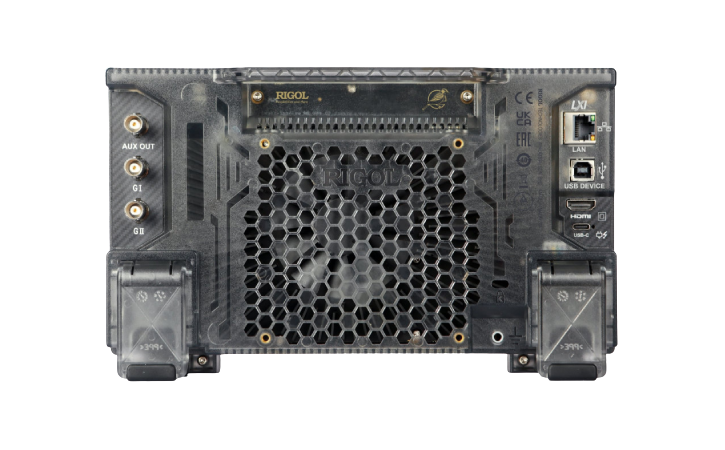
Standard interfaces include:
- USB 2.0 Host
- USB 2.0 Device
- 100 Mbps LAN
- HDMI output
- SCPI remote programming
- Web Control
These interfaces support:
- USB storage
- PC communication
- Automated test systems
- External monitor connection
- Screenshot and waveform transfer
- Network control
- Browser-based remote operation
RIGOL’s current product page also describes Wi-Fi and Bluetooth adapter support. Availability and included adapter configuration should be confirmed for the supplied regional package.
Applications
The RIGOL MHO984 is suitable for:
- Embedded-system development
- Microcontroller debugging
- FPGA and CPLD testing
- High-speed digital circuit analysis
- Mixed-signal debugging
- Serial protocol analysis
- CAN and CAN FD testing
- Automotive electronics
- Industrial control systems
- Power electronics
- Switching power supplies
- Sensor testing
- Communication circuit development
- Audio electronics
- Research and development
- Production validation
- Educational laboratories
- Service and repair
- Portable field testing
-
Why Buy from Revine Tech
Revine Tech supplies RIGOL oscilloscopes, logic probes, protocol options, signal-generator upgrades and measurement accessories for professional electronics testing.
Technical support can include:
- Bandwidth and model selection
- 50 Ω and 1 MΩ measurement planning
- Analogue and digital channel requirements
- PLA2216 logic probe selection
- Memory-depth upgrades
- Embedded protocol analysis
- CAN FD and FlexRay options
- Audio and aerospace bus analysis
- AFG50 or AFG100 selection
- Bode plot accessories
- Passive probe selection
- High-voltage differential probes
- Current probes
- Remote-control integration
- Calibration and documentation
The final RIGOL MHO984 price depends on the selected memory upgrade, PLA2216 logic probe, protocol licences, AFG option, probes, accessories and calibration requirements.