Home All Rigol Oscilloscopes Rigol MSO/DS4000 Series
All Rigol Oscilloscopes

Rigol MSO/DS4000 Series

Now includes NABL Calibration Certificate.

The RIGOL MSO/DS4000 Series Digital Oscilloscope is designed for embedded-system debugging, electronics development, serial bus analysis and industrial testing. With bandwidth options from 100 MHz to 500 MHz, real-time sampling up to 4 GSa/s, memory depth up to 140 Mpts and mixed-signal capability on MSO models, the series supports detailed waveform capture, protocol decoding and intermittent fault analysis..

  • Detail
  • Special Features
  • Specification

The RIGOL MSO/DS4000 Series Digital Oscilloscope is a high-performance test and measurement platform developed for engineers, electronics manufacturers, research laboratories, service departments and educational institutions.

Built around RIGOL UltraVision technology, the series combines deep acquisition memory, fast waveform capture, hardware waveform recording, advanced trigger modes and serial bus analysis. It is suitable for testing analog, digital and mixed-signal electronic systems.

The series includes conventional digital oscilloscope models and mixed-signal models. DS models provide analog waveform measurement, while MSO models add 16 digital channels through a compatible logic probe.


Bandwidth and Channel Configurations

The original MSO/DS4000 Series includes bandwidth options of:

  • 100 MHz
  • 200 MHz
  • 350 MHz
  • 500 MHz

Depending on the selected model, the series provides:

  • Two or four analog input channels on DS configurations
  • Four analog channels on MSO configurations
  • 16 digital channels on supported MSO models with a compatible logic probe
  • One external trigger input

This range allows users to choose a configuration according to the required signal bandwidth, number of analog channels and digital debugging requirements.
 

High-Speed Signal Acquisition

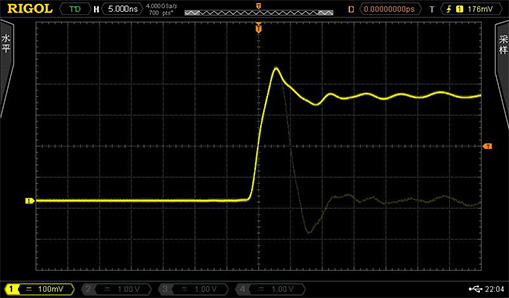
The series provides a maximum real-time sampling rate of up to 4 GSa/s.

High-speed sampling helps engineers observe:

  • Fast signal transitions
  • Clock timing
  • Pulse behaviour
  • Overshoot and ringing
  • Setup and hold violations
  • Intermittent glitches
  • Serial bus activity
  • Switching waveforms

The available sample rate may depend on the number of active analog channels and the selected acquisition configuration.


Deep Acquisition Memory

The RIGOL MSO/DS4000 Series supports memory depth up to 140 Mpts.

Deep memory allows users to capture longer waveform records while maintaining a useful sample rate. This is important when debugging complex systems where the event of interest may occur long after the acquisition begins.

Typical deep-memory applications include:

  • Serial bus packet analysis
  • Embedded software debugging
  • Long-duration waveform capture
  • Power-supply start-up testing
  • Intermittent fault detection
  • Timing sequence analysis
  • Communication interface validation

Users can zoom into recorded waveforms and examine small signal details without immediately repeating the acquisition.


Waveform Recording and Playback

The series supports hardware-based waveform recording, playback and analysis.

This function allows engineers to:

  • Capture multiple waveform frames
  • Replay recorded waveform sequences
  • Compare normal and abnormal events
  • Locate intermittent faults
  • Review signal behaviour after testing
  • Analyse long-duration acquisitions

A dedicated navigation control helps users move through waveform records and search for events efficiently.
 

Advanced Trigger Functions

The MSO/DS4000 Series provides trigger functions designed to isolate specific waveform conditions.

Supported trigger types can include:

  • Edge
  • Pulse width
  • Slope
  • Video
  • Pattern
  • Duration
  • Timeout
  • Runt
  • Window
  • Delay
  • Setup and hold
  • Nth edge
  • Serial bus trigger

These trigger modes help users capture signal abnormalities such as narrow pulses, timing errors, invalid logic combinations and communication faults.


Serial Bus Triggering and Decoding

The oscilloscope supports serial bus triggering and decoding for embedded, automotive and industrial electronics applications.

Supported protocol options include:

  • I2C
  • SPI
  • RS232/UART
  • CAN
  • LIN
  • FlexRay

Protocol availability may depend on the selected model and installed software option.

Decoded protocol information is displayed together with the electrical waveform, allowing engineers to identify:

  • Invalid packets
  • Incorrect addresses
  • Timing problems
  • Missing acknowledgements
  • Communication errors
  • Intermittent bus faults
  •  

Mixed-Signal Debugging

MSO models add up to 16 digital channels using a compatible logic probe.

Mixed-signal capability allows users to observe analog and digital signals on the same time-correlated display.

This is useful for:

  • Microcontroller debugging
  • FPGA validation
  • Parallel bus analysis
  • Embedded control systems
  • Digital power systems
  • ADC and DAC testing
  • Timing relationship analysis
  • Mixed analog and digital circuit testing
  •  

Waveform Measurement and Analysis

The RIGOL MSO/DS4000 Series provides multiple waveform-analysis tools for time-domain and frequency-domain measurements.

Available functions include:

  • Automatic waveform measurements
  • Cursor measurements
  • FFT frequency analysis
  • Waveform mathematics
  • Waveform statistics
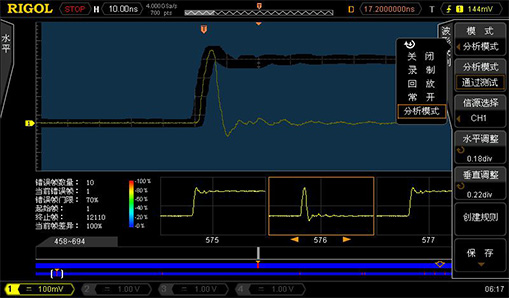
  • Pass/fail testing
  • Mask testing
  • Search and navigation
  • Waveform recording and playback
  • Protocol decoding
  • Logic analysis on MSO models

These functions help engineers perform design verification and fault analysis without transferring every waveform to external analysis software.
 

Pass/Fail and Mask Testing

The series supports waveform template and pass/fail testing.

Users can define acceptable waveform boundaries and monitor whether acquired signals remain within those limits.

Pass/fail testing is suitable for:

  • Production-line validation
  • Long-term signal monitoring
  • Component screening
  • Quality inspection
  • Repetitive design verification
  • Manufacturing test systems

The oscilloscope can record pass/fail statistics and respond to failed tests according to the configured action.


Display and User Interface

The MSO/DS4000 Series uses a large colour display that provides sufficient space for multiple analog traces, digital channels, measurements and decoded protocol information.

The interface supports:

  • Multi-channel waveform display
  • Digital channel grouping
  • Measurement tables
  • Protocol decode information
  • Waveform zoom
  • Recording navigation
  • Configurable waveform intensity
  • Colour-coded channel identification
  •  

Connectivity and Remote Operation

Available interfaces can include:

  • USB Host
  • USB Device
  • LAN
  • LXI
  • VGA output
  • AUX output
  • Optional USB-GPIB connectivity

These interfaces support:

  • Screenshot and waveform storage
  • PC communication
  • Remote programming
  • Network control
  • External monitor connection
  • Automated test-system integration
  • Pass/fail output

Interface availability should be confirmed for the selected model.
 

Applications:

The RIGOL MSO/DS4000 Series is suitable for:

  • Embedded-system development
  • Electronics design and debugging
  • Microcontroller testing
  • FPGA validation
  • Analog circuit testing
  • Digital circuit analysis
  • Mixed-signal debugging
  • Serial bus decoding
  • Automotive electronics testing
  • Industrial control-system testing
  • Communication interface analysis
  • Power electronics testing
  • Semiconductor testing
  • Production-line validation
  • Quality-control testing
  • Research and development
  • Educational laboratories
  • Service and repair laboratories
  •  

Why Buy from Revine Tech:

Revine Tech supplies professional test and measurement equipment for engineering, laboratory, educational and industrial applications.

Our technical team can help customers confirm:

  • Required oscilloscope bandwidth
  • Two-channel or four-channel configuration
  • Digital channel requirements
  • Compatible logic probes
  • Memory-depth requirements
  • Serial bus decoding options
  • Passive and active probe selection
  • High-voltage probe requirements
  • Current probe requirements
  • Remote-control interfaces
  • Rack-mounting requirements
  • Calibration and documentation

The original MSO/DS4000 Series is a legacy product family in several markets. Current availability, replacement models, software licences, accessories and support status should therefore be confirmed before ordering.

Up to 500 MHz Analog Bandwidth

The series offers bandwidth options from 100 MHz to 500 MHz.

Available bandwidths support applications ranging from general electronics debugging to higher-speed embedded and communication-system analysis.

Model selection should consider both signal frequency and edge rise time rather than selecting bandwidth based only on the nominal clock frequency.


Up to 4 GSa/s Real-Time Sampling

The maximum real-time sampling rate of up to 4 GSa/s provides detailed acquisition of fast-changing waveforms.

It helps improve visibility into:

  • Short pulses
  • Clock edges
  • Signal ringing
  • Overshoot
  • Timing errors
  • Switching events
  • Serial data transitions
  •  

Up to 140 Mpts Memory Depth

Deep memory up to 140 Mpts enables longer acquisition records with detailed waveform information.

Benefits include:

  • Longer time capture
  • Better protocol packet analysis
  • Detailed waveform zoom
  • Improved intermittent-event investigation
  • Extended timing analysis
  • More effective waveform search
  •  

Mixed-Signal Capability

Supported MSO models provide:

  • Four analog channels
  • 16 digital channels
  • Time-correlated analog and digital display
  • Parallel bus analysis
  • Digital channel grouping
  • Mixed-signal triggering

A compatible logic probe is required to use the digital channels.


UltraVision Technology

RIGOL UltraVision technology integrates deep memory, waveform capture, recording, playback, analysis and intensity-graded display functions.

This architecture helps engineers identify low-probability events and review complex signal behaviour more efficiently.


Fast Waveform Capture

The series uses a high waveform capture rate to reduce acquisition dead time and improve the probability of detecting rare signal events.

This is valuable for finding:

  • Random glitches
  • Intermittent pulses
  • Unstable timing
  • Signal dropouts
  • Abnormal waveform shapes
  • Occasional protocol errors

The precise maximum capture rate depends on the model and acquisition mode.


Hardware Waveform Recording

Hardware recording supports long sequences of waveform frames.

Recorded waveforms can be:

  • Played back
  • Analysed
  • Compared
  • Navigated
  • Reviewed frame by frame
  • Used to locate intermittent events
  •  

Advanced Serial Bus Analysis

Protocol trigger and decoding options support embedded and automotive bus testing.

Supported protocols include:

  • I2C
  • SPI
  • RS232/UART
  • CAN
  • LIN
  • FlexRay

Optional software may be required for specific protocol packages.


Advanced Triggering

The series includes trigger modes for both common and complex waveform conditions.

Advanced triggering can isolate:

  • Runt pulses
  • Pulse-width violations
  • Setup and hold errors
  • Timeout conditions
  • Window violations
  • Delayed events
  • Specific serial data patterns
  •  

FFT and Waveform Mathematics

FFT analysis allows users to view the frequency content of acquired waveforms.

Waveform mathematics can be used for:

  • Addition
  • Subtraction
  • Multiplication
  • Division
  • Frequency-domain analysis
  • Differential measurement calculations
  • Power-related calculations

Available mathematical functions should be confirmed for the selected firmware and model.


Pass/Fail Testing

Pass/fail testing compares acquired waveforms against a predefined mask.

It supports:

  • Production testing
  • Repetitive validation
  • Quality monitoring
  • Long-duration reliability checks
  • Automated fault indication
  •  

Measurement Statistics

Measurement statistics help users evaluate signal variation over multiple acquisitions.

Typical statistical results include:

  • Current value
  • Minimum
  • Maximum
  • Average
  • Standard deviation
  •  

Large Colour Display

The large colour display supports simultaneous viewing of:

  • Multiple analog channels
  • Digital channels
  • Measurements
  • Decoded bus information
  • Zoomed waveform sections
  • Reference waveforms
  • Mathematical traces
  •  

Flexible Probe Support

Depending on the model and bandwidth, compatible probe categories can include:

  • Passive voltage probes
  • Active probes
  • Differential probes
  • High-voltage probes
  • High-voltage differential probes
  • AC/DC current probes
  • Logic probes for MSO models

Probe bandwidth, voltage rating, input loading and common-mode capability should match the measurement application.

Specification Details
Product Series RIGOL MSO/DS4000 Series
Product Type Digital Oscilloscope / Mixed-Signal Oscilloscope
Analog Bandwidth 100 MHz, 200 MHz, 350 MHz or 500 MHz
Analog Channels Two or four, model-dependent
Digital Channels 16 on supported MSO models with compatible logic probe
External Trigger Supported
Maximum Real-Time Sample Rate Up to 4 GSa/s
Maximum Memory Depth Up to 140 Mpts
Vertical Resolution 8 bits
Display Large colour LCD
Waveform Recording Hardware recording, playback and analysis
Waveform Analysis Automatic measurements, cursors, FFT, mathematics and statistics
Trigger Functions Edge, pulse, slope, video, pattern, duration, timeout, runt, window, delay, setup/hold and Nth edge
Protocol Options I2C, SPI, RS232/UART, CAN, LIN and FlexRay
Mixed-Signal Capability 16 digital channels on MSO models
Pass/Fail Testing Supported
Mask Testing Supported
Connectivity USB Host, USB Device, LAN/LXI, VGA, AUX and optional USB-GPIB
Remote Programming Supported
Primary Applications Embedded debugging, serial bus testing, industrial electronics, communications and R&D


Typical Model Structure

Model Type Analog Channels Digital Channels Bandwidth Options
DS4000 two-channel models 2 None Model-dependent
DS4000 four-channel models 4 None 100 MHz to 500 MHz
MSO4000 models 4 16 with logic probe 100 MHz to 500 MHz

The exact model number should be used on the product page whenever possible because channel count, bandwidth, included probes and installed software options differ across the series.


Bandwidth Options

Bandwidth Class Typical Application
100 MHz General electronics, education and low-speed embedded systems
200 MHz Embedded design, switching circuits and industrial electronics
350 MHz Faster digital systems, communications and signal-integrity testing
500 MHz High-speed clock, data and advanced embedded-system analysis


Acquisition Specifications

Specification Details
Maximum Sample Rate Up to 4 GSa/s
Maximum Memory Depth Up to 140 Mpts
Acquisition Modes Normal, average, peak detect and high-resolution modes
Waveform Recording Supported
Waveform Playback Supported
Search and Navigation Supported
Segmented or Frame Analysis Configuration-dependent


Trigger Specifications

Trigger Category Supported Types
Basic Triggers Edge, pulse and video
Timing Triggers Duration, timeout, delay and Nth edge
Signal-Quality Triggers Runt, slope and window
Digital Triggers Pattern and setup/hold
Protocol Triggers I2C, SPI, RS232/UART, CAN, LIN and FlexRay, option-dependent


Protocol Decoding

Protocol Typical Application
I2C Sensors, memory devices and embedded peripherals
SPI Microcontrollers, converters and display interfaces
RS232/UART Serial communication and diagnostic interfaces
CAN Automotive and industrial networks
LIN Automotive body electronics
FlexRay Automotive control and safety systems


Connectivity

Interface Primary Use
USB Host Storage devices, screenshots and waveform files
USB Device PC control and data transfer
LAN/LXI Network control and automated testing
VGA External display connection
AUX Output Trigger or pass/fail output
USB-GPIB Optional legacy test-system integration


Important Product Note

The original RIGOL MSO/DS4000 Series should not be combined with the later DS4000E Series on the same specification page.

The DS4000E consists of the DS4014E and DS4024E four-channel models and provides:

  • 100 MHz or 200 MHz bandwidth
  • Four analog channels
  • Up to 2 GSa/s on each channel
  • 14 Mpts memory on each channel
  • Up to 60,000 wfms/s capture
  • Up to 127,000 waveform recording frames

These DS4000E specifications are different from the 4 GSa/s and 140 Mpts figures associated with the original MSO/DS4000 family.