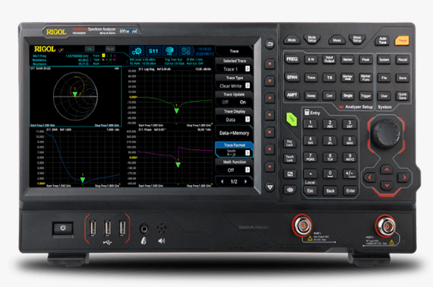
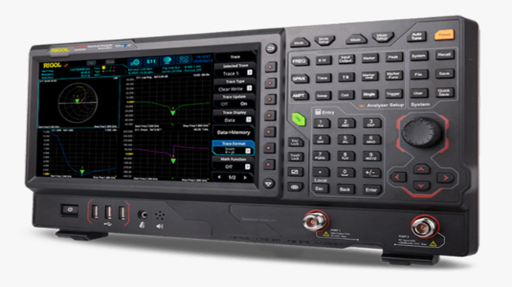
The RIGOL RSA5000 Series Real-Time Spectrum Analyzer is designed for engineers, RF laboratories, electronics manufacturers and research teams that need to capture, monitor and analyse conventional, transient and digitally modulated RF signals.
The series combines swept spectrum analysis with real-time spectrum analysis. Selected N models also include vector network analysis, allowing one instrument to support spectrum measurements, transient signal capture, component characterisation and EMI troubleshooting.
The RSA5000 family includes 3.2 GHz and 6.5 GHz configurations with standard, tracking-generator and VNA versions.
Available Models
The series includes:
- RSA5032: 9 kHz to 3.2 GHz spectrum analyzer
- RSA5065: 9 kHz to 6.5 GHz spectrum analyzer
- RSA5032-TG: 9 kHz to 3.2 GHz with tracking generator
- RSA5065-TG: 9 kHz to 6.5 GHz with tracking generator
- RSA5032N: 9 kHz to 3.2 GHz with tracking generator and VNA
- RSA5065N: 9 kHz to 6.5 GHz with tracking generator and VNA
The RSA5065N is the highest-frequency and most fully integrated configuration in the family. It combines swept analysis, real-time analysis, tracking-generator measurements and vector network analysis up to 6.5 GHz.
General-Purpose Spectrum Analysis
The GPSA operating mode provides conventional swept-spectrum analysis for measuring RF amplitude and frequency characteristics.
It is suitable for:
- Carrier frequency measurement
- Signal amplitude measurement
- Harmonic analysis
- Spurious-emission testing
- Channel-power measurement
- Occupied-bandwidth measurement
- Adjacent-channel power analysis
- Frequency-response testing
- Amplifier analysis
- Filter testing
- Transmitter validation
The analyzer provides resolution bandwidth settings from 1 Hz to 10 MHz, allowing users to balance frequency resolution, measurement noise and sweep speed.
Real-Time Spectrum Analysis
The RTSA mode continuously captures signals within the selected analysis bandwidth and is designed to identify short-duration or intermittent RF events that may be missed by conventional swept analysis.
Typical applications include:
- Wi-Fi interference analysis
- Bluetooth frequency-hopping analysis
- Cellular signal troubleshooting
- Burst-transmission testing
- Intermittent spurious-emission detection
- Radar pulse monitoring
- Frequency-agile signal analysis
- Wireless coexistence testing
- Unstable oscillator investigation
The RSA5000 provides 25 MHz standard real-time analysis bandwidth. The optional RSA5000-B40 upgrade increases this bandwidth to 40 MHz.
With the 40 MHz bandwidth option, the instrument provides a 100% probability of intercept for signals lasting longer than 7.45 μs under specified conditions.
UltraReal Technology
RIGOL UltraReal technology supports gap-free signal acquisition within the selected real-time analysis bandwidth.
This allows engineers to:
- Monitor rapidly changing RF environments
- Capture low-probability events
- Observe frequency-hopping behaviour
- Identify intermittent interference
- Analyse signal occupancy over time
- Trigger on abnormal spectrum events
Real-time analysis is supported by several display formats, including density, spectrogram and power-versus-time views.
Frequency Mask Trigger
The Frequency Mask Trigger function allows users to define a spectral boundary and trigger when a signal enters or leaves the selected region.
FMT is useful for locating:
- Unexpected emissions
- Intermittent interference
- Frequency-hopping signals
- Transient spurious signals
- Unstable carriers
- Short-duration communication bursts
- Abnormal signal-power changes
The mask can be created around an existing signal and adjusted according to the expected spectrum limits.
Seven Real-Time Display Modes
The RSA5000 provides seven real-time signal displays for examining RF behaviour across frequency, amplitude and time.
Available displays include combinations of:
- Real-time spectrum
- Density display
- Spectrogram
- Power versus time
- Frequency versus time
- Time-domain signal behaviour
- Multi-window analysis
These views help users distinguish persistent signals from intermittent or low-occurrence events.
Vector Signal Analysis
The optional RSA5000-VSA application supports demodulation and analysis of digitally modulated signals.
Supported modulation families include:
Available analysis views can include:
- Constellation diagram
- Eye diagram for supported baseband signals
- Spectrum
- Spectrogram
- Demodulated data
- Symbol information
- Error vector magnitude
- Magnitude error
- Phase error
- Frequency error
VSA analysis is useful for:
- Wireless transmitter development
- Digital modulation troubleshooting
- Communication-module testing
- RF component validation
- Modulation-quality analysis
- Research and education
The VSA application requires a separate software licence unless included in a specific product bundle.
Vector Network Analysis
VNA mode is available only on the RSA5032N and RSA5065N models.
The built-in tracking generator and bridge-based network-analysis architecture support measurements including:
- S11 reflection
- S21 transmission
- Return loss
- Insertion loss
- VSWR
- Impedance
- Phase
- Group delay
- Distance-to-fault analysis
VNA measurements can be displayed using:
- Log magnitude
- Linear magnitude
- Phase
- Smith chart
- Polar chart
- SWR
- Group delay
The VNA mode can be used to characterise:
- Filters
- Amplifiers
- Cables
- Antennas
- Attenuators
- RF connectors
- Splitters
- Matching networks
- RF components
- Circuit networks
A compatible calibration kit is required for accurate S-parameter and network measurements. RIGOL lists calibration kits covering up to 6.5 GHz for the RSA5000N platform.
Tracking-Generator Measurements
Tracking-generator capability is included in TG and N models.
The tracking generator can be used with the spectrum analyzer to perform scalar frequency-response measurements on:
- Filters
- Amplifiers
- Cables
- Attenuators
- Splitters
- RF networks
- Passive components
The tracking-generator frequency range depends on the selected model:
- Up to 3.2 GHz on RSA5032-TG and RSA5032N
- Up to 6.5 GHz on RSA5065-TG and RSA5065N
-
EMI Pre-Compliance Testing
The optional RSA5000-EMI application supports conducted and radiated emissions pre-compliance testing.
EMI capabilities include:
- CISPR-compliant bandwidth filters
- Peak detector
- Quasi-peak detector
- Average detector
- Limit lines
- Frequency scanning
- Signal identification
- Emission-source troubleshooting
- Measurement result reporting
The analyzer can be used with suitable accessories such as:
- Line impedance stabilisation networks
- Near-field probes
- Current probes
- Antennas
- Preamplifiers
- Attenuators
- RF cables
The EMI application helps engineers locate emission problems before formal EMC certification testing. Formal compliance testing must still follow the applicable standard and laboratory requirements.
Low Displayed Average Noise Level
With the optional RSA5000-PA preamplifier enabled, the RSA5000 can achieve a typical displayed average noise level down to approximately -165 dBm/Hz over part of its frequency range.
Typical DANL performance varies with frequency. For example, the official datasheet lists typical performance down to approximately -165 dBm/Hz between 20 MHz and 1.5 GHz with the preamplifier enabled.
Without the preamplifier, typical DANL is approximately -145 dBm/Hz over the same frequency range.
Actual noise-floor performance depends on:
- Measurement frequency
- Preamplifier status
- Input attenuation
- Resolution bandwidth
- Detector type
- Trace averaging
- Instrument temperature
The -165 dBm figure should not be presented as applying uniformly across the complete 9 kHz to 6.5 GHz frequency range.
Low Phase Noise
The RSA5000 provides typical phase-noise performance below -108 dBc/Hz at a 1 GHz carrier with a 10 kHz offset.
Low phase noise improves measurements of:
- Weak signals close to strong carriers
- Oscillators
- Frequency synthesizers
- Wireless transmitters
- Local oscillators
- Radar sources
- Communication signals
The phase-noise test condition should always be published with the numerical value because phase noise changes with carrier frequency and offset frequency.
Advanced RF Measurements
The optional RSA5000-AMK Advanced Measurement Kit adds automated RF measurements for communication and transmitter testing.
Depending on the selected mode and configuration, measurements can include:
- Channel power
- Occupied bandwidth
- Adjacent-channel power
- Harmonic distortion
- Third-order intercept
- Emission bandwidth
- Carrier-to-noise ratio
- Noise figure-related measurements
- Time-domain power analysis
-
10.1-Inch Touchscreen
The analyzer uses a 10.1-inch capacitive multi-touch display.
The touchscreen supports:
- Dragging traces
- Expanding and reducing frequency spans
- Marker movement
- Touch-based parameter entry
- Spectrogram navigation
- Multi-window analysis
- Measurement setup
- File management
The display resolution is 1024 × 600 pixels.
Remote Control and Connectivity
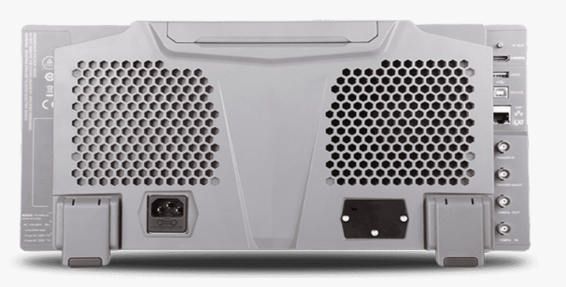
The RSA5000 provides several interfaces for instrument control and test-system integration:
- USB Host
- USB Device
- LAN
- HDMI
- Web Control
- SCPI remote programming
The HDMI interface allows the analyzer display to be shown on an external monitor or projector.
Web Control allows users to operate the instrument through a compatible browser by accessing its network address.
Applications:
The RIGOL RSA5000 Series is suitable for:
- Wi-Fi interference troubleshooting
- Bluetooth signal analysis
- Cellular transmitter testing
- Wireless coexistence analysis
- IoT device testing
- RF interference detection
- Spectrum monitoring
- Frequency-hopping signal analysis
- Transient RF event detection
- EMI pre-compliance testing
- Conducted-emission troubleshooting
- Radiated-emission troubleshooting
- Filter and amplifier testing
- Cable and antenna measurements
- S-parameter measurements
- Distance-to-fault testing
- Vector signal analysis
- Digital modulation testing
- RF production testing
- Research and development
- Educational RF laboratories
- Automated test-system integration
-
Why Buy from Revine Tech:
Revine Tech provides RF, microwave, EMC and general test and measurement equipment for engineering, laboratory, research and industrial applications.
Our technical team can help customers select the correct RSA5000 configuration according to:
- Required frequency range
- Real-time bandwidth
- Tracking-generator requirements
- VNA requirements
- VSA application requirements
- EMI pre-compliance requirements
- Preamplifier requirements
- Advanced measurement functions
- VNA calibration kit
- RF cables and adapters
- Near-field probes
- LISN and antenna requirements
- Remote-control requirements
- Calibration documentation