Home PMK | Optically-Isolated Probes Optical probe Electric Current Sensor: OpECS
PMK | Optically-Isolated Probes

Optical probe Electric Current Sensor: OpECS

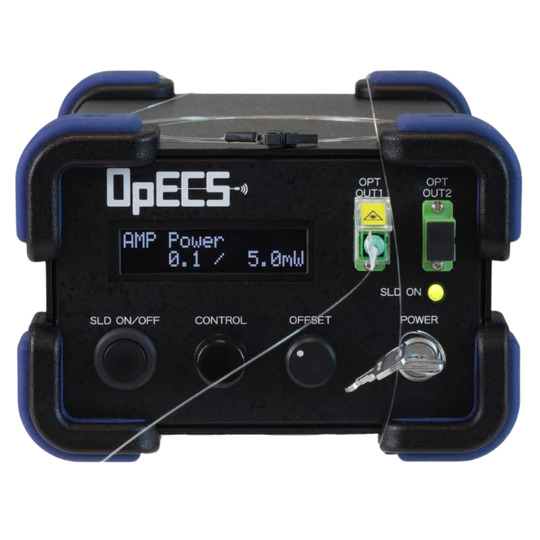
OpECS is an innovative optical current sensor that uses the Faraday effect to measure current by detecting the surrounding magnetic field — all while providing high bandwidth up to 150 MHz, ±140 A measurement capability, and galvanic isolation in an ultra-miniature form factor..

  • Detail
  • Special Features
  • Specification

The OpECS (Optical Electric Current Sensor) is a groundbreaking sensor system that leverages the Faraday effect to detect magnetic fields produced by electric current — translating them into measurable electrical signals with exceptional accuracy and safety.

Instead of relying on a current shunt, transformer, or hall effect sensor, OpECS utilizes polarized light modulation. When a current flows through a conductor, the magnetic field around it alters the polarization of the light at the sensor tip. This light is sent to a control unit, where it is converted back into an electrical signal and output via BNC for waveform monitoring.

Its tiny optical probe can be placed near or against the wire being measured. The closer it is to the wire's center, the higher the sensitivity. This makes it possible to measure currents beyond the rated ±140 A by varying the probe distance — making it scalable for both small-signal and high-current applications.

The OpECS is especially effective in applications where:

  • Isolation is mandatory

  • Contactless probing is needed

  • Space is severely limited

  • High-speed transient current detection is critical

  • Ultra-small sensor head: as small as Φ0.45 mm

  • Galvanic isolation for safe current sensing

  • Wide bandwidth: DC to 150 MHz

  • Current measurement range: ±140 A (extendable through placement technique)

  • Directly usable with oscilloscopes with 50 Ω BNC input

  • Supports non-contact sensing via magnetic field coupling

  • No core or clamp needed – truly non-intrusive sensing

  • Compatible with 1 MΩ scopes via 50 Ω feed-through termination

  • Bandwidth: DC to 150 MHz

  • Measurable Current: ±140 A (typical, based on Φ0.5 mm wire contact)

  • Sensor Head Size: As small as Φ0.45 mm

  • Output Interface: 50 Ω BNC

  • Oscilloscope Compatibility:

    • Directly with 50 Ω inputs

    • With 1 MΩ scopes using 50 Ω feed-through termination

  • Isolation: Complete galvanic isolation (optical)

  • Measurement Principle: Faraday effect-based optical sensing

  • Measurement Distance Sensitivity:

    • Max sensitivity when sensor contacts wire center

    • Sensitivity decreases with distance (non-linear drop)

  • Wire Diameter Effect: Sensitivity constant if center distance is unchanged

  • Usage:

    • Switching power supplies

    • GaN/SiC testing

    • High-speed digital power stages

    • Safety-critical or isolated current sensing setups