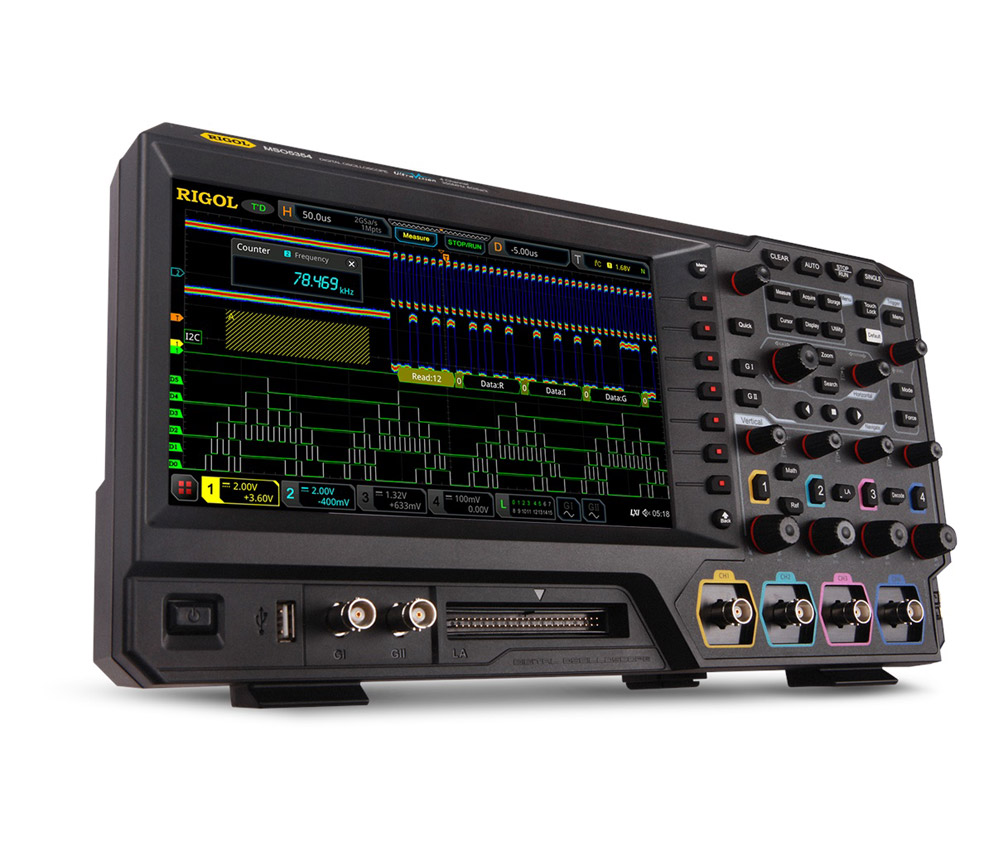
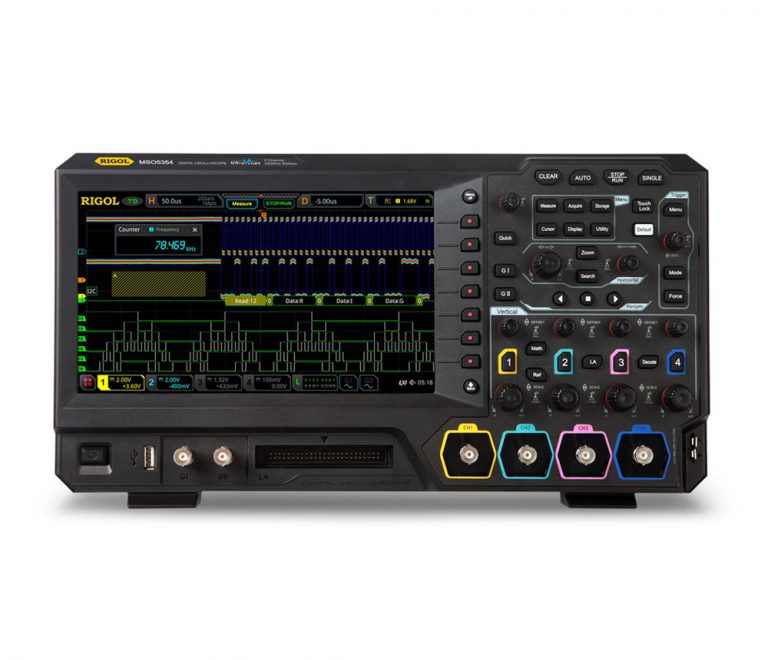
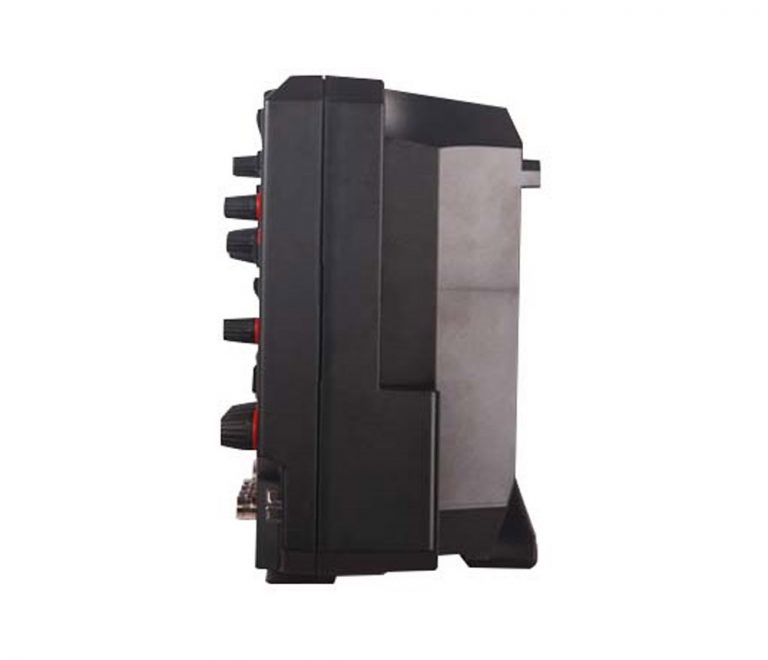
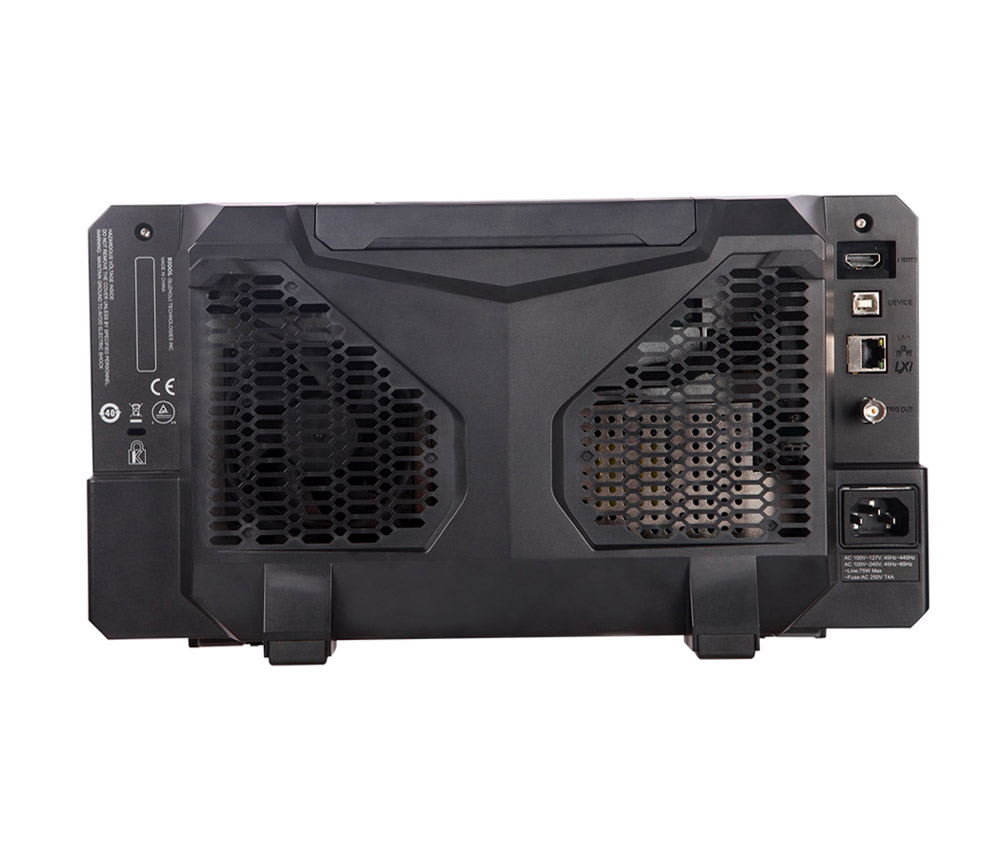
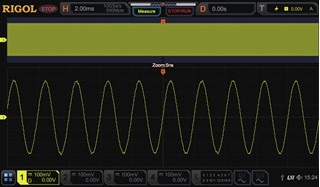
The RIGOL MSO5104 is the 100 MHz, four-analogue-channel model in the MSO5000 Series. It combines high-speed analogue acquisition, mixed-signal debugging, protocol analysis, frequency-domain analysis and optional waveform generation within a compact benchtop instrument.
Built on RIGOL’s UltraVision II architecture and Phoenix chipset, the MSO5104 provides:
- 100 MHz analogue bandwidth
- Four analogue channels as standard
- Sixteen digital-channel capability
- Up to 8 GSa/s real-time sampling
- 100 Mpts standard acquisition memory
- Optional expansion to 200 Mpts
- Up to 500,000 waveform captures per second
- Up to 450,000 segmented waveform frames
- 9-inch capacitive multi-touch display
- Optional dual-channel 25 MHz arbitrary waveform generator
- Optional serial-bus trigger and decode
- Enhanced FFT analysis
- Full-memory automatic measurements
- Bode-plot analysis
- Digital voltmeter
- Six-digit frequency counter and 48-bit totaliser
- Web Control for browser-based remote operation
The official RIGOL ordering table identifies the MSO5104 as a 100 MHz model with four analogue channels, sixteen digital-channel capability, an 8 GSa/s maximum real-time sample rate and 100 Mpts standard memory.
100 MHz Analogue Bandwidth
The MSO5104 provides 100 MHz analogue bandwidth across four input channels.
This bandwidth is suitable for examining signals found in:
- Microcontroller-based systems
- Embedded control boards
- General digital electronics
- Sensor and actuator interfaces
- Switching power supplies
- Industrial automation systems
- Automotive control electronics
- Audio and consumer products
- IoT hardware
- PWM control circuits
- Communication interfaces
- Electronic production-test fixtures
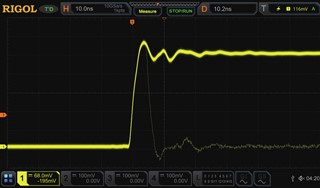
The typical rise-time specification for the 100 MHz MSO5104 is 3.5 ns. This makes the instrument suitable for investigating waveform properties such as overshoot, undershoot, ringing, pulse distortion, settling behaviour and timing relationships in moderate-speed electronic systems.
Upgradeable to 200 MHz or 350 MHz
The standard 100 MHz bandwidth can be increased electronically through official RIGOL bandwidth licences.
| Upgrade option |
Resulting bandwidth |
| MSO5000-BW1T2 |
200 MHz |
| MSO5000-BW1T3 |
350 MHz |
These licences allow an engineering laboratory to begin with a 100 MHz configuration and increase its measurement capability later without replacing the oscilloscope hardware.
Bandwidth expansion is useful when future projects involve:
- Faster FPGA or processor clocks
- Shorter signal rise times
- Higher-frequency switching converters
- Faster PWM transitions
- More demanding signal-integrity analysis
- Wider-bandwidth sensor interfaces
- Detailed examination of switching noise and ringing
The MSO5104 can be upgraded to the 350 MHz maximum bandwidth supported by the MSO5000 platform.
Four Analogue Channels as Standard
Unlike the two-channel MSO5102, the MSO5104 provides four active analogue inputs as standard. No analogue-channel activation licence is required.
Four-channel acquisition allows engineers to observe several related signals during the same event.
Typical measurement combinations include:
- Clock, data, enable and reset
- Input voltage, switching node, output voltage and feedback
- Gate drive, drain voltage, current and controller output
- PWM command, current sense, feedback and fault signal
- Three motor phases and one control signal
- Sensor output, reference, excitation and supply voltage
- Transmit, receive, clock and control lines
- Multiple power rails during system start-up
- Primary voltage, primary current, secondary voltage and secondary current
Simultaneous acquisition helps preserve the timing relationship between channels and makes it easier to identify sequencing, propagation-delay and cause-and-effect problems.
Up to 8 GSa/s Real-Time Sampling
The RIGOL MSO5104 supports a maximum real-time sample rate of 8 GSa/s.
The available sample rate depends on the analogue channels enabled and their acquisition grouping.
| Active analogue-channel arrangement |
Maximum real-time sample rate |
| One channel active |
8 GSa/s |
| Half-channel operation |
4 GSa/s |
| All four channels active |
2 GSa/s |
Channels 1 and 2 share one acquisition group, while channels 3 and 4 share the other. When one channel in each group is enabled, each active channel can operate at up to 4 GSa/s. With all four channels enabled, the maximum rate is 2 GSa/s per channel. RIGOL specifies 8 GSa/s as the maximum real-time sampling rate for the MSO5000 Series.
A high sampling rate improves visibility into:
- Fast rising and falling edges
- Narrow pulses
- Random glitches
- Overshoot and undershoot
- Ringing
- Switching transients
- Clock instability
- Pulse-width variation
- Timing skew
- Communication disturbances
- Short-duration interference
-
100 Mpts Standard Memory
The MSO5104 includes 100 Mpts of acquisition memory as standard.
Deep memory allows a longer time interval to be captured while maintaining a relatively high sample rate. This is useful when both the overall system sequence and short-duration waveform details must be preserved.
Typical deep-memory applications include:
- Complete system power-up and shutdown
- Long serial communication transactions
- Motor acceleration and braking cycles
- Extended PWM sequences
- Intermittent circuit failures
- Random protection trips
- Burst-mode power-converter operation
- Unexpected resets
- Long sensor-monitoring intervals
- Thermal or load-dependent faults
- Production-test records
Once the event is captured, the user can zoom into an individual transition or fault while retaining the context of the complete acquisition.
Optional 200 Mpts Memory
The MSO5000-2RL licence expands the maximum analogue memory depth to 200 Mpts.
Maximum memory allocation depends on the active-channel configuration.
| Acquisition configuration |
Maximum memory with MSO5000-2RL |
| One analogue channel |
200 Mpts |
| Half-channel operation |
100 Mpts |
| Four analogue channels |
50 Mpts |
| Digital channels |
25 Mpts |
The 200 Mpts figure represents the maximum available in single-channel acquisition. It is not independently available on each enabled analogue channel. RIGOL lists 200 Mpts as the optional maximum memory depth of the MSO5000 Series.
Up to 500,000 Waveforms per Second
The MSO5104 supports waveform capture rates up to 500,000 waveforms per second under specified acquisition conditions.
Waveform capture rate indicates how quickly the instrument can acquire, process and display successive waveform records. A faster update rate reduces dead time and increases the probability of observing infrequent signal abnormalities.
This is valuable for detecting:
- Random glitches
- Missing pulses
- Noise bursts
- Signal dropouts
- Timing violations
- Metastable transitions
- Unstable switching behaviour
- Occasional communication errors
- Unexpected resets
- Irregular clock edges
- Rare amplitude changes
RIGOL specifies a maximum waveform capture rate of 500,000 waveforms per second for the MSO5000 platform.
256-Level Intensity Grading and Colour Persistence
The 9-inch display supports 256-level intensity grading and colour persistence.
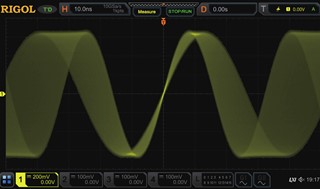
Frequently occurring waveform paths appear with greater intensity, while low-probability events appear differently. This visual probability representation helps users distinguish normal repetitive activity from rare or intermittent faults.
It is useful for identifying:
- Timing jitter
- Changing edge positions
- Sporadic glitches
- Amplitude instability
- Multiple operating states
- Intermittent ringing
- Modulation behaviour
- Occasional noise events
The official datasheet lists both 256-level intensity grading and colour persistence as standard MSO5000 display features.
Up to 450,000 Segmented Waveform Frames
The MSO5104 supports hardware waveform recording and playback of up to 450,000 frames.
Segmented acquisition captures only events that satisfy the configured trigger condition. Long inactive periods between those events do not consume the same amount of acquisition memory.
This makes recording more efficient when monitoring:
- Intermittent circuit faults
- Serial communication errors
- Power-supply shutdown events
- Automotive ECU problems
- Motor-drive protection trips
- Oscillator instability
- Repeated production failures
- Random noise disturbances
- Unexpected resets
- Long-duration reliability tests
Recorded events can be reviewed individually or played back sequentially. Time tags help identify when each event occurred relative to the others.
Sixteen Digital Channels with PLA2216
The MSO5104 supports sixteen digital channels, D0 through D15, for logic and mixed-signal analysis.
The digital acquisition hardware is part of the MSO5000 platform, but the optional PLA2216 active logic probe is required to connect digital signals to the oscilloscope.
Digital inputs can be used to monitor:
- Microcontroller GPIO lines
- FPGA logic signals
- Address and data buses
- Enable and reset lines
- State-machine outputs
- Digital control signals
- Parallel communication buses
- Memory interfaces
- Timing relationships
- Communication lines
The channels are divided into two threshold groups:
Each group has an independently adjustable threshold. Preset levels include TTL, CMOS, ECL, PECL and LVDS. RIGOL specifies up to 1 GSa/s digital sampling and 25 Mpts memory for all digital channels.
Digital-Input Specifications
| Parameter |
Specification |
| Number of digital channels |
16 |
| Required probe |
PLA2216 |
| Channel groups |
D0–D7 and D8–D15 |
| Maximum digital sample rate |
Up to 1 GSa/s |
| Digital memory depth |
25 Mpts |
| Threshold range |
±15 V |
| Threshold adjustment |
10 mV steps |
| Threshold accuracy |
±100 mV plus 3% of setting |
| Preset thresholds |
TTL, CMOS, ECL, PECL, LVDS and 0 V |
| Maximum input voltage |
±40 V peak, CAT I |
| Minimum input swing |
Approximately 500 mV peak-to-peak |
| Input impedance |
Approximately 101 kΩ |
| Probe loading |
Approximately 8 pF |
Analogue and Digital Signal Correlation
Mixed-signal capability allows analogue waveforms and digital logic activity to be displayed on the same time-aligned acquisition.
Examples include:
- Supply-voltage dips alongside reset activation
- Analogue sensor outputs alongside controller states
- PWM voltage alongside digital command signals
- Motor current alongside commutation logic
- Bus voltage alongside decoded protocol data
- Start-up power rails alongside enable lines
- Oscillator behaviour alongside state transitions
- Converter output alongside protection logic
This correlation helps engineers determine whether a fault originates in the analogue circuitry, digital control system or the interaction between both domains.
Parallel-Bus Analysis
With the PLA2216 connected, the MSO5104 can group digital channels into a parallel bus.
Parallel-bus analysis supports:
- Microprocessor interfaces
- Address buses
- Data buses
- Memory systems
- FPGA designs
- Digital state machines
- Industrial-control electronics
- Proprietary parallel interfaces
Individual digital traces, grouped bus values and analogue waveforms can be displayed together for complete mixed-signal debugging.
Optional Dual-Channel 25 MHz Arbitrary Waveform Generator
The MSO5000-AWG option activates the instrument’s two waveform-generator outputs.
Official generator specifications include:
- Two output channels
- Maximum output frequency of 25 MHz
- Maximum sample rate of 200 MSa/s
- Thirteen predefined waveforms
- Modulation
- Sweep
- Burst output
The generator hardware is incorporated into the MSO5000 platform, but the software licence is required to activate it.
Typical waveform types include:
- Sine
- Square
- Ramp
- Pulse
- Noise
- DC
- Arbitrary waveform
The optional generator can be used for:
- Circuit stimulation
- Sensor simulation
- Amplifier testing
- Filter evaluation
- Frequency-response testing
- Control-loop experiments
- Educational demonstrations
- Signal-path troubleshooting
- Response testing with known inputs
Combining signal generation and oscilloscope acquisition reduces the need for a separate function generator during many routine bench measurements.
Seven Instruments in One Platform
Depending on installed options and accessories, the MSO5104 integrates seven measurement functions:
- Digital oscilloscope
- Sixteen-channel logic analyser
- Protocol analyser
- Spectrum analyser through enhanced FFT
- Dual-channel arbitrary waveform generator
- Digital voltmeter
- Frequency counter and totaliser
RIGOL officially presents the MSO5000 as a seven-in-one measurement platform. Some functions require the relevant software licence or probe.
9-Inch Capacitive Multi-Touch Display
The MSO5104 features a 9-inch capacitive colour touchscreen with 1024 × 600-pixel resolution.
The screen provides sufficient working area for:
- Four analogue waveforms
- Sixteen digital traces
- Automatic measurements
- Serial-bus decoding
- FFT traces
- Histograms
- Cursors
- Trigger settings
- Search markers
- Analysis menus
Touch gestures can be used to:
- Move waveforms
- Change vertical scale
- Adjust the horizontal time base
- Set trigger level
- Position cursors
- Zoom into waveform records
- Navigate deep acquisitions
- Configure measurements
- Select analysis tools
Dedicated front-panel knobs and buttons remain available for conventional oscilloscope operation. RIGOL specifies a 9-inch capacitive multi-touch screen with 256-level intensity grading for the MSO5000 Series.
Full-Memory Hardware Measurements
The MSO5104 can calculate automatic measurements across the complete acquisition record rather than analysing only the waveform portion visible on the screen.
This capability is useful for:
- Long waveform records
- Burst signals
- Start-up sequences
- Communication packets
- Modulated waveforms
- Intermittent pulses
- Changing duty cycles
- Motor-control cycles
- Power-conversion events
- Signals containing different frequencies
The oscilloscope supports automatic measurement of 41 waveform parameters and full-memory hardware measurement.
Automatic Waveform Measurements
Typical automatic measurements include:
Voltage Measurements
- Maximum
- Minimum
- Peak-to-peak
- Amplitude
- Top
- Base
- Average
- RMS
- Overshoot
- Preshoot
Timing Measurements
- Frequency
- Period
- Rise time
- Fall time
- Positive pulse width
- Negative pulse width
- Positive duty cycle
- Negative duty cycle
- Delay
- Phase
Pulse and Statistical Measurements
- Positive pulse count
- Negative pulse count
- Rising-edge count
- Falling-edge count
- Area
- Cycle area
- Standard deviation
Measurement statistics help users evaluate minimum, maximum, average and variation across repeated acquisitions.
Advanced Trigger System
The MSO5104 provides a broad selection of trigger modes for isolating specific signal conditions.
Standard trigger types include:
- Edge
- Pulse
- Slope
- Video
- Pattern
- Duration
- Timeout
- Runt
- Window
- Delay
- Setup and hold
- Nth edge
- Zone
These modes allow acquisition to be based on:
- Voltage level
- Edge direction
- Pulse width
- Rise or fall rate
- Digital pattern
- Signal duration
- Timing relationship
- Abnormal pulse shape
- Waveform position
Optional protocol triggers extend the system to embedded, automotive, industrial, audio and avionics buses.
Zone Triggering
Zone triggering allows users to draw one or more rectangular regions directly on the touchscreen.
The oscilloscope can then trigger when the waveform:
- Enters a selected zone
- Avoids a selected zone
This graphical approach is useful when a fault is visually recognisable but difficult to define using numerical trigger conditions.
Zone triggering can help locate:
- Excessive overshoot
- Ringing
- Missing transitions
- Abnormal pulse shapes
- Amplitude instability
- Timing jitter
- Unexpected waveform paths
- Incomplete settling
- Intermittent modulation
- Signal excursions
-
Optional Serial-Protocol Trigger and Decode
The MSO5104 supports optional serial communication packages.
| Option |
Supported protocols |
| MSO5000-COMP |
RS232 and UART |
| MSO5000-EMBD |
I²C and SPI |
| MSO5000-AUTO |
CAN and LIN |
| MSO5000-FLEX |
FlexRay |
| MSO5000-AUDIO |
I²S |
| MSO5000-AERO |
MIL-STD-1553 |
Decoded protocol information can be displayed alongside the electrical waveform, helping users correlate data errors with physical-layer conditions such as noise, incorrect voltage levels, slow edges, ringing, timing errors or bus contention. The official MSO5000 datasheet lists all eight supported serial protocols.
Up to Four Serial Buses
The four analogue channels allow the MSO5104 to acquire and decode multiple communication signals, subject to channel availability and installed protocol options.
Typical applications include:
- Embedded controller debugging
- Automotive CAN and LIN testing
- Industrial communication analysis
- Sensor-interface troubleshooting
- Digital audio development
- FlexRay network analysis
- Avionics MIL-STD-1553 testing
Event-table presentation and search tools help users review decoded data in long acquisitions.
I²S Audio-Bus Analysis
The four-channel MSO5104 is compatible with the optional MSO5000-AUDIO package.
I²S analysis is useful for testing:
- Audio processors
- Codecs
- Digital amplifiers
- Embedded multimedia systems
- Consumer audio products
- Digital audio interfaces
The four analogue inputs provide sufficient channel availability for common I²S signal arrangements without requiring a channel-number upgrade.
Enhanced FFT and Spectrum Analysis
The MSO5104 includes enhanced FFT analysis as a standard function.
Official capabilities include:
- Up to 1 Mpts FFT processing
- Frequency range up to the oscilloscope’s analogue bandwidth
- Independent colour-persistence view
- Up to four mathematical operations displayed simultaneously
- Automatic search for up to fifteen peaks
- Exportable peak event table
FFT analysis can help identify:
- Harmonic distortion
- Switching noise
- Power-supply ripple
- Clock feed-through
- Oscillator spurs
- Resonance
- Modulation components
- Unwanted frequency content
- Potential EMI sources
RIGOL specifies real-time processing of up to 1 Mpts of waveform data and peak search for up to fifteen frequencies.
Mathematical Waveform Operations
The MSO5104 provides mathematical processing for deriving additional waveform information.
Typical functions include:
- Addition
- Subtraction
- Multiplication
- Division
- Integration
- Differentiation
- Base-10 logarithm
- Natural logarithm
- Exponential
- Square root
- Absolute value
- Linear transformation
- AND
- OR
- XOR
- NOT
These operations can support:
- Input-versus-output comparison
- Differential waveform calculation
- Instantaneous power calculation
- Phase analysis
- Control-loop evaluation
- Common-signal removal
- Derived waveform generation
Up to four mathematical functions can be shown simultaneously on the MSO5000 platform.
Digital Filtering
Built-in digital filters include:
- Low-pass
- High-pass
- Band-pass
- Band-stop
Filtering helps isolate the frequency content relevant to a measurement and suppress unwanted noise or interference.
Waveform Histogram Analysis
Histogram analysis displays the statistical distribution of waveform positions or measurement values across repeated acquisitions.
It can be used to evaluate:
- Timing jitter
- Amplitude variation
- Noise distribution
- Pulse-width consistency
- Frequency stability
- Duty-cycle variation
- Production tolerance
- Long-term signal drift
Histograms are listed as a standard analysis capability of the MSO5000 Series.
Hardware Pass/Fail Testing
The MSO5104 includes hardware mask testing for repetitive waveform evaluation.
A reference mask is created around an acceptable waveform. Subsequent acquisitions are compared against this mask to detect violations.
The instrument can support procedures such as:
- Counting passed and failed acquisitions
- Stopping after a failure
- Saving an abnormal waveform
- Activating the pass/fail output
- Continuing long-duration monitoring
- Capturing screen images
Pass/fail testing is useful for:
- PCB production testing
- Component screening
- Power-supply verification
- Signal-quality inspection
- End-of-line testing
- Reliability monitoring
- Educational laboratory assessment
RIGOL lists hardware mask testing as a standard MSO5000 function.
Optional Power Analysis
The MSO5000-PWR licence enables built-in power-analysis functions.
It can support analysis of:
- Power quality
- Input-line behaviour
- Output ripple
- Switching characteristics
- Power-converter performance
- Voltage and current relationships
Typical applications include:
- AC-DC power supplies
- DC-DC converters
- Inverters
- Motor drives
- Power-factor-correction circuits
- Industrial power systems
- Battery-operated electronics
The optional RPA246 phase-difference correction jig can be used to compensate for timing differences between voltage and current probes.
Bode Plot and Control-Loop Analysis
The MSO5000 Series includes a Bode-plot function for loop-response testing.
With the optional AWG activated, the oscilloscope can apply a frequency sweep and display gain and phase response. Engineers can use the results to assess:
- Gain margin
- Phase margin
- Control-loop stability
- Filter response
- Amplifier response
- Power-supply feedback behaviour
- Frequency-dependent circuit performance
RIGOL specifically identifies phase-margin and gain-margin analysis as major uses of the Bode-plot function.
Built-In Digital Voltmeter
The integrated digital voltmeter supports:
- DC measurement
- AC measurement
- RMS measurement
- AC+DC RMS measurement
- Limit checking with audible alarm
The DVM is a three-digit measurement function and operates through the analogue input channels.
It is useful for:
- DC rail verification
- Bias-voltage measurement
- RMS voltage checks
- Average voltage monitoring
- Slowly varying signals
- Comparison between circuit stages
-
Six-Digit Frequency Counter and 48-Bit Totaliser
The MSO5104 includes a selectable three- to six-digit high-precision frequency counter and a standard 48-bit totaliser.
The counter also supports statistics for maximum and minimum frequency values.
Applications include:
- Clock-frequency verification
- Oscillator testing
- Pulse counting
- Sensor-output analysis
- Repetition-rate measurement
- Timing-system evaluation
- Production inspection
-
Search, Navigation and Event Table
Independent search and navigation controls help users examine long waveform records.
Search functions can help locate:
- Specific edges
- Pulse-width conditions
- Runt pulses
- Logic patterns
- Serial-protocol events
- Timing abnormalities
- Intermittent faults
Matching events can be marked and reviewed individually. The MSO5000 platform also supports event-table presentation for analysis and export.
Browser-Based Web Control
The MSO5104 supports remote operation through a standard web browser.
After connecting the oscilloscope to a network, authorised users can:
- View the instrument display
- Operate front-panel controls
- Configure channels
- Adjust time-base settings
- Set trigger conditions
- Start and stop acquisition
- Perform measurements
- Transfer files
- Send remote commands
Web Control is suitable for:
- Automated test systems
- Production lines
- Environmental chambers
- Restricted-access laboratories
- Shared engineering facilities
- Classroom demonstrations
- Long-duration monitoring
RIGOL lists browser-based Web Control as a standard feature of the MSO5000 platform.
Connectivity
The MSO5104 provides:
- USB host
- USB device
- LAN with LXI support
- HDMI output
- Trigger output
- Pass/fail output
- Probe-compensation output
- Optional USB-to-GPIB converter
- Web Control
- Remote programming support
The official datasheet lists USB host and device, LAN, HDMI, TRIG OUT and USB-GPIB connectivity.
Applications
Embedded-System Development
The MSO5104 can be used to examine:
- Microcontroller clocks
- Processor control lines
- Reset and enable signals
- PWM outputs
- Sensor interfaces
- Power sequencing
- Communication buses
- Analogue front ends
- Digital control logic
-
Mixed-Signal Debugging
Four analogue channels and sixteen digital channels help correlate analogue events with digital state changes.
Typical examples include:
- Power-rail disturbances and reset logic
- Sensor voltage and controller states
- PWM waveform quality and digital commands
- Communication voltage and decoded data
- Motor current and commutation logic
- Converter response and protection signals
-
Power-Electronics Testing
The instrument can be used to evaluate:
- Input and output voltage
- Switching-node behaviour
- Gate-drive waveforms
- Feedback-loop response
- Output ripple
- Start-up and shutdown
- Current-sense signals
- Protection events
- Control-loop stability
-
Automotive Electronics
Optional CAN and LIN analysis supports:
- Electronic control unit debugging
- Sensor and actuator evaluation
- Vehicle communication buses
- Battery-management systems
- Motor-control electronics
- Automotive power conversion
-
Industrial Electronics
Applications include:
- Industrial control boards
- PLC-associated electronics
- Variable-frequency drives
- Servo systems
- Robotics
- Factory automation
- Machine monitoring
- Sensor interfaces
-
Communication Interface Testing
The MSO5104 can analyse embedded, automotive, industrial, audio and avionics communication buses through optional protocol packages.
IoT and Consumer Electronics
The oscilloscope is suitable for:
- Sensor nodes
- Smart appliances
- Battery-powered devices
- Charging systems
- Audio electronics
- Display controls
- Wireless-module interfaces
- Embedded consumer products
-
Education and Research
The combination of four analogue channels, mixed-signal capability, deep memory and upgradeable software makes the MSO5104 suitable for:
- Engineering colleges
- Universities
- Technical institutes
- Electronics training centres
- Research laboratories
- Student project laboratories
-
Manufacturing and Quality Control
Hardware mask testing, waveform recording and remote-control functions support:
- Repetitive production inspection
- PCB verification
- Component screening
- Failure analysis
- End-of-line testing
- Automated test systems
- Reliability monitoring
-
Why Buy the RIGOL MSO5104 from Revine Technologies?
Revine Technologies supplies professional test and measurement equipment for electronics design, research, manufacturing, automotive development, power electronics and educational laboratories across India.
Customers can receive assistance with:
- Selecting the correct oscilloscope bandwidth
- Comparing MSO5000 models
- Planning 200 MHz or 350 MHz upgrades
- Selecting the 200 Mpts memory licence
- Choosing the PLA2216 logic probe
- Activating the dual-channel waveform generator
- Selecting serial-protocol analysis licences
- Configuring power-analysis measurements
- Choosing passive, active, differential and current probes
- Integrating the instrument into automated test systems
- Matching probes to bandwidth, voltage and safety requirements
- Post-sales product and application coordination
Purchasing through Revine Technologies helps ensure that the oscilloscope, software licences, probes and accessories are matched correctly to the intended application.