
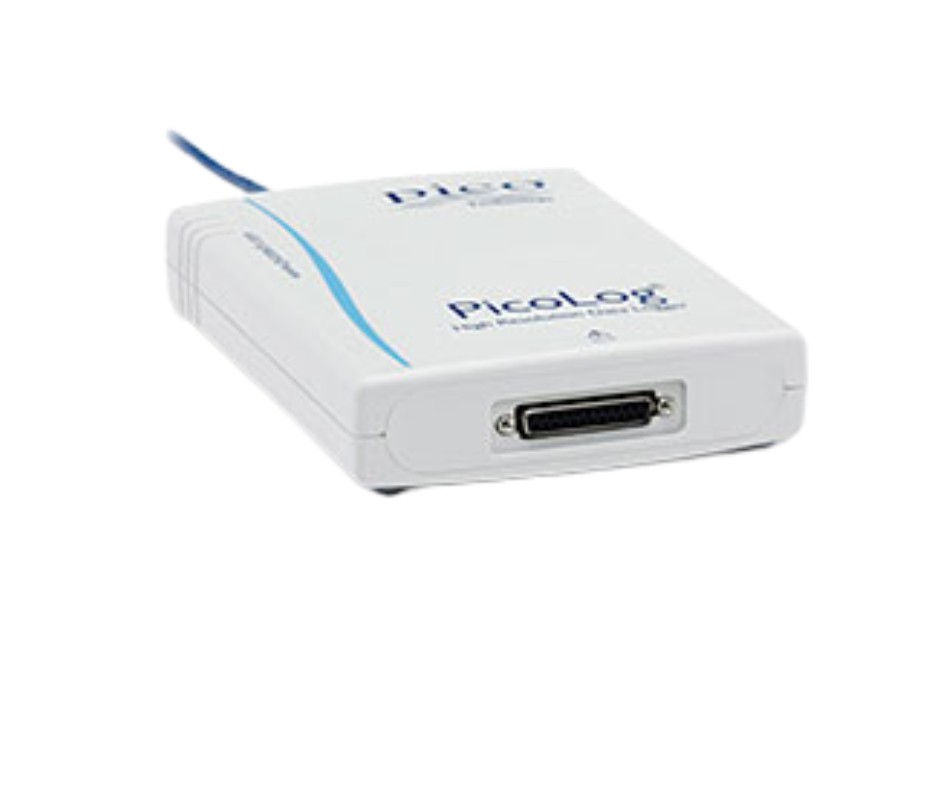
.jpg)
.jpg)
ADC-20 and ADC-24
Precision You Can Trust
NABL-Accredited Calibration | Available on Request
The Pico ADC-20 and ADC-24 Precision Data Loggers are high-resolution USB data acquisition devices designed for accurate multichannel voltage measurement. Offering 20-bit or 24-bit resolution, true differential inputs, programmable bipolar ranges, galvanic isolation, high 50/60 Hz noise rejection and PicoLog software support, they are ideal for sensor monitoring, laboratory testing, research, industrial measurements and precision DAQ applications..
- Detail
- Special Features
- Specification
The PicoLog ADC-20 and ADC-24 are precision USB data loggers developed for applications where high measurement resolution, low noise and flexible multichannel acquisition are required.
The ADC-20 provides 20-bit resolution with four true differential inputs that can alternatively be configured as up to eight single-ended channels. The ADC-24 increases resolution to 24 bits and provides eight true differential inputs or up to sixteen single-ended channels.
This flexible channel configuration allows engineers to select differential measurements for improved noise rejection or use additional single-ended channels where a larger channel count is required.
High-Resolution Voltage Measurement
The ADC-20 and ADC-24 are designed to detect very small changes in voltage.
Key model differences include:
- ADC-20: 20-bit ADC resolution
- ADC-24: 24-bit ADC resolution
- ADC-20: 4 differential or 8 single-ended inputs
- ADC-24: 8 differential or 16 single-ended inputs
- ADC-20 gain error: 0.2% of reading
- ADC-24 gain error: 0.1% on ±39 mV to ±1250 mV ranges and 0.2% on the ±2500 mV range
The higher resolution and additional low-voltage ranges of the ADC-24 make it particularly suitable for precision sensor measurements and applications involving small signal levels.
Programmable Bipolar Input Ranges
The two models have different voltage-range capabilities.
ADC-20 Input Ranges
- ±1250 mV
- ±2500 mV
ADC-24 Input Ranges
- ±39 mV
- ±78 mV
- ±156 mV
- ±312/313 mV
- ±625 mV
- ±1250 mV
- ±2500 mV
The lower ranges available on the ADC-24 allow small sensor outputs to use more of the converter's available measurement range, improving effective resolution in low-level signal applications.
True Differential and Single-Ended Inputs
Each physical differential input can be configured either as:
- One differential measurement channel, or
- Two single-ended channels
Differential measurement is useful when measuring low-level signals in electrically noisy environments because it measures the voltage difference between two inputs rather than referencing only one signal to common.
Typical applications include:
- Sensor measurements
- Bridge circuits
- Laboratory instrumentation
- Low-level voltage measurements
- Process monitoring
- Research experiments
High Noise Rejection
Pico specifies 120 dB typical noise rejection at 50/60 Hz.
This is particularly beneficial in precision measurement environments where mains-frequency interference could otherwise affect small sensor signals or long-duration voltage measurements.
Galvanic Isolation from the Computer
The ADC-20 and ADC-24 provide galvanic isolation between the measurement inputs and PC ground up to ±30 V.
The analog ground and digital ground are also isolated.
This isolation helps reduce measurement problems caused by ground loops and electrical noise transferred through the connected computer.
The units do not provide channel-to-channel isolation, so this distinction should be considered when planning measurements involving multiple independent electrical systems.
Selectable Conversion Speed
Both models support software-selectable conversion times per channel of:
- 660 ms
- 340 ms
- 180 ms
- 100 ms
- 60 ms
Longer conversion times provide higher noise-free resolution, while shorter conversion times allow measurements to be updated more quickly.
This allows engineers to select an appropriate balance between acquisition speed and effective measurement resolution according to the application.
Noise-Free Resolution
The effective noise-free resolution depends on the selected voltage range and conversion time.
For example, the ADC-24 can provide up to 20 bits of noise-free resolution on selected ranges at the longest conversion time.
At faster conversion rates, effective noise-free resolution is reduced, allowing users to trade resolution for speed according to measurement requirements.
ADC-24 Digital I/O
The ADC-24 includes four bidirectional digital I/O channels.
These use 3.3 V CMOS levels and can be used in compatible applications for functions such as:
- Alarm control
- External switching
- Test automation
- Digital status monitoring
- Trigger-related control
- Interfacing with external circuits
The ADC-20 does not include digital I/O channels.
Reference Voltage Outputs
Both models provide reference outputs that can be useful when powering or interfacing suitable sensor circuits:
- +2.5 V ±2.5 mV at 2 mA
- +5 V ±1.0 V at 2 mA
- −5 V ±1.5 V at 2 mA
These reference outputs can support compatible signal-conditioning and sensor circuits within the manufacturer's stated current limits.
Optional ADC-20/ADC-24 Terminal Board
Pico offers a dedicated ADC-20/ADC-24 Terminal Board for easier sensor and signal connection.
The terminal board provides screw-terminal connections so that sensor wires can be attached without soldering. It also provides space for additional components that can be used to create signal-conditioning circuits.
Typical uses include:
- Temperature measurement circuits
- Voltage-divider networks
- Sensor interfacing
- Custom signal conditioning
- Educational experiments
- Prototype DAQ systems
The terminal board is an accessory and should only be described as included when the selected package specifically contains it.
PicoLog 6 Data Logging Software
The ADC-20 and ADC-24 work with PicoLog 6, Pico Technology's data acquisition and logging software.
PicoLog 6 supports:
- Real-time data acquisition
- Graph and table displays
- Multiple measurement channels
- Calculated channels
- Channel scaling
- Programmable alarms
- Capture annotations
- Multiple graph axes
- Long-duration PC logging
- CSV export
- PDF reporting
- Multiple Pico data loggers on one computer
PicoLog also supports mixed systems containing different compatible Pico data loggers.
PicoLog Cloud
The ADC-20 and ADC-24 support PicoLog Cloud, allowing measurement captures to be uploaded to Pico's cloud service.
Data can then be shared through a browser-accessible link on:
- PCs
- Smartphones
- Tablets
Pico also provides a Cloud API that can transfer live captured data into compatible third-party software or databases.
This can be useful for remote data review, distributed engineering teams and connected monitoring applications.
PicoSDK for Custom DAQ Applications
Pico provides PicoSDK software drivers and programming support, allowing the ADC-20 and ADC-24 to be integrated into custom measurement applications.
Typical uses include:
- Automated test equipment
- Custom laboratory software
- Industrial monitoring systems
- Production test applications
- Research instrumentation
- Database-integrated DAQ systems
Typical Applications
The Pico ADC-20 and ADC-24 are suitable for:
- Precision voltage measurement
- Multichannel data acquisition
- Sensor and transducer monitoring
- Low-level signal measurement
- Laboratory research
- Industrial process monitoring
- Environmental measurements
- Electronic design verification
- Battery and power-system experiments
- Educational laboratories
- Long-duration data logging
- Production test systems
- Automated measurement systems
- Scientific experiments
- Custom DAQ applications
Up to 24-Bit Resolution
The ADC-24 provides 24-bit converter resolution, while the ADC-20 provides 20-bit resolution.
This high-resolution architecture is intended for applications where small voltage changes need to be observed accurately.
Up to 16 Single-Ended Inputs
The series provides flexible channel configurations:
- ADC-20: 4 differential or 8 single-ended
- ADC-24: 8 differential or 16 single-ended
Users can also combine differential and single-ended channels within the available physical inputs.
Seven Voltage Ranges on ADC-24
The ADC-24 offers seven programmable bipolar ranges from:
- ±39 mV to ±2500 mV
The ADC-20 supports:
- ±1250 mV
- ±2500 mV
The additional ADC-24 ranges make it better suited to low-level sensor and instrumentation signals.
120 dB Typical 50/60 Hz Noise Rejection
Both devices provide 120 dB typical rejection of 50 Hz and 60 Hz interference, helping improve measurement stability where mains-frequency noise is present.
True Differential Measurement
True differential inputs help reject common-mode interference and are valuable for low-level voltage measurements where the signal cannot be reliably measured relative to a single common reference.
Galvanic USB Isolation
The measurement input circuitry is galvanically isolated from earth ground up to ±30 V.
This helps reduce noise pickup and ground-loop problems caused by the connected PC.
Flexible Conversion Time
Users can select conversion times between:
- 60 ms and 660 ms per channel
This allows the measurement configuration to be optimized for either faster acquisition or higher noise-free resolution.
Four Digital I/O Channels on ADC-24
The ADC-24 includes:
- 4 bidirectional 3.3 V CMOS digital I/O channels
These can support compatible control and automation applications.
The ADC-20 does not provide digital I/O.
±30 V Input Protection
Pico specifies:
- ±30 V overvoltage protection between any input and common
- ±30 V common-to-earth-ground range
This protection specification should not be interpreted as the normal measurement range. The normal measurement ranges remain a maximum of ±2.5 V.
USB Powered
Both devices are powered directly from the computer USB port and require a maximum of approximately:
- 100 mA
No separate external power adapter is required for normal logger operation.
Permanently Attached USB Cable
The ADC-20 and ADC-24 include a permanently attached USB cable approximately:
- 4.4 m
- 13.8 ft
This provides additional flexibility when locating the logger away from the host computer.
PicoLog Cloud Support
PicoLog Cloud enables browser-based sharing and remote access to compatible logged datasets without requiring recipients to install PicoLog software.
Optional Calibration Service
Pico offers an optional calibration service referenced to national standards.
A calibration certificate records measured errors at the time of calibration and can be useful for scientific, laboratory or industrial applications where documented measurement traceability is required.
Five-Year Warranty
Pico Technology currently specifies a 5-year warranty for the ADC-20 and ADC-24.
Model Comparison
| Specification | ADC-20 | ADC-24 |
|---|---|---|
| Product Type | Precision USB Data Logger | Precision USB Data Logger |
| ADC Resolution | 20 bits | 24 bits |
| Differential Inputs | 4 | 8 |
| Maximum Single-Ended Inputs | 8 | 16 |
| Voltage Ranges | ±1250 mV, ±2500 mV | ±39, ±78, ±156, ±312/313, ±625, ±1250, ±2500 mV |
| Gain Error | 0.2% of reading | 0.1% on ±39 to ±1250 mV; 0.2% on ±2500 mV |
| Conversion Time per Channel | 60 to 660 ms | 60 to 660 ms |
| Typical 50/60 Hz Noise Rejection | 120 dB | 120 dB |
| Digital I/O | None | 4 bidirectional, 3.3 V CMOS |
| Galvanic Isolation to Ground | Up to ±30 V | Up to ±30 V |
| Power | USB powered | USB powered |
| Warranty | 5 years | 5 years |
Input Specifications
| Specification | Details |
| Input Configuration | True differential or single-ended |
| Differential Input Impedance | 2 MΩ |
| Single-Ended Input Impedance | 1 MΩ |
| Maximum Measurement Range | ±2.5 V |
| ADC-20 Available Ranges | ±1250 mV, ±2500 mV |
| ADC-24 Available Ranges | ±39 mV to ±2500 mV, 7 ranges |
| Common-Mode Range, Channel to Common | ±1.9 V on ±39 mV to ±1250 mV ranges; ±3.0 V on ±2500 mV range |
| Common to Earth Ground | ±30 V |
| Overvoltage Protection | ±30 V between any input and common |
| Channel-to-Common CMRR | 95 dB, DC to 60 Hz |
| Common-to-Earth CMRR | >125 dB, DC to 60 Hz |
| 50/60 Hz Noise Rejection | 120 dB typical |
Official input and isolation specifications:
Conversion Time and Noise-Free Resolution
Available conversion times per channel are:
- 660 ms
- 340 ms
- 180 ms
- 100 ms
- 60 ms
At the 660 ms setting, noise-free resolution can reach approximately:
| Voltage Range | Noise-Free Resolution |
| ±39 mV | 17 bits |
| ±78 mV | 18 bits |
| ±156 mV | 19 bits |
| ±313 mV | 20 bits |
| ±625 mV | 20 bits |
| ±1250 mV | 20 bits |
| ±2500 mV | 20 bits |
The ±39 mV through ±625 mV ranges shown above apply only where supported by the ADC-24.
ADC-24 Digital I/O Specifications
| Specification | ADC-24 |
| Digital I/O Channels | 4 bidirectional |
| Logic Type | 3.3 V CMOS |
| Output High | >2.40 V |
| Output Low | <0.40 V |
| Input High | >2.20 V |
| Input Low | <0.88 V |
The ADC-20 has no digital I/O channels.
Reference Output Specifications
| Output | Specification |
| +2.5 V Reference | +2.5 V ±2.5 mV @ 2 mA |
| +5 V Reference | +5 V ±1.0 V @ 2 mA |
| −5 V Reference | −5 V ±1.5 V @ 2 mA |
Physical and General Specifications
| Specification | Details |
| I/O Connector | 25-way D female |
| PC Connection | USB |
| Power Requirement | USB powered, 100 mA maximum |
| USB Cable | Permanently attached, approximately 4.4 m |
| Dimensions | 135 × 184 × 36 mm |
| Weight | Approximately 505 g |
| Warranty | 5 years |
| Compliance | European EMC and LVD standards; FCC Part 15 Class A |
Environmental Specifications
| Specification | Details |
| Temperature for Quoted Accuracy | 20 °C to 30 °C |
| Operating Temperature | 0 °C to 45 °C |
| Storage Temperature | −20 °C to +60 °C |
| Operating Humidity | 5% to 80% RH, non-condensing |
| Storage Humidity | 5% to 95% RH, non-condensing |
Software Compatibility
| Specification | Details |
| Data Logging Software | PicoLog 6 |
| Custom Programming | PicoSDK |
| Cloud Functionality | PicoLog Cloud |
| Windows | Windows 10 and Windows 11, 64-bit |
| macOS | macOS 14 Sonoma or later, 64-bit |
| Linux | 64-bit Linux |
| Raspberry Pi | PicoLog 6 support is separately documented by Pico for compatible Raspberry Pi / Raspbian systems |
| Required Computer Interface | USB 2.0 or compatible USB connection |