
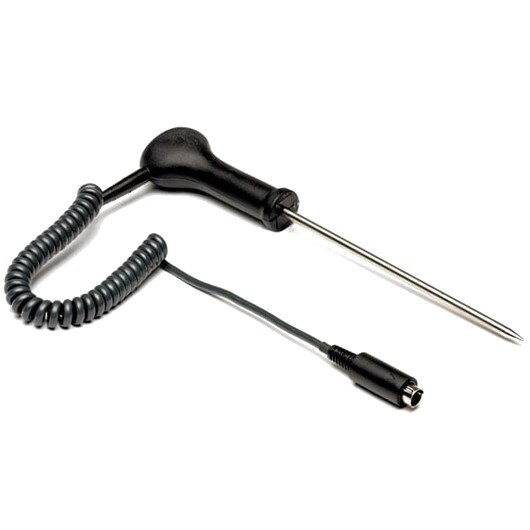
PT100 probe, insertion, class A, 1 m
Precision You Can Trust
NABL-Accredited Calibration | Available on Request
The Pico SE015 PT100 Insertion Probe is a Class A platinum resistance thermometer designed for accurate insertion temperature measurements. It offers a −75 °C to +250 °C temperature range, ±0.15 °C accuracy at 0 °C, a 120 mm × 3.3 mm stainless-steel probe, 1 m coiled PVC cable, four-wire construction, integrated handle and 4-pin mini-DIN connector for compatible Pico temperature data-logging systems..
- Detail
- Special Features
- Specification
The Pico SE015 PT100 Insertion Probe, Class A, 1 m is designed for engineers, laboratories, research teams and test environments that require reliable temperature measurement by inserting the sensing probe into a suitable measurement point.
Pico Technology specifies the SE015 as a Class A accuracy platinum resistance thermometer probe for insertion applications.
Its key manufacturer specifications include:
- Order Code: SE015
- Sensor Type: PT100 platinum resistance thermometer
- Probe Type: Insertion
- Accuracy Class: Class A
- Accuracy at 0 °C: ±0.15 °C
- Temperature Range: −75 °C to +250 °C
- Probe Length: 120 mm
- Probe Diameter: 3.3 mm
- Cable Length: 1 m coiled
- Probe Material: Stainless steel
- Cable Material: PVC
- Wiring: 4-wire
- Connector: 4-pin mini-DIN
- Handle: Yes
Class A PT100 Temperature Measurement
The SE015 uses a PT100 platinum resistance sensing element with a manufacturer-specified Class A accuracy of:
- ±0.15 °C at 0 °C
Class A performance makes the probe suitable for engineering and laboratory applications where reliable and repeatable temperature measurement is required.
Typical uses can include:
- Laboratory temperature testing
- Engineering experiments
- Product thermal evaluation
- Equipment testing
- Research and development
- Quality-control measurements
- Temperature data logging
- Suitable insertion measurement points in test assemblies
−75 °C to +250 °C Measurement Range
Pico specifies an operating measurement range of:
- Minimum temperature: −75 °C
- Maximum temperature: +250 °C
This broad range supports both sub-zero and elevated-temperature measurement applications.
The complete measurement setup should remain within the probe's specified range and be suitable for the physical construction of the sensor, cable and handle.
Designed Specifically for Insertion Measurements
The SE015 is specifically described by Pico as an insertion probe.
Its stainless-steel sensing stem can be inserted into suitable measurement locations where direct contact with the test object is required.
Possible engineering uses include:
- Temperature measurement inside suitable test fixtures
- Thermal characterization of test objects
- Product-development experiments
- Laboratory insertion measurements
- Equipment temperature validation
The probe should only be inserted where its dimensions and physical construction are suitable for the application.
Important Difference from an Immersion Probe
The SE015 should not automatically be described as an immersion probe.
Pico sells a separate model, SE014, specifically identified as a PT100 immersion probe.
For this reason, the SE015 product page should focus on insertion applications, rather than broadly claiming suitability for liquid immersion unless Pico explicitly approves the intended installation.
This distinction improves both technical accuracy and product selection.
120 mm Stainless-Steel Probe
The SE015 sensing stem is specified as:
- Length: 120 mm
- Diameter: 3.3 mm
- Material: Stainless steel
The relatively narrow probe diameter makes it suitable for insertion into compatible measurement locations where a slim temperature probe is required.
The 120 mm length provides useful insertion reach for laboratory and engineering applications.
1 m Coiled PVC Cable
Pico specifies the SE015 with:
- Cable length: 1 metre
- Cable form: Coiled
- Cable material: PVC
The coiled cable provides flexibility between the measurement point and the connected data logger while helping reduce loose cable around a test setup when the full extension is not needed.
This can be useful on:
- Laboratory benches
- Engineering test stations
- Product-development setups
- Research experiments
- Temperature-logging systems
Four-Wire PT100 Construction
The SE015 uses a 4-wire PT100 connection.
Four-wire resistance measurement allows a compatible temperature instrument to compensate for resistance in the probe leads.
This is important because PT100 temperature measurement is based on small changes in electrical resistance. Lead resistance can otherwise introduce additional measurement error.
The four-wire configuration therefore supports more accurate PRT measurement when used with compatible instrumentation.
4-Pin Mini-DIN Connector
The probe is fitted with a:
- 4-pin mini-DIN connector
This enables direct connection to compatible Pico PRT measurement hardware.
The connector should be described precisely as 4-pin mini-DIN. DIN accuracy classifications and mini-DIN connector types are separate specifications.
For the SE015:
- Accuracy classification: Class A
- Physical connector: 4-pin mini-DIN
Integrated Probe Handle
Pico specifies:
- Handle: Yes
The integrated handle makes the SE015 convenient for insertion measurements where the probe may need to be positioned, removed and repositioned manually.
This distinguishes it from fixed probe styles supplied without a handle.
Recommended for Pico PT-104
Pico lists the SE015 as a recommended accessory for the PT-104 High-Accuracy Temperature Data Logger.
The PT-104 provides four PRT measurement channels and supports standard PT100 and PT1000 sensors.
Using the SE015 with the PT-104 creates a suitable measurement system for:
- Insertion temperature logging
- Engineering development
- Laboratory experiments
- Product testing
- Research applications
- Multi-point thermal measurement
- Long-duration temperature recording
Multiple SE015 probes can be connected to available PT-104 channels for simultaneous measurements.
Probe Accuracy and Overall System Accuracy
The published ±0.15 °C at 0 °C specification applies to the SE015 probe.
The total accuracy of a complete temperature-measurement system also depends on:
- Data logger accuracy
- Probe tolerance at the measured temperature
- Probe insertion depth
- Thermal contact
- Measurement environment
- Calibration status
- Heat transfer between the probe and test object
For precision measurements, the complete measurement chain should therefore be considered rather than using the probe's Class A specification alone.
Typical Applications
The Pico SE015 is suitable for:
- PT100 insertion temperature measurement
- Laboratory testing
- Engineering development
- Product thermal testing
- Temperature data logging
- Research experiments
- Equipment temperature validation
- Quality-control measurements
- Prototype testing
- Multi-point temperature monitoring
- Educational laboratory experiments
- PT-104 temperature-logging systems
Class A Accuracy
The SE015 provides:
- Accuracy Class: Class A
- Accuracy at 0 °C: ±0.15 °C
This is the correct manufacturer specification and should replace the current Class B information.
PT100 Platinum Resistance Sensor
The probe uses a PT100 platinum resistance thermometer for resistance-based temperature measurement.
PT100 sensors are widely used in industrial, scientific and laboratory applications because of their standardized temperature-resistance characteristics.
Wide −75 °C to +250 °C Range
Pico specifies:
- −75 °C to +250 °C
This is broader at the low-temperature end than the −50 °C to +250 °C range currently shown on the RevineTech page.
Purpose-Built Insertion Probe
Pico specifically identifies the SE015 for:
- Insertion applications
The page should therefore position it as an insertion temperature probe rather than a generic PT100 sensor.
120 mm Probe Length
The stainless-steel sensing stem has a length of:
- 120 mm
This provides useful insertion depth for compatible test locations.
3.3 mm Probe Diameter
The SE015 has a manufacturer-specified diameter of:
- 3.3 mm
This slim diameter should be considered when selecting insertion points, fixtures or test openings.
Stainless-Steel Probe
Pico specifies:
- Probe material: Stainless steel
This is preferable to generic claims such as “robust construction” because it provides the exact manufacturer-published material.
Four-Wire Connection
The probe uses:
- 4 wires
Four-wire measurement enables compatible instrumentation to compensate for lead resistance, supporting more accurate PT100 measurements.
1 m Coiled Cable
The SE015 includes:
- 1 m coiled cable
The coiled format provides flexible probe positioning while helping keep the test setup organized.
PVC Cable Construction
Pico specifies:
- Cable material: PVC
Cable routing and exposure should remain compatible with the cable material and intended measurement conditions.
4-Pin Mini-DIN Connector
The physical connector is:
- 4-pin mini-DIN
This enables direct connection to compatible Pico PRT measurement equipment.
Integrated Handle
The probe includes:
- Handle: Yes
The handle supports convenient manual insertion and repositioning during test and laboratory measurements.
Recommended PT-104 Accessory
Pico officially lists the SE015 among the recommended sensors for its PT-104 High-Accuracy Temperature Data Logger.
SE015 vs SE014 Immersion Probe
| Feature | SE015 Insertion Probe | SE014 Immersion Probe |
|---|---|---|
| Primary Probe Type | Insertion | Immersion |
| Accuracy Class | Class A | Class A |
| Accuracy at 0 °C | ±0.15 °C | ±0.15 °C |
| Temperature Range | −75 °C to +250 °C | −75 °C to +250 °C |
| Cable Length | 1 m | 1 m |
| Probe Material | Stainless steel | Stainless steel |
| Cable Material | PVC | PVC |
| Primary Selection Reason | Insertion measurement | Immersion measurement |
Choose the probe according to the physical measurement method required rather than treating insertion and immersion probes as interchangeable.
Technical Specifications
| Specification | Details |
| Manufacturer | Pico Technology |
| Model / Order Code | SE015 |
| Product Name | PT100 Probe, Insertion, Class A, 1 m |
| Product Type | Platinum Resistance Thermometer / PT100 Insertion Probe |
| Sensor Type | PT100 |
| Probe Type | Insertion |
| Accuracy Class | Class A |
| Accuracy at 0 °C | ±0.15 °C |
| Temperature Range | −75 °C to +250 °C |
| Probe Length | 120 mm |
| Probe Diameter | 3.3 mm |
| Cable Length | 1 m |
| Cable Configuration | Coiled |
| Probe Material | Stainless steel |
| Cable Material | PVC |
| Connector | 4-pin mini-DIN |
| Number of Wires | 4 |
| Handle | Yes |
| PT-104 Compatibility | Recommended accessory |
| Primary Application | Insertion temperature measurement |