

PicoScope® 6000E Series MSO USB Oscilloscopes
Precision You Can Trust
NABL-Accredited Calibration | Available on Request
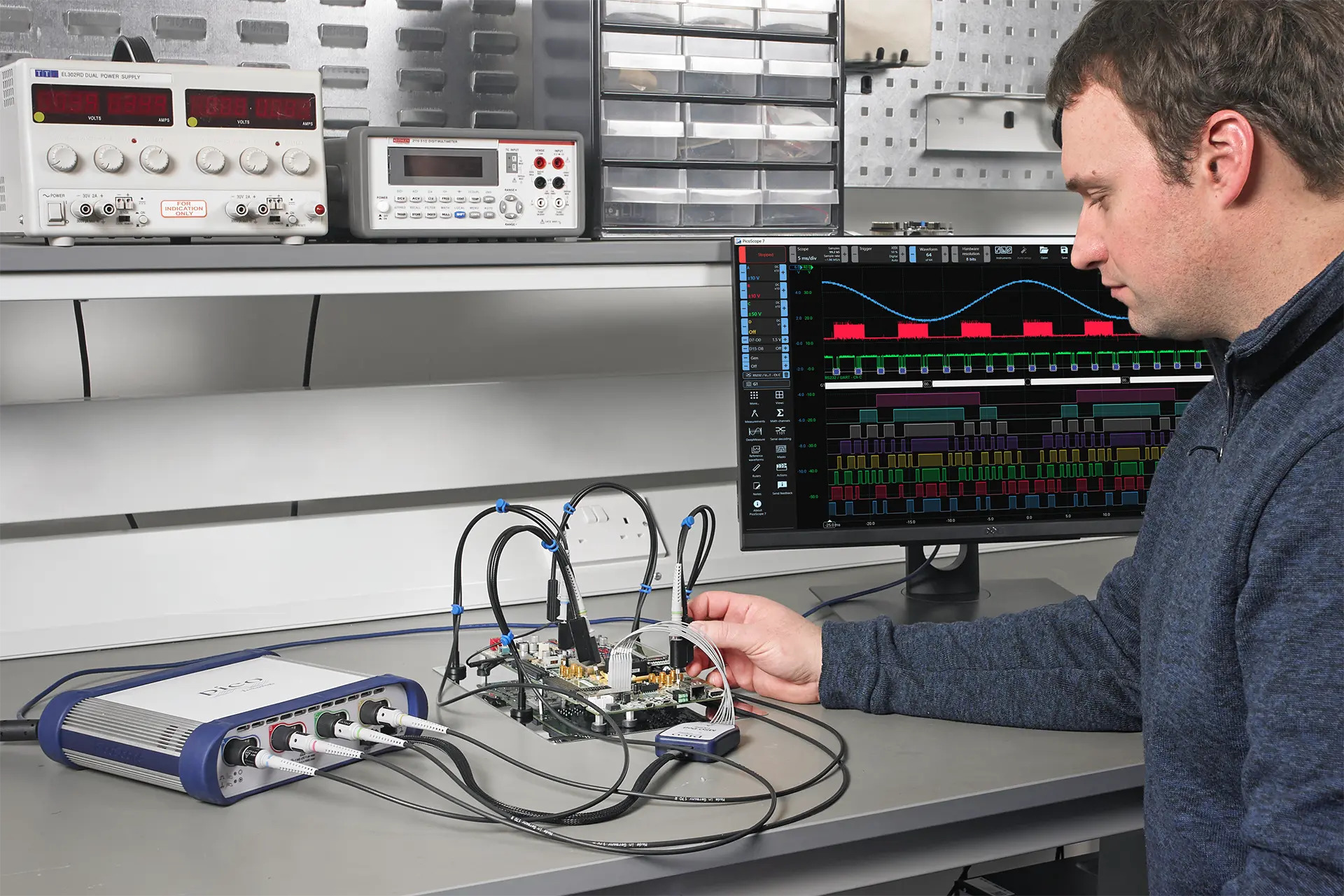
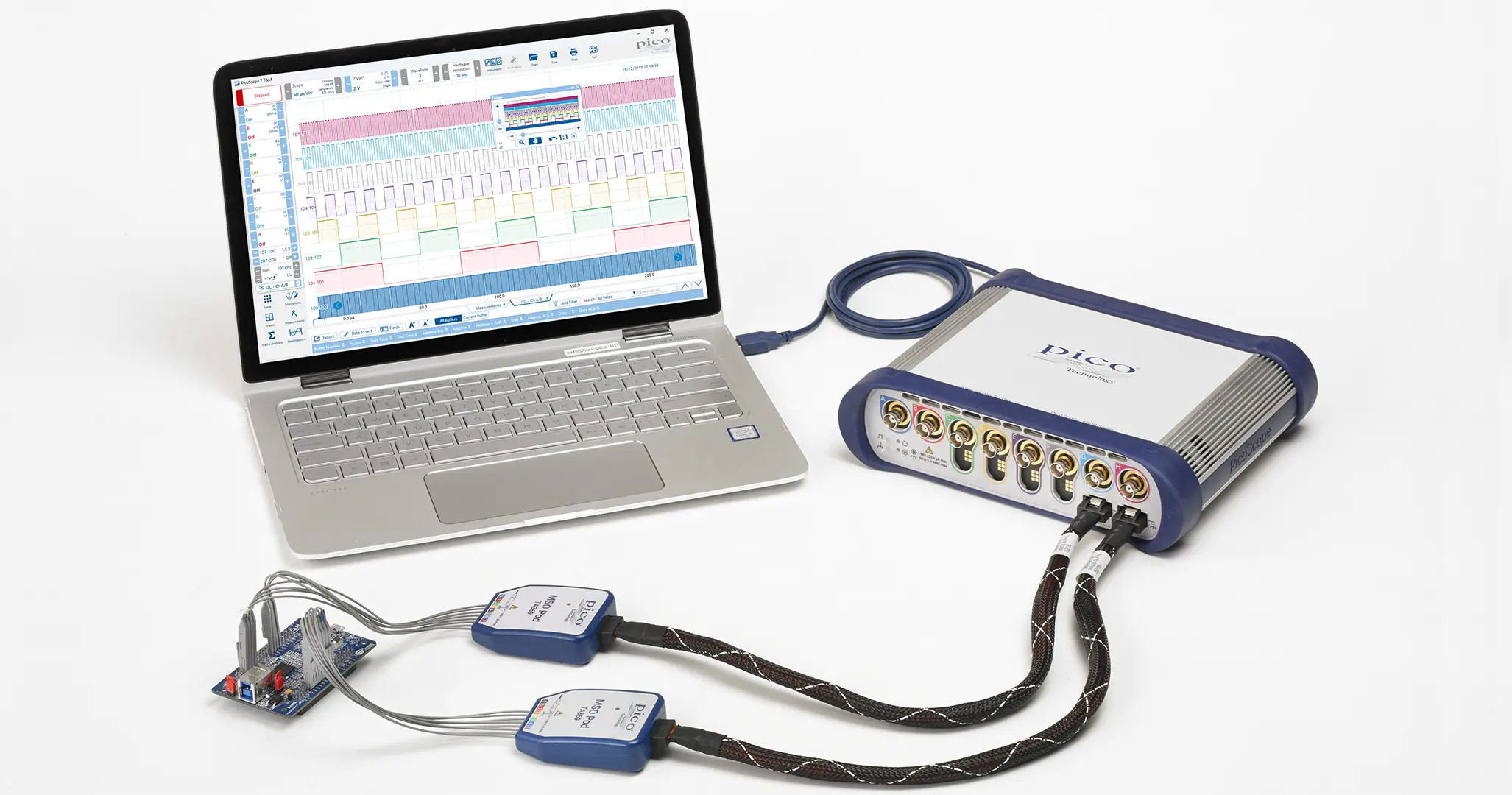
The PicoScope 6000E Series is a high-performance USB oscilloscope range offering four or eight analogue channels, 300 MHz to 3 GHz bandwidth, fixed 8-bit or FlexRes 8-bit to 12-bit acquisition, up to 10 GS/s real-time sampling and up to 4 GS capture memory. Optional TA369 MSO pods add up to 16 digital channels for embedded-system debugging, serial bus analysis, power electronics, signal integrity and automated testing..
- Detail
- Special Features
- Specification
The PicoScope 6000E Series MSO USB Oscilloscope is designed for engineers, researchers, electronics manufacturers and test laboratories that require high bandwidth, multiple analogue channels and exceptionally deep capture memory.
Depending on the selected model, the series provides:
- Four or eight analogue input channels
- 300 MHz to 3 GHz analogue bandwidth
- Fixed 8-bit or selectable 8-bit, 10-bit and 12-bit FlexRes resolution
- Up to 10 GS/s real-time sampling
- 1 GS to 4 GS capture memory
- Up to 16 optional digital channels
- Built-in 50 MHz function generator
- Built-in 14-bit, 200 MS/s arbitrary waveform generator
- Rapid triggering and segmented acquisition
- Serial protocol decoding
- Spectrum analysis
- PicoScope 7 software
- PicoSDK support for custom applications
The PicoScope 6000E Series is suitable for embedded-system development, high-speed digital design, power electronics, communications testing, automotive electronics, multi-channel signal analysis and automated production validation.
PicoScope 6000E Model Range
| Model | Analogue Channels | Bandwidth | Hardware Resolution | Capture Memory |
|---|---|---|---|---|
| PicoScope 6403E | 4 | 300 MHz | 8 bits | 1 GS |
| PicoScope 6404E | 4 | 500 MHz | 8 bits | 2 GS |
| PicoScope 6804E | 8 | 500 MHz | 8 bits | 2 GS |
| PicoScope 6405E | 4 | 750 MHz | 8 bits | 2 GS |
| PicoScope 6406E | 4 | 1 GHz | 8 bits | 2 GS |
| PicoScope 6424E | 4 | 500 MHz | 8, 10 or 12 bits | 4 GS |
| PicoScope 6824E | 8 | 500 MHz | 8, 10 or 12 bits | 4 GS |
| PicoScope 6425E | 4 | 750 MHz | 8, 10 or 12 bits | 4 GS |
| PicoScope 6426E | 4 | 1 GHz | 8, 10 or 12 bits | 4 GS |
| PicoScope 6428E-D | 4 | Up to 3 GHz | 8, 10 or 12 bits | 4 GS |
The selected model should always be stated in the quotation because bandwidth, analogue channel count, resolution and capture memory vary across the series.
300 MHz to 3 GHz Analogue Bandwidth
The PicoScope 6000E Series covers a wide range of high-speed measurement requirements.
Available bandwidths include:
- 300 MHz
- 500 MHz
- 750 MHz
- 1 GHz
- Up to 3 GHz
The 3 GHz PicoScope 6428E-D is designed for faster signal-integrity, communications and semiconductor applications. Other models provide a combination of four or eight channels with bandwidth up to 1 GHz.
Typical applications include:
- High-speed microcontroller and FPGA debugging
- Clock and data signal analysis
- Switching power-supply testing
- Gate-drive waveform measurement
- Automotive communication testing
- High-speed serial interface analysis
- Semiconductor validation
- Power integrity testing
- Pulse and transient characterisation
- Multi-channel timing measurements
The PicoScope 6428E-D uses 50 Ω inputs and provides up to 3 GHz bandwidth on specified input ranges. Other PicoScope 6000E models support both 50 Ω and 1 MΩ input configurations.
Four or Eight Analogue Channels
The series includes both four-channel and eight-channel instruments.
Four-channel models support measurements such as:
- Clock, data, enable and reset
- Input voltage, input current, output voltage and output current
- High-side and low-side gate-drive signals
- Multiple power rails
- Converter input and output
- Sensor signal and controller response
Eight-channel models provide additional visibility for:
- Multi-phase power systems
- Motor-control circuits
- Complex embedded systems
- Multiple communication buses
- Multi-rail power sequencing
- Three-phase voltage and current measurements
- Multi-channel automotive electronics
- Parallel timing measurements
All active analogue and digital channels are sampled using a common acquisition timing system, helping preserve time correlation across signals.
FlexRes 8-Bit to 12-Bit Resolution
Selected PicoScope 6000E models use Pico Technology’s FlexRes architecture.
Available hardware-resolution modes include:
- 8 bits
- 10 bits
- 12 bits
FlexRes allows users to prioritise either:
- Higher sampling speed for fast digital signals
- Greater vertical detail for analogue and low-noise measurements
In 8-bit mode, the oscilloscope provides maximum sampling performance.
In 10-bit or 12-bit mode, the instrument provides improved amplitude resolution for:
- Power-rail ripple
- Sensor outputs
- Low-noise analogue circuits
- Signal distortion
- Reference-voltage stability
- Power-integrity measurements
- Small signals superimposed on larger waveforms
Software-based enhanced resolution can add up to four additional bits under suitable acquisition conditions.
Up to 10 GS/s Real-Time Sampling
Most PicoScope 6000E models provide a maximum real-time sampling rate of 5 GS/s. The PicoScope 6428E-D increases this to 10 GS/s.
The maximum sample rate depends on:
- Selected model
- Resolution mode
- Number of active analogue channels
- Number of connected MSO pods
- Channel grouping
Typical FlexRes sampling performance includes:
| Hardware Resolution | Maximum Real-Time Sampling |
|---|---|
| 8-bit mode | Up to 5 GS/s on standard models |
| 10-bit mode | Up to 5 GS/s with one active acquisition resource |
| 12-bit mode | Up to 1.25 GS/s |
| PicoScope 6428E-D | Up to 10 GS/s |
The 10 GS/s capability of the 6428E-D provides 100 ps real-time sample spacing, supporting detailed single-shot analysis of fast pulses, transitions and transient behaviour.
Up to 4 GS Capture Memory
Capture memory depends on the selected model:
- 1 GS on the PicoScope 6403E
- 2 GS on fixed 8-bit models
- 4 GS in 8-bit mode on FlexRes models
- 2 GS in 10-bit and 12-bit modes on FlexRes models
The deep memory allows engineers to record long-duration signals while retaining a high sampling rate.
Typical uses include:
- Long serial protocol captures
- Power-supply start-up sequences
- Multi-stage power sequencing
- High-speed packet analysis
- Long PWM records
- Intermittent fault investigation
- Automotive communication logging
- Semiconductor start-up testing
- Multi-channel timing analysis
A FlexRes model can capture approximately 200 ms at 5 GS/s in PicoScope 7. The PicoScope 6428E-D can maintain 10 GS/s over a long high-speed acquisition because of its 4 GS memory.
Rapid Triggering and Segmented Memory
The PicoScope 6000E Series supports rapid triggering for closely spaced waveform events.
PicoScope 7 can retain up to:
- 40,000 waveform segments
PicoSDK can support up to:
- 2,000,000 segmented captures on applicable models
Typical rapid-trigger rearm time can be approximately 300 ns under supported single-channel conditions.
Segmented acquisition is useful for:
- Communication packets
- Switching events
- Pulse trains
- Rare glitches
- Intermittent faults
- Production test cycles
- Radar and pulse applications
- Repetitive embedded events
Instead of filling memory with inactive periods, each trigger event can be stored in an individual memory segment.
Optional 8 or 16 Digital MSO Channels
The PicoScope 6000E Series can be upgraded to mixed-signal operation using optional TA369 active MSO pods.
Each TA369 pod provides:
- Eight digital inputs
- Permanently attached flying leads
- High-speed logic acquisition
- Independent threshold control
- Mixed analogue and digital triggering
The oscilloscope supports:
- One pod for eight digital channels
- Two pods for 16 digital channels
Digital input performance includes:
- Up to 500 MHz detectable input frequency
- Data rates up to approximately 1 Gb/s
- Minimum detectable pulse width of 1 ns
- ±8 V threshold range
- 5 mV threshold adjustment
- TTL, CMOS, ECL, PECL and user-defined thresholds
- Up to 16 time-correlated digital signals
The MSO pods are optional accessories and should not be described as standard unless they are included in the RevineTech package.
Serial Protocol Decoding
PicoScope 7 includes serial protocol decoding without separate paid decoder licences.
The software supports embedded, automotive, industrial and communications protocols, including:
- I²C
- SPI
- RS232/UART
- CAN
- CAN FD
- CAN J1939
- LIN
- FlexRay
- I²S
- USB
- Ethernet
- BroadR-Reach
- 10BASE-T1S
- SENT
- PSI5
- PMBus
- SMBus
- Modbus
- ARINC 429
- MIL-STD-1553
- Parallel bus
With optional MSO pods installed, the instrument can decode serial data across analogue and digital channels simultaneously.
Decoded information can be displayed:
- Directly under the waveform
- In a protocol table
- In hexadecimal, binary, decimal or ASCII
- Across stored waveform buffers
- With filtering and search conditions
Pico Technology states that PicoScope software includes more than 40 protocol decoders as standard.
Built-In 50 MHz Function Generator
All PicoScope 6000E models include a function generator.
Its maximum sine and square-wave frequency is up to:
- 50 MHz
Supported output waveforms include:
- Sine
- Square
- Triangle
- DC
- White noise
- PRBS
- User-defined sweeps
- Other standard waveforms at model-dependent frequencies
The function generator can be used for:
- Amplifier testing
- Filter testing
- Sensor simulation
- Clock generation
- Frequency-response testing
- Circuit stimulus
- Production validation
The generator also supports sweep and triggered-output operation.
Built-In 14-Bit Arbitrary Waveform Generator
Every PicoScope 6000E model includes a:
- 14-bit arbitrary waveform generator
- 200 MS/s update rate
- Variable sample clock
- User-defined waveform editor
- Waveform import and export
- Captured-waveform replay
Custom waveforms can be:
- Created in PicoScope
- Imported from CSV files
- Loaded from spreadsheets
- Derived from captured oscilloscope traces
- Edited for application-specific testing
The AWG is included as standard and should not be described as a paid software option.
Intelligent Probe Interface
Selected PicoScope 6000E models include an Intelligent Probe Interface for compatible Pico active probes.
The interface supports:
- Automatic probe recognition
- Probe power supplied by the oscilloscope
- Automatic scaling
- Automatic impedance configuration
- Probe status indication
- Capture control from a button on the probe
Compatible A3000 Series active probes include models with:
- 750 MHz probe bandwidth
- 1.3 GHz probe bandwidth
- 0.9 pF nominal input capacitance
- 1 MΩ input resistance
- 10:1 attenuation
This helps reduce loading on high-speed signals compared with a conventional passive probe.
External 10 MHz Reference Clock
The PicoScope 6000E Series includes a dedicated external reference clock input.
It supports:
- 10 MHz external reference
- Oscilloscope timebase synchronisation
- AWG clock synchronisation
- Multi-instrument timing
- Laboratory reference systems
- Automated test integration
The reference input can improve timing correlation between the oscilloscope and other test instruments.
Advanced Digital Triggering
Pico’s digital triggering system operates on digitised waveform data.
Trigger types include:
- Edge
- Window
- Pulse width
- Window pulse width
- Dropout
- Interval
- Runt pulse
- Rise and fall time
- Logic
- Mixed analogue and digital pattern
- Digital input conditions with MSO pods
The trigger system supports:
- Adjustable hysteresis
- Full-bandwidth triggering
- Pre-trigger capture
- Long post-trigger delay
- Logic combinations across several channels
- Rapid segmented acquisition
These functions help isolate rare and complex signal conditions.
DeepMeasure Analysis
DeepMeasure uses the series’ deep memory to perform cycle-by-cycle analysis across long acquisitions.
It can calculate parameters such as:
- Frequency
- Period
- Pulse width
- Duty cycle
- Rise time
- Fall time
- Maximum voltage
- Minimum voltage
- Amplitude
- Overshoot
- Undershoot
- Timing variation
Results can be:
- Sorted
- Filtered
- Correlated with the waveform
- Exported to CSV
- Used to locate abnormal cycles
DeepMeasure is useful for clock stability, PWM analysis, serial timing, production validation and intermittent fault investigation.
Spectrum Analysis
PicoScope 7 includes FFT spectrum-analysis functions.
Applications include:
- Harmonic analysis
- Clock spectrum measurement
- Switching-frequency analysis
- Noise-source identification
- Amplifier and filter testing
- EMI troubleshooting
- Distortion measurement
- Detection of unwanted oscillations
The integrated AWG can be used with spectrum mode for swept frequency-response testing.
Mask Limit Testing
Mask testing compares acquired waveforms against a defined reference envelope.
Users can:
- Automatically generate a mask
- Count pass and fail events
- Store failed waveforms
- Search the waveform buffer
- Stop acquisition after failure
- Save screenshots or waveform files
- Trigger the AWG or an external program
This function supports production-line testing, long-duration monitoring and repetitive signal validation.
PicoScope 7 Software
PicoScope 7 provides:
- Oscilloscope views
- Spectrum views
- Serial decoding
- Automatic measurements
- DeepMeasure
- Waveform mathematics
- Mask testing
- Reference waveforms
- Segmented acquisition
- Waveform buffer navigation
- Custom probe scaling
- Automated actions
- Multiple waveform windows
PicoScope 7 is available for Windows, macOS and Linux, although availability of particular high-performance modes may depend on the operating system and driver configuration. Pico Technology supplies software updates without separate feature-unlock charges.
PicoSDK and Automated Testing
PicoSDK provides programming access to the oscilloscope for:
- Automated production testing
- Custom measurement applications
- Semiconductor validation
- Research data acquisition
- OEM integration
- Long-duration recording
- Custom protocol analysis
- Multi-instrument systems
Supported development environments include common C, C++, C#, Python, MATLAB and LabVIEW workflows through Pico’s drivers and examples.
Applications
The PicoScope 6000E Series is suitable for:
- High-speed embedded-system development
- FPGA and CPLD debugging
- Signal-integrity analysis
- Power electronics testing
- Switching power-supply analysis
- Semiconductor validation
- High-speed clock analysis
- Automotive electronics
- Serial protocol debugging
- Industrial control systems
- Communication-interface testing
- Multi-channel power sequencing
- Production-line validation
- Research and development
- Automated test systems
- Engineering education
Up to 3 GHz Bandwidth
Available bandwidths include:
- 300 MHz
- 500 MHz
- 750 MHz
- 1 GHz
- 3 GHz
Four or Eight Analogue Channels
The series supports:
- Four-channel high-bandwidth measurements
- Eight-channel system-level analysis
- Simultaneous multi-signal acquisition
- Complex embedded and power testing
FlexRes 8-Bit to 12-Bit Acquisition
Selected models allow users to choose:
- 8-bit mode for maximum sampling speed
- 10-bit mode for improved signal detail
- 12-bit mode for precision analogue measurements
Up to 10 GS/s Sampling
- Up to 5 GS/s on most models
- Up to 10 GS/s on the PicoScope 6428E-D
- Real-time single-shot acquisition
- Model and channel-dependent allocation
Up to 4 GS Capture Memory
Deep memory supports:
- Long high-speed recordings
- Detailed waveform zoom
- Serial packet analysis
- Intermittent fault investigation
- Power-sequence testing
Optional 16 Digital Channels
Using two TA369 MSO pods:
- Eight digital inputs per pod
- Up to 500 MHz digital input frequency
- Up to 1 Gb/s data rate
- Individually adjustable thresholds through PicoSDK
Built-In Function Generator and AWG
Every model includes:
- 50 MHz function generator
- 14-bit AWG
- 200 MS/s AWG update rate
- Custom waveform generation
- Sweep and triggered output
Serial Decoding Included
PicoScope 7 includes more than 40 protocol decoders without separate paid licences.
Rapid Triggering
- Typical rearm time down to approximately 300 ns
- Up to 40,000 waveform segments in PicoScope 7
- Up to 2 million segments through PicoSDK
Intelligent Probe Support
Compatible active probes can be:
- Automatically identified
- Powered by the oscilloscope
- Automatically scaled
- Controlled through the intelligent interface
Core Series Specifications
| Specification | PicoScope 6000E Series |
|---|---|
| Product type | High-performance USB oscilloscope and optional MSO |
| Analogue channels | 4 or 8 |
| Optional digital channels | 8 or 16 with TA369 MSO pods |
| Analogue bandwidth | 300 MHz to 3 GHz |
| Hardware resolution | Fixed 8-bit or FlexRes 8, 10 and 12 bits |
| Enhanced resolution | Up to four additional bits |
| Maximum real-time sampling | Up to 10 GS/s |
| Standard high-speed sampling | Up to 5 GS/s on most models |
| Capture memory | 1 GS to 4 GS |
| Function generator | Included, up to 50 MHz |
| AWG | Included, 14-bit, 200 MS/s |
| Waveform buffer | Up to 40,000 in PicoScope 7 |
| PicoSDK segmented captures | Up to 2,000,000 |
| External reference | 10 MHz input |
| Software | PicoScope 7 |
| SDK | PicoSDK |
| PC interface | SuperSpeed USB 3.x |
| Warranty | Five years |
Model Comparison
| Model | Analogue Channels | Bandwidth | Resolution | Memory |
|---|---|---|---|---|
| 6403E | 4 | 300 MHz | 8 bits | 1 GS |
| 6404E | 4 | 500 MHz | 8 bits | 2 GS |
| 6804E | 8 | 500 MHz | 8 bits | 2 GS |
| 6405E | 4 | 750 MHz | 8 bits | 2 GS |
| 6406E | 4 | 1 GHz | 8 bits | 2 GS |
| 6424E | 4 | 500 MHz | 8 to 12 bits | 4 GS |
| 6824E | 8 | 500 MHz | 8 to 12 bits | 4 GS |
| 6425E | 4 | 750 MHz | 8 to 12 bits | 4 GS |
| 6426E | 4 | 1 GHz | 8 to 12 bits | 4 GS |
| 6428E-D | 4 | Up to 3 GHz | 8 to 12 bits | 4 GS |
Analogue Input System
| Specification | Details |
|---|---|
| Input connectors | BNC |
| Input impedance | 1 MΩ or 50 Ω on most models |
| PicoScope 6428E-D input | 50 Ω only |
| Input coupling | AC/DC at 1 MΩ, DC at 50 Ω |
| Typical input ranges | ±10 mV to ±20 V, model and impedance dependent |
| Selectable bandwidth limits | 20 MHz and 200 MHz on applicable models |
| Analogue offset | Supported |
| Simultaneous sampling | Supported across active channels |
FlexRes Sampling
| Resolution Mode | Maximum Sampling |
|---|---|
| 8-bit | Up to 5 GS/s on standard FlexRes models |
| 10-bit | Up to 5 GS/s with one active acquisition resource |
| 12-bit | Up to 1.25 GS/s |
| PicoScope 6428E-D | Up to 10 GS/s, mode-dependent |
Sample rate reduces as additional analogue channels and MSO pods are enabled.
Capture Memory
| Model Category | 8-Bit Memory | 10/12-Bit Memory |
|---|---|---|
| Fixed-resolution models | 1 GS or 2 GS | Not applicable |
| FlexRes models | Up to 4 GS | Up to 2 GS |
| PicoScope 6428E-D | 4 GS | 2 GS |
Memory is shared between active analogue channels and MSO ports.
Optional Digital Input System
| Specification | TA369 MSO Pod |
|---|---|
| Digital channels per pod | 8 |
| Maximum pods | 2 |
| Maximum digital channels | 16 |
| Maximum detectable frequency | 500 MHz |
| Maximum data rate | Approximately 1 Gb/s |
| Minimum pulse width | 1 ns |
| Threshold range | ±8 V |
| Threshold resolution | 5 mV |
| Input impedance | Approximately 101 kΩ with 3.5 pF |
| Threshold presets | TTL, CMOS, ECL and PECL |
| Maximum input protection | Frequency-dependent, up to ±40 V at lower frequencies |
Function Generator and AWG
| Specification | Details |
|---|---|
| Function generator | Included |
| Maximum sine frequency | 50 MHz |
| Maximum square frequency | 50 MHz |
| AWG resolution | 14 bits |
| AWG update rate | 200 MS/s |
| Frequency sweep | Supported |
| Triggered output | Supported |
| Custom waveform editor | Included |
| CSV import and export | Supported |
| Captured-waveform replay | Supported |
Software and Analysis
| Function | Capability |
|---|---|
| PicoScope software | PicoScope 7 |
| Serial protocol decoding | More than 40 protocols |
| DeepMeasure | Supported |
| Spectrum analysis | Supported |
| Mask testing | Supported |
| Waveform mathematics | Supported |
| Advanced digital triggering | Supported |
| Reference waveforms | Supported |
| Automated actions | Supported |
| Waveform buffer | Up to 40,000 captures |
| Custom applications | PicoSDK |