
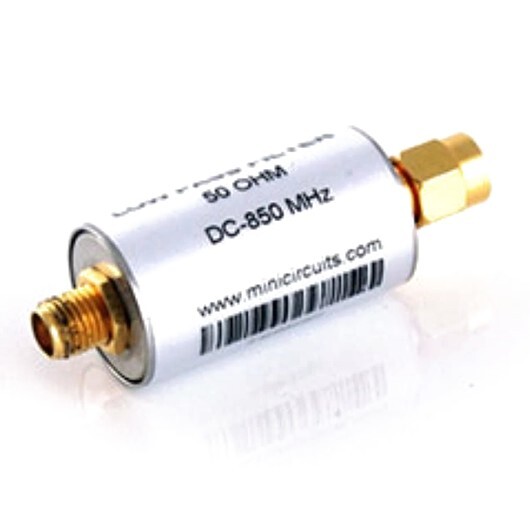
Bessel-Thomson reference filter 155 Mb/s
Precision You Can Trust
NABL-Accredited Calibration | Available on Request
The TA121 is a Bessel-Thomson reference receiver filter designed for 155 Mb/s OC3/STM1 optical communication signals. Installed between an optical-to-electrical converter and the oscilloscope input, it reduces unwanted peaking and ringing and helps reproduce the response of an equalised optical receiver. The filter is suitable for optical eye-diagram analysis, signal characterisation and standards-oriented testing with compatible PicoScope sampling oscilloscopes..
- Detail
- Special Features
- Specification
The TA121 Bessel-Thomson Reference Filter is designed for engineers working with optical communication systems where accurate time-domain characterisation of 155 Mb/s OC3/STM1 signals is required.
In an optical test setup, the optical signal is first converted into an electrical waveform using an optical-to-electrical converter. The TA121 is then connected between the converter output and the oscilloscope input.
Pico Technology states that this arrangement helps the oscilloscope display a representation of the signal that an equalised optical receiver would see. This is particularly important for optical eye-diagram and waveform measurements where excessive receiver bandwidth can otherwise exaggerate high-frequency components, peaking or ringing.
The TA121 is part of Pico Technology's family of Bessel-Thomson reference receiver filters for standard serial data rates.
Designed for 155 Mb/s OC3/STM1
The TA121 is specifically matched to:
- 155 Mb/s nominal data rate
- OC3
- STM1
- SONET/SDH optical transmission testing
Pico's product family assigns a separate Bessel-Thomson filter to each supported communication rate. TA121 is the model intended for the 155 Mb/s OC3/STM1 application.
What a Bessel-Thomson Filter Does
A Bessel-Thomson reference receiver filter provides a controlled frequency response that approximates the response defined for optical communication receivers.
Its purpose is not simply to remove noise. It shapes the overall measurement bandwidth so the captured waveform better represents how a compliant receiver responds to the transmitted signal.
This helps reduce:
- Excessive waveform peaking
- High-frequency ringing
- Unrealistically sharp transitions
- Measurement differences caused by excessive oscilloscope bandwidth
- Eye-diagram distortion caused by an incorrect receiver response
Pico specifically states that its Bessel-Thomson filters are used to reduce peaking and ringing and are selected according to the bit rate being analysed.
Optical Signal Characterisation
The TA121 is intended for optical transmission testing after optical-to-electrical conversion.
A typical measurement chain is:
Optical transmitter → Optical fibre → O/E converter → TA121 Bessel-Thomson filter → Sampling oscilloscope
This configuration is useful for evaluating:
- Optical eye diagrams
- Rise and fall times
- Pulse shape
- Overshoot
- Undershoot
- Timing quality
- Signal amplitude
- Receiver-oriented waveform behaviour
- SONET/SDH transmitter performance
The filter provides the required reference receiver response before the electrical waveform reaches the oscilloscope.
OC3 and STM1 Applications
OC3 and STM1 represent closely related SONET and SDH transmission levels operating around 155 Mb/s.
The TA121 is therefore suitable for measurements involving:
- SONET OC3 transmitters
- SDH STM1 transmitters
- Fibre-optic communication modules
- Optical transceivers
- Telecom line cards
- Optical receiver development
- Fibre transmission test systems
- Optical component validation
- Research and educational telecom laboratories
Pico lists TA121 explicitly as the 155 Mb/s OC3/STM1 filter in its reference receiver filter table.
Compatible PicoScope Systems
Pico Technology currently identifies the Bessel-Thomson reference filter range for use with:
- PicoScope 9221A
- PicoScope 9231A
- PicoScope 9321
These oscilloscopes incorporate or support optical-to-electrical measurement functions suitable for optical communication characterisation.
Older PicoScope 9200A documentation also identifies TA121 for use with the optical-to-electrical converter on the PicoScope 9221A and 9231A.
Use with Optical-to-Electrical Converters
The TA121 is an electrical reference filter. It is not connected directly to an optical fibre.
The optical signal must first pass through an optical-to-electrical converter.
The converted electrical signal is then routed through the TA121 before entering the oscilloscope.
This distinction should be clear on the product page because the TA121 is:
- Not an optical filter
- Not a fibre-optic attenuator
- Not an optical receiver
- Not an O/E converter
- Not a standalone signal analyser
It is a reference receiver filter used as part of an optical measurement system.
Eye-Diagram Measurements
Eye diagrams are widely used to evaluate digital communication quality.
With the correct Bessel-Thomson response applied, engineers can more meaningfully evaluate:
- Eye height
- Eye width
- Crossing points
- Rise time
- Fall time
- Timing jitter
- Signal symmetry
- Overshoot and ringing
- Receiver margin
The TA121 helps prevent the measurement system from displaying a waveform response that is significantly different from the receiver response defined for the applicable transmission rate.
Helps Reduce Peaking and Ringing
Pico specifically identifies reduction of peaking and ringing as one of the purposes of its Bessel-Thomson reference receiver filters.
This is important because an excessively wide measurement bandwidth can display high-frequency waveform content that a real receiver would attenuate.
Applying the proper reference filter helps produce a more representative signal shape.
Reference Receiver Testing
The TA121 is useful when measurements need to approximate the behaviour of a standardised optical receiver.
This can support:
- Design verification
- Transmitter development
- Pre-compliance testing
- Production validation
- Research measurements
- Comparative device testing
- Telecom training laboratories
The filter does not itself determine whether a product passes a communication standard. Compliance still depends on the complete test method, oscilloscope, optical converter, masks, trigger configuration and applicable specification.
Passive Measurement Accessory
The TA121 is a passive RF measurement accessory.
It does not require:
- USB power
- External DC power
- Software control
- Firmware
- Electronic switching
- Calibration software
Its function is determined by its fixed analogue Bessel-Thomson response for the specified bit rate.
The RevineTech page should therefore avoid describing it as an active digital signal-processing accessory.
Bessel-Thomson Filter Family
Pico Technology currently lists the following reference filters.
| Order Code | Bit Rate / Standard |
|---|---|
| TA120 | 51.8 Mb/s, OC1/STM0 |
| TA121 | 155 Mb/s, OC3/STM1 |
| TA122 | 622 Mb/s, OC12/STM4 |
| TA123 | 1.250 Gb/s, Gigabit Ethernet |
| TA124 | 2.488 Gb/s OC48/STM16 / 2.500 Gb/s InfiniBand 2.5G |
This makes it important to select the filter according to the signal's communication bit rate rather than choosing one solely by connector type or oscilloscope model.
Why Correct Bit-Rate Selection Matters
Each reference receiver filter has a response optimised for a particular serial data rate.
Using a filter intended for another bit rate could change:
- Measured rise time
- Eye opening
- Overshoot
- Pulse shape
- Noise response
- Jitter appearance
- Mask-test results
For 155 Mb/s OC3 or STM1 testing, the correct Pico reference filter is TA121.
Applications
The TA121 is suitable for:
- OC3 optical transmitter testing
- STM1 optical system testing
- SONET signal analysis
- SDH signal analysis
- Optical eye-diagram testing
- Fibre-optic transmitter development
- Optical receiver validation
- Telecom equipment testing
- Optical module characterisation
- Pre-compliance testing
- Production-line optical testing
- Research laboratories
- Telecom training
- Engineering education
- Fibre communication system development
Why Buy from RevineTech?
RevineTech can supply the TA121 reference filter as part of a Pico Technology optical measurement setup.
Technical product-selection support can include:
- TA121 filter selection
- PicoScope compatibility
- Optical-to-electrical converter configuration
- Sampling oscilloscope selection
- Matching the filter to the required data rate
- Related RF adaptors and cables
- Eye-diagram measurement setup
- Telecom measurement accessories
155 Mb/s Reference Receiver Filter
Specifically designed for:
- OC3
- STM1
- 155 Mb/s optical communication measurements
Bessel-Thomson Response
Helps provide the controlled receiver response required for accurate optical waveform characterisation.
Reduces Peaking and Ringing
The filter helps prevent excessive high-frequency response from distorting the waveform displayed by the oscilloscope.
Optical Eye-Diagram Testing
Suitable for evaluating optical signals after conversion to an electrical waveform.
Compatible PicoScope Platforms
Pico currently lists use with:
- PicoScope 9221A
- PicoScope 9231A
- PicoScope 9321
Passive Accessory
- No external power
- No USB interface
- No software control
- Fixed filter response
Part of a Multi-Rate Filter Family
TA121 is the dedicated 155 Mb/s model within Pico's Bessel-Thomson filter range.
Core Technical Specifications
| Specification | Details |
|---|---|
| Product name | Bessel-Thomson Reference Filter 155 Mb/s |
| Order code | TA121 |
| Product type | Bessel-Thomson reference receiver filter |
| Target bit rate | 155 Mb/s |
| Communication standard | OC3 / STM1 |
| Primary application | Optical transmission signal characterisation |
| Filter type | Bessel-Thomson |
| Signal domain | Electrical signal after O/E conversion |
| Operating method | Passive |
| External power required | No |
| USB control | No |
| Software control | No |
System Integration
| Position in Measurement Chain | Function |
|---|---|
| Optical transmitter | Generates optical data signal |
| Optical transmission path | Carries optical signal |
| O/E converter | Converts optical signal to electrical |
| TA121 | Applies 155 Mb/s Bessel-Thomson receiver response |
| Sampling oscilloscope | Displays and measures filtered waveform |
Compatibility
| Instrument | Application |
|---|---|
| PicoScope 9221A | Optical signal characterisation |
| PicoScope 9231A | Optical and TDR/TDT measurements |
| PicoScope 9321 | Optical sampling oscilloscope measurements |
Pico's current product page explicitly identifies these three platforms as compatible examples.
Reference Filter Comparison
| Model | Supported Bit Rate | Standard |
|---|---|---|
| TA120 | 51.8 Mb/s | OC1 / STM0 |
| TA121 | 155 Mb/s | OC3 / STM1 |
| TA122 | 622 Mb/s | OC12 / STM4 |
| TA123 | 1.250 Gb/s | Gigabit Ethernet |
| TA124 | 2.488 / 2.500 Gb/s | OC48 / STM16 / InfiniBand 2.5G |