
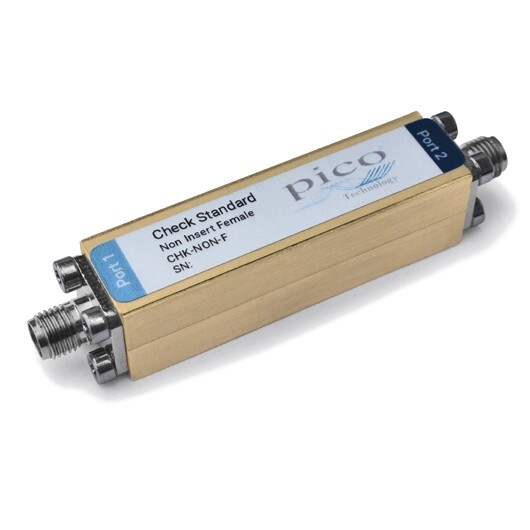
CHK-NON-F Noninsertable check standard SMA(f-f)
Precision You Can Trust
NABL-Accredited Calibration | Available on Request
The TA431 CHK-NON-F is a non-insertable vector network analyser check standard designed to verify VNA calibration and measurement-system accuracy. It features two 50 Ω SMA female ports connected through a 75 mm, 25 Ω mismatched transmission line with a stable and predictable S-parameter response. Individually characterised reference data supports comparison of S11, S21, S12 and S22 measurements for PicoVNA and compatible RF measurement systems..
- Detail
- Special Features
- Specification
The TA431 CHK-NON-F Non-Insertable Check Standard is designed for RF engineers, laboratories, electronics manufacturers, educational institutions and research teams that need to confirm that a vector network analyser calibration is producing reliable measurements.
Unlike a SOLT calibration kit, the TA431 is measured after calibration. Its measured response is compared against the characterised reference data supplied for that specific standard.
This helps users detect problems such as:
- Incorrect VNA calibration
- Test-cable movement after calibration
- Connector contamination
- Connector damage
- Incorrect torque
- Reference-plane errors
- Measurement drift
- Setup configuration errors
- Unexpected changes in VNA performance
Pico describes the TA431 as a non-insertable check standard intended to validate a network-analysis test setup and its calibration before, during or after measurements.
Non-Insertable SMA Female-to-Female Configuration
The TA431 uses:
- Two SMA female RF ports
- 50 Ω port interfaces
- Female-to-female non-insertable configuration
- Precision RF construction
A non-insertable device has the same connector gender at both ports, so it cannot normally be inserted directly between two mating test leads without a suitable calibration method or adaptor arrangement.
The TA431 supports verification following non-insertable calibration workflows, including known-through and unknown-through methods. Pico's VNA documentation identifies TA431 specifically as the non-insertable female-port check standard.
75 mm, 25 Ω Mismatched Transmission Line
At the centre of the TA431 is a deliberately mismatched transmission line approximately:
- 75 mm long
- 25 Ω nominal impedance
This mismatched line produces a predictable combination of reflection and transmission across frequency.
Pico compares the concept to a Beatty-line-style standard because the mismatch generates a smooth and stable RF response that is useful for checking whether a calibrated VNA can correctly measure a non-ideal device.
Why Use a Mismatched Check Standard?
Testing only a very good 50 Ω through connection may not reveal all calibration problems.
The TA431 intentionally presents a significant impedance mismatch. This allows the calibrated measurement system to be challenged with meaningful:
- Reflections
- Transmission loss
- Phase variation
- Impedance variation
This makes it useful for verifying whether the VNA correctly measures both reflection and transmission parameters.
Full S-Parameter Verification
The TA431 can be used to compare all four two-port S-parameters:
- S11 input reflection
- S21 forward transmission
- S12 reverse transmission
- S22 output reflection
These measurements allow users to validate:
- Return loss
- Insertion loss
- Reflection coefficient
- Transmission coefficient
- Magnitude
- Phase
- Smith-chart response
- Forward and reverse network behaviour
Pico's VNA documentation specifies full S-parameter characterisation for the TA431.
Characterised Reference Data
Each check standard is supplied with characterised measurement data linked to the individual unit.
Pico documentation identifies the supplied data as a serial-numbered Touchstone file. This allows the live VNA measurement to be compared with the known response of the standard.
The reference data supports verification of:
- S11
- S21
- S12
- S22
- Magnitude response
- Phase response
- Return loss
- Insertion loss
The current RevineTech wording stating that the data is supplied via USB is broadly consistent with Pico's VNA documentation, but the page should clarify that the USB contains reference data, not calibration-control software.
Traceable Measurement Verification
Pico's network metrology material describes its calibration kits and check standards as being supplied with reference data traceable back to national standards.
This makes the TA431 useful for:
- Measurement assurance
- RF laboratory quality control
- Research measurements
- Production-test validation
- Calibration verification
- Engineering education
- Network metrology training
The RevineTech page currently states that an NABL Calibration Certificate is included. That should only remain if RevineTech can confirm that the certificate applies specifically to the supplied TA431 and is part of the current commercial package. The Pico product information supports traceable reference data, but this is not the same as confirming a specific NABL certificate.
Suitable for PicoVNA 106 and PicoVNA 108
Pico states that the TA431's mismatch and transmission characteristics span the operating ranges of the PicoVNA 106 and PicoVNA 108.
Typical compatible applications include:
- PicoVNA 106 measurement verification
- PicoVNA 108 measurement verification
- Other compatible 50 Ω VNAs
- RF test systems capable of loading Touchstone reference data
The exact usable range should remain within the characterised reference data supplied with the standard.
Calibration Versus Verification
This distinction should be clear on the RevineTech product page.
Calibration kits such as SOLT standards:
- Establish VNA error correction
- Define measurement reference planes
- Are used during the calibration procedure
TA431 check standard:
- Is measured after calibration
- Tests whether the calibration is producing expected results
- Provides an independent known reference
- Helps identify measurement-system problems
The current RevineTech phrase describing the TA431 as a "precision calibration tool" should therefore be changed to precision VNA verification or check standard.
Non-Insertable Calibration Verification
The TA431 is particularly useful for measurement systems involving non-insertable devices.
Supported calibration approaches include:
- Non-insertable calibration
- Known-through calibration
- Unknown-through calibration
- Full two-port S-parameter verification
Pico's VNA documentation specifically associates the TA431 with these non-insertable calibration configurations.
Typical Verification Workflow
A typical TA431 verification process is:
- Allow the VNA, test cables and check standard to stabilise.
- Inspect and clean all SMA connectors.
- Perform the required VNA calibration.
- Leave the calibrated test cables in their calibrated positions.
- Connect the TA431 check standard.
- Apply the correct SMA connector torque.
- Measure S11, S21, S12 and S22.
- Load the supplied Touchstone reference data.
- Compare the live measurement with the reference trace.
- Investigate unexpected differences before testing critical devices.
This process allows engineers to confirm that the complete measurement chain is functioning as expected.
Why Connector Handling Matters
The effectiveness of any check standard depends on good RF measurement practice.
Users should:
- Inspect connectors before use
- Keep connectors clean
- Use appropriate protective caps
- Apply the recommended connector torque
- Avoid twisting the check-standard body during mating
- Minimise movement of calibrated test cables
- Avoid worn or damaged adaptors
A check standard cannot distinguish every possible physical failure automatically, but comparison with its characterised response can reveal when the measurement system no longer behaves as expected.
Applications
The TA431 is suitable for:
- Vector network analyser verification
- Calibration confidence checks
- RF filter measurement validation
- Amplifier measurement verification
- Cable and connector testing
- PCB transmission-line analysis
- Antenna measurement systems
- Wireless component development
- Production RF testing
- Telecom laboratories
- Research and development
- University RF laboratories
- Network metrology training
- Measurement assurance programmes
- Automated RF test systems
Why Buy from RevineTech?
RevineTech supplies Pico Technology vector network analysers, calibration kits, check standards and RF measurement accessories.
Technical support can include:
- TA431 check-standard selection
- TA430 versus TA431 comparison
- PicoVNA compatibility
- Manual SOLT kit selection
- E-Cal selection
- RF test-cable configuration
- SMA adaptor selection
- Torque-wrench selection
- Measurement verification workflow
- Recalibration coordination
Non-Insertable Check Standard
Designed specifically for verification of non-insertable VNA measurement configurations.
SMA Female-to-Female Interfaces
- Two SMA female ports
- 50 Ω external interfaces
- Non-insertable connector arrangement
Deliberately Mismatched Transmission Line
The internal line is:
- 75 mm long
- 25 Ω nominal impedance
- Designed to generate a stable reflection and transmission response
Full S-Parameter Characterisation
Supports comparison of:
- S11
- S21
- S12
- S22
Serial-Numbered Reference Data
The characterised response is supplied as individual reference data for the check standard, including Touchstone data according to Pico's VNA documentation.
Calibration Verification
Helps identify:
- Calibration errors
- Cable movement
- Connector problems
- Measurement drift
- Reference-plane issues
Suitable for Non-Insertable Workflows
Supports verification associated with:
- Known-through calibration
- Unknown-through calibration
- Non-insertable two-port measurements
Core Technical Specifications
| Specification | Details |
|---|---|
| Product name | CHK-NON-F Non-Insertable Check Standard SMA Female-to-Female |
| Pico order code | TA431 |
| Pico type | CHK-NON-F |
| Product type | Non-insertable VNA check standard |
| RF ports | 2 |
| Connector configuration | SMA female to SMA female |
| External port impedance | 50 Ω |
| Internal mismatched line impedance | 25 Ω |
| Mismatched-line length | 75 mm |
| Characterisation | Full two-port S-parameter data |
| Parameters | S11, S21, S12, S22 |
| Reference-data format | Touchstone |
| Primary function | Verify VNA calibration and measurement setup |
| Calibration-standard function | No |
The 75 mm, 25 Ω construction and female-to-female configuration are confirmed by Pico's current product listing.
Measurement Characteristics
| Specification | Details |
|---|---|
| Network type | Deliberately mismatched transmission line |
| Nominal line impedance | 25 Ω |
| External system impedance | 50 Ω |
| Line length | 75 mm |
| Reflection behaviour | Smooth, predictable and stable mismatch |
| Transmission behaviour | Smooth, predictable and stable response |
| Verification direction | Forward and reverse |
| S-parameter verification | Full two-port |
Connector Configuration
| Port | Connector |
|---|---|
| Port 1 | SMA female |
| Port 2 | SMA female |
Supported Verification
| Measurement | Supported |
|---|---|
| S11 | Yes |
| S21 | Yes |
| S12 | Yes |
| S22 | Yes |
| Return loss | Yes |
| Insertion loss | Yes |
| Magnitude comparison | Yes |
| Phase comparison | Yes |
| Smith-chart comparison | Yes |