
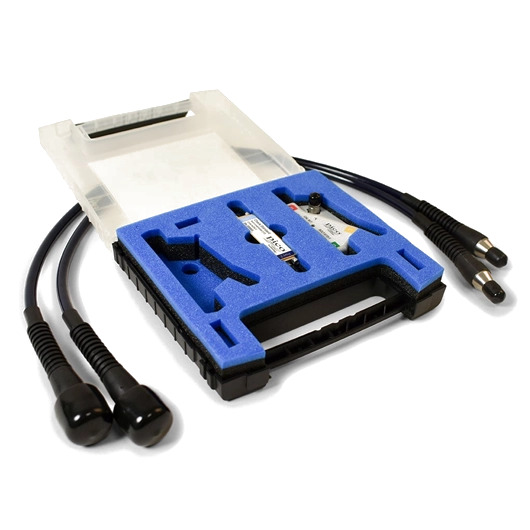
Network Metrology Standard SMA(f) Demonstrator kit and carry case
Precision You Can Trust
NABL-Accredited Calibration | Available on Request
The Pico PQ187 Network Metrology Standard SMA(f) Demonstrator Kit is a professional VNA calibration, verification and training package for RF measurements up to 8.5 GHz. It includes two TA336 N-type male to SMA male standard test leads, a TA345 SMA female SOLT calibration kit, a TA431 SMA female-to-female non-insertable check standard, serial-number-specific traceable reference data and a protective carry case for accurate PicoVNA measurements, research and network metrology training..
- Detail
- Special Features
- Specification
The Network Metrology Standard SMA(f) Demonstrator Kit, product code PQ187, combines the essential accessories required to calibrate and independently verify a PicoVNA measurement setup.
The official kit contains:
- 2 × TA336 N(m)-SMA(m) standard VNA test leads
- 1 × TA345 Standard SMA(f) SOLT calibration kit
- 1 × TA431 SMA(f-f) non-insertable check standard
- Serial-number-specific reference data for TA345 and TA431
- USB memory containing the reference data
- Protective carry case
- Network Metrology Training Kit documentation and supporting files
The PQ187 does not include a PicoVNA instrument. It is an accessory and metrology kit designed to be used with a suitable VNA.
VNA Calibration and Independent Verification
A major advantage of the PQ187 is that it provides equipment for both calibration and verification.
The TA345 SOLT calibration kit establishes the VNA error correction at the measurement reference planes.
The TA431 check standard then provides an independent way to verify whether the calibrated VNA, test leads and complete measurement setup are producing results consistent with the standard's characterised reference data.
This can help identify problems such as:
- Incorrect SOLT calibration
- Test-lead movement after calibration
- Connector contamination
- Incorrect connector torque
- Reference-plane errors
- Damaged RF cables
- Measurement drift
- Incorrect calibration data
- Unexpected changes in the measurement system
This distinction is important. The SOLT kit performs calibration, while the check standard is used to verify the resulting calibrated measurement setup.
Two TA336 Standard VNA Test Leads
PQ187 includes two TA336 standard 8.5 GHz test leads.
Each TA336 uses:
- N-type male connector at the VNA end
- SMA male connector at the measurement end
- 50 Ω RF architecture
- Standard professional-grade construction
- Phase-stable design for VNA measurements
The two test leads connect the VNA ports to the SMA female calibration standards and devices under test.
They are suitable for:
- S-parameter measurements
- Filter testing
- Amplifier characterisation
- Antenna measurements
- Cable testing
- Connector measurements
- PCB transmission-line analysis
- RF component testing
The official PQ187 package specifically contains two TA336 leads, so the quantity should be clearly stated on the RevineTech page.
TA345 Standard SMA Female SOLT Calibration Kit
The PQ187 includes the TA345 Standard 8.5 GHz SOLT Calibration Kit with SMA female interfaces.
The TA345 is a manual mechanical calibration kit containing:
- Short
- Open
- Load
- Through
It uses a four-piece, five-port construction and is characterised from 300 kHz to 8.5 GHz.
The calibration standards allow a VNA to calculate corrections for systematic errors such as:
- Directivity
- Source match
- Load match
- Reflection tracking
- Transmission tracking
- Forward measurement errors
- Reverse measurement errors
The TA345 is a manual SOLT kit, not an electronic E-Cal module. It does not contain USB-controlled switching or an internal oven.
SMA Female Calibration Reference Plane
The TA345 uses SMA female calibration interfaces, which mate directly with the SMA male measurement ends of the included TA336 test leads.
This provides a logical measurement chain:
PicoVNA → TA336 N(m)-SMA(m) test leads → TA345 SMA(f) calibration standards
After calibration, the TA345 is removed and the device under test or check standard is connected without unnecessarily moving the test leads.
Serial-Number-Specific TA345 Calibration Data
The TA345 supplied in the PQ187 kit includes calibration data associated with its individual serial number.
This data represents the actual electrical characteristics of the:
- Short standard
- Open standard
- Load standard
- Through adaptor
Using characterised data allows the VNA to account for the real frequency-dependent behaviour of the standards instead of assuming that the standards are electrically ideal.
TA431 Non-Insertable Check Standard
The PQ187 also includes the TA431 CHK-NON-F non-insertable check standard.
The TA431 uses:
- SMA female port 1
- SMA female port 2
- Non-insertable female-to-female configuration
- Mismatched transmission-line architecture
- Serial-number-specific reference data
The check standard is measured after completing the VNA calibration.
The live measurement can then be compared with the supplied reference data to determine whether the calibrated measurement system is behaving as expected.
Full S-Parameter Verification
The TA431 allows verification using the four fundamental two-port S-parameters:
- S11 for input reflection
- S21 for forward transmission
- S12 for reverse transmission
- S22 for output reflection
These measurements can be evaluated in terms of:
- Return loss
- Insertion loss
- Magnitude
- Phase
- Smith-chart response
- Transmission behaviour
This makes the check standard useful for verifying both reflection and transmission measurement performance.
Traceable Reference Data
Pico states that the SOLT calibration kit and check standard are supplied with reference data traceable back to national standards.
The official training guide further confirms that PQ187 includes serial-number-specific data for both the TA431 and TA345 on a USB stick.
This supports applications requiring:
- Measurement traceability
- VNA calibration verification
- Research documentation
- Laboratory quality control
- Measurement assurance
- Educational demonstrations
- Production validation
- Reference measurements
A separate NABL certificate should only be stated if it is specifically supplied and confirmed for the RevineTech commercial package.
Designed to Realise PicoVNA Measurement Capability
Pico describes the PQ187 as a kit capable of helping users realise and verify the measurement capability and accuracy of a PicoVNA.
The combination of:
- Stable RF test leads
- Characterised SOLT standards
- Independent check standard
- Traceable reference data
provides a more complete measurement workflow than using a basic calibration kit alone.
Network Metrology Training
The PQ187 is also designed as a demonstrator and training package.
It can be used to teach concepts such as:
- S-parameters
- One-port measurements
- Two-port measurements
- SOLT calibration
- Calibration reference planes
- Directivity
- Source match
- Load match
- Reflection tracking
- Transmission tracking
- Connector repeatability
- Cable movement
- Measurement uncertainty
- Calibration verification
- Traceability
- Reference measurements
Pico provides a dedicated Network Metrology Training Kit User's Guide and supporting files for the PQ187/PQ188 measurement ecosystem.
Suitable for Research Applications
The PQ187 is not limited to classroom demonstrations.
Pico specifically identifies the demonstrator kits as suitable for wider use in research and doctorate projects, where accurate measurements can establish reference and error terms for experimental measurements.
Typical research applications include:
- RF filter development
- Antenna characterisation
- Amplifier testing
- Matching-network design
- PCB transmission-line measurements
- Cable and connector analysis
- Wireless component evaluation
- RF material experiments
- Network metrology studies
Typical Calibration and Verification Workflow
A practical PQ187 measurement procedure is:
- Allow the VNA, test leads and standards to stabilise.
- Inspect and clean the RF connectors.
- Connect both TA336 leads to the VNA ports.
- Position the cables as they will be used during measurement.
- Load the serial-number-specific TA345 calibration data.
- Perform the manual short, open, load and through calibration.
- Save the completed VNA calibration.
- Connect the TA431 check standard.
- Load its supplied reference data.
- Compare the measured S-parameters with the reference values.
- Investigate any unexpected difference.
- Remove the check standard.
- Connect the device under test without disturbing the calibrated test leads.
This workflow separates calibration from independent verification.
Applications
The PQ187 is suitable for:
- Vector network analyser calibration
- VNA calibration verification
- Network metrology training
- RF and microwave education
- University laboratories
- Research projects
- Antenna measurements
- Filter testing
- Amplifier characterisation
- Cable and connector testing
- PCB transmission-line analysis
- Wireless component development
- Telecom testing
- Production validation
- Measurement assurance
- RF laboratory training
Complete Standard-Grade VNA Demonstrator Kit
The PQ187 combines:
- Two standard VNA test leads
- Manual SOLT calibration standards
- Independent check standard
- Traceable reference data
- Protective storage
Two TA336 Standard Test Leads
Each test lead provides:
- N-type male VNA connection
- SMA male measurement connection
- 50 Ω architecture
- Up to 8.5 GHz application range
TA345 SMA Female SOLT Kit
Includes:
- Short
- Open
- Load
- Through
- Serial-number-specific calibration data
TA431 Non-Insertable Check Standard
Supports independent verification of:
- S11
- S21
- S12
- S22
Traceable Reference Data
Reference information is supplied for both:
- TA345 SOLT calibration kit
- TA431 check standard
The official training documentation states that the serial-number-specific data is supplied on USB memory.
Up to 8.5 GHz Measurement Accessories
The principal RF components in the demonstrator kit support measurements up to 8.5 GHz.
Calibration Plus Verification
Unlike a basic calibration-only package, PQ187 provides equipment for both:
- Establishing VNA error correction
- Independently checking the calibrated setup
Protective Carry Case
The complete kit is supplied in a carry case for organised storage and transportation.
Core Kit Specifications
| Specification | Details |
|---|---|
| Product name | Network Metrology Standard SMA(f) Demonstrator Kit and Carry Case |
| Pico product code | PQ187 |
| Product type | VNA calibration, verification and network metrology demonstrator kit |
| Measurement interface | SMA |
| Nominal impedance | 50 Ω |
| Maximum component frequency | Up to 8.5 GHz |
| Calibration method | Manual SOLT |
| Calibration kit | TA345 |
| Calibration connector | SMA female |
| Test leads | 2 × TA336 |
| Test-lead connectors | N male to SMA male |
| Check standard | TA431 |
| Check-standard connectors | SMA female to SMA female |
| Reference data | Included |
| Data storage | USB memory |
| Carry case | Included |
| VNA instrument | Not included |
Official Package Contents
| Component | Quantity | Description |
|---|---|---|
| TA336 | 2 | N(m)-SMA(m) standard VNA test lead |
| TA345 | 1 | Standard SMA(f) SOLT calibration kit and data |
| TA431 | 1 | SMA(f-f) non-insertable check standard and data |
| Reference-data USB | 1 | Serial-number-specific data for TA345 and TA431 |
| Carry case | 1 | Protective kit storage |
| Training documentation | Available | Network Metrology Training Kit User's Guide and files |
The official package composition is confirmed in Pico's product listing and Network Metrology Training Kit User's Guide.
TA336 Test Lead
| Specification | Details |
|---|---|
| Product code | TA336 |
| Product type | Standard VNA test lead |
| VNA-side connector | N-type male |
| Measurement-side connector | SMA male |
| Nominal impedance | 50 Ω |
| Intended maximum frequency | 8.5 GHz |
| Quantity in PQ187 | 2 |
TA345 SOLT Calibration Kit
| Specification | Details |
|---|---|
| Product code | TA345 |
| Type | Standard manual mechanical SOLT kit |
| Connector type | SMA female |
| Nominal impedance | 50 Ω |
| Characterised frequency range | 300 kHz to 8.5 GHz |
| Standards | Short, open, load and through |
| Construction | Four-piece, five-port |
| Characterisation | Serial-number-specific |
| Automated E-Cal | No |
TA431 Check Standard
| Specification | Details |
|---|---|
| Product code | TA431 |
| Product type | Non-insertable VNA check standard |
| Connector configuration | SMA female to SMA female |
| Nominal line impedance | Approximately 25 Ω |
| Mismatched line length | 75 mm |
| Characterised range | 300 kHz to 8.5 GHz |
| S-parameters | S11, S21, S12 and S22 |
| Reference data | Included |
| Primary purpose | Independent VNA calibration verification |