
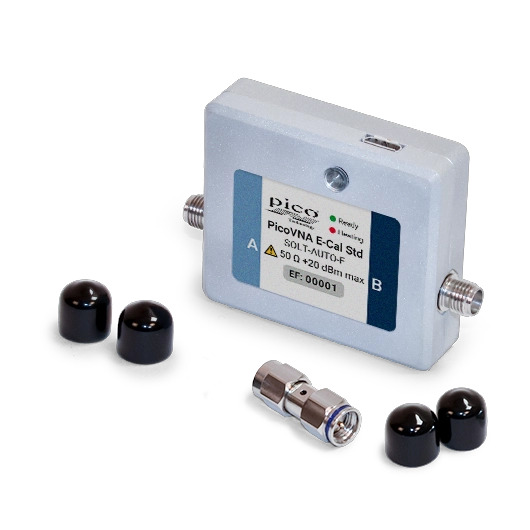
SOLT-AUTO-M or SOLT-AUTO-F calibration data
Precision You Can Trust
NABL-Accredited Calibration | Available on Request
The Pico Technology CC057 service provides factory recalibration for an existing SOLT-AUTO-M or SOLT-AUTO-F electronic VNA calibration module. It applies to the TA518 SMA male and TA519 SMA female E-Cal standards. The returned module is recharacterised and its embedded traceable calibration data is updated for continued automated SOLT calibration through PicoVNA software. An RMA number is required before returning the module to Pico Technology..
- Detail
- Special Features
- Specification
The SOLT-AUTO-M or SOLT-AUTO-F Calibration Data Service, product code CC057, is intended for customers who already own a Pico Technology electronic calibration module and require renewed traceable calibration data.
The service applies to:
- TA518 SOLT-AUTO-M, automated E-Cal module with two SMA male ports
- TA519 SOLT-AUTO-F, automated E-Cal module with two SMA female ports
Each new Pico E-Cal standard is originally supplied with traceable calibration data stored within the module. CC057 is the factory recalibration option for updating that data on an existing male or female E-Cal module.
Factory Recalibration Service
CC057 is a service, not a new calibration accessory.
The customer must already own a TA518 or TA519 module. The existing E-Cal must be returned to Pico Technology so that its electronic standards can be recharacterised.
The service does not include:
- A new TA518 E-Cal module
- A new TA519 E-Cal module
- A TA520 dual E-Cal kit
- A manual SOLT calibration kit
- A new PicoVNA
- RF test cables
- Check standards
- Connector adaptors
Pico states that it provides calibration only for its own SOLT, E-Cal and check standards.
Applicable Electronic Calibration Modules
| E-Cal Module | Order Code | RF Connector Configuration |
|---|---|---|
| SOLT-AUTO-M | TA518 | Two SMA male ports |
| SOLT-AUTO-F | TA519 | Two SMA female ports |
Both products are automated electronic two-port SOLT calibration modules designed for operation through PicoVNA software.
Embedded Calibration Data
Unlike a manual SOLT kit, the TA518 and TA519 store their individual characterisation data inside the E-Cal hardware.
PicoVNA software uses this embedded information to:
- Identify the connected E-Cal module
- Read its individual calibration data
- Control the internal electronic standards
- Apply the characterised standard responses
- Complete automated two-port SOLT calibration
CC057 updates the calibration data associated with the returned E-Cal module.
Internal SOLT Standards
The applicable E-Cal modules electronically switch between:
- Short
- Open
- Load
- Through
These standards are used to calculate systematic VNA error corrections, including:
- Directivity
- Source match
- Load match
- Reflection tracking
- Transmission tracking
- Forward measurement errors
- Reverse measurement errors
The CC057 service recalibrates the electronic standard module. It does not change the product into a different calibration type.
SMA Male and Female Versions
The service supports two connector configurations.
TA518 SOLT-AUTO-M
The TA518 has:
- Two SMA male RF ports
- 50 Ω nominal impedance
- Automated two-port SOLT operation
- USB power and control
- Embedded characterisation data
It is typically used where the VNA test cables or calibration reference planes terminate in SMA female connectors.
TA519 SOLT-AUTO-F
The TA519 has:
- Two SMA female RF ports
- 50 Ω nominal impedance
- Automated two-port SOLT operation
- USB power and control
- Embedded characterisation data
It is typically used where the VNA test cables or calibration reference planes terminate in SMA male connectors.
300 kHz to 8.5 GHz E-Cal Range
The TA518 and TA519 electronic calibration modules are characterised from 300 kHz to 8.5 GHz.
This supports calibration for measurements involving:
- RF filters
- Amplifiers
- Antennas
- Cables and connectors
- Attenuators
- Couplers and splitters
- PCB transmission lines
- Matching networks
- Wireless modules
- Cellular equipment
- Wi-Fi and Bluetooth products
- GNSS systems
- RFID and IoT devices
The frequency range describes the compatible E-Cal modules. CC057 itself is a recalibration service rather than a measurement device.
USB-Controlled E-Cal Operation
After recalibration, the TA518 or TA519 continues to use USB for:
- Module power
- Device identification
- Characterisation-data transfer
- Electronic standard switching
- Communication with PicoVNA software
The USB interface is a feature of the returned E-Cal hardware. CC057 does not include a separate USB-powered instrument unless Pico replaces the hardware under an agreed service arrangement.
Oven-Stabilised Electronic Standards
The TA518 and TA519 use internal temperature stabilisation to improve repeatability during automated calibration.
Recalibration renews the characterised data for the returned module. Overall calibration quality still depends on:
- Module condition
- Connector condition
- Correct connector torque
- VNA source level
- Test-cable stability
- Temperature
- Calibration reference planes
- Measurement settings
The service should not be described as making every VNA measurement automatically error-free.
Traceable Recalibration
Pico states that new E-Cal SOLT standards are supplied with traceable calibration data embedded in the module. CC057 is the option to select when recalibration of an existing male or female E-Cal is required.
Traceable recalibration is relevant for:
- RF laboratories
- Electronics manufacturers
- Production test facilities
- Research organisations
- Telecom development teams
- University laboratories
- Quality-controlled measurement systems
- Internal calibration programmes
- Measurement assurance workflows
A separate NABL calibration certificate should only be stated when RevineTech has confirmed that such a certificate is included and applies specifically to the returned module.
RMA Return Process
Pico requires an RMA number before the E-Cal standard is returned.
A typical return process includes:
- Confirm whether the module is TA518 or TA519.
- Record the model and serial number.
- Contact RevineTech or Pico support.
- Obtain an authorised RMA number.
- Inspect the SMA ports for visible damage.
- Fit protective connector caps.
- Pack the module securely in its carrying case.
- Include the required service and return information.
- Send the module according to the issued instructions.
- Reload or verify the updated embedded data after return.
When Recalibration May Be Required
Recalibration may be considered when:
- The organisation’s calibration interval has expired
- Internal quality procedures require current traceability
- The E-Cal module is used frequently
- The connectors have undergone many mating cycles
- Measurement verification shows unexplained deviation
- The module has been transported regularly
- Temperature or storage conditions have been unsuitable
- The module is used as part of a production test system
The appropriate interval depends on usage, handling, connector condition and the organisation’s measurement assurance policy.
Connector Condition and Service Limitations
Recalibration updates the module’s characterisation, but it may not correct serious physical damage.
Before returning the module, inspect for:
- Damaged centre conductors
- Scratched mating surfaces
- Worn connector threads
- Loose connector bodies
- Contamination
- Signs of over-torque
- Bent or misaligned contacts
- Damaged USB connector
Physical repair or replacement may require a separate assessment and quotation.
Compatible VNA Systems
The recalibrated TA518 or TA519 can be used within supported PicoVNA calibration workflows, including setups based on:
- PicoVNA 106
- PicoVNA 108
- PicoVNA software
- Compatible automated RF test systems
The selected calibration sweep should remain within the E-Cal module’s characterised frequency range.
Applications
CC057 is suitable for E-Cal modules used in:
- Vector network analyser calibration
- Antenna measurements
- RF filter testing
- Amplifier characterisation
- Cable and connector analysis
- PCB transmission-line measurements
- Wireless product development
- Cellular component testing
- Wi-Fi and Bluetooth development
- GNSS testing
- RF production systems
- Automated test equipment
- Research laboratories
- University RF laboratories
- Measurement verification
- Calibration-controlled environments
Why Buy Through RevineTech?
RevineTech can assist with the recalibration process for an existing TA518 or TA519 E-Cal module.
Support may include:
- Confirming the E-Cal model
- Selecting the CC057 service
- RMA coordination
- Return-shipping guidance
- Calibration documentation
- PicoVNA compatibility support
- Replacement E-Cal quotation
- TA520 dual-kit comparison
- Check-standard selection
- RF cable and torque-wrench selection
The final service quotation may include recalibration charges, freight, taxes and return logistics.
Recalibration for Existing E-Cal Modules
Applies to:
- TA518 SOLT-AUTO-M
- TA519 SOLT-AUTO-F
Male and Female SMA Support
- Two SMA male ports on TA518
- Two SMA female ports on TA519
- 50 Ω electronic calibration interfaces
Embedded Traceable Calibration Data
- Stored inside the E-Cal module
- Linked to the individual device
- Read automatically by PicoVNA software
- Updated through factory recalibration
Automated SOLT Function Retained
The recalibrated module continues to electronically switch between:
- Short
- Open
- Load
- Through
RMA-Based Factory Service
- Existing module must be returned
- RMA number required
- Pico calibrates only its own standards
Not a New Physical Product
CC057 does not include:
- A new E-Cal module
- A manual SOLT kit
- A dual E-Cal kit
- A check standard
- A PicoVNA instrument
| Service name | SOLT-AUTO-M or SOLT-AUTO-F Calibration Data |
| Pico product code | CC057 |
| Service type | Factory recalibration of an existing E-Cal SOLT standard |
| Applicable male module | TA518 SOLT-AUTO-M |
| Applicable female module | TA519 SOLT-AUTO-F |
| Existing E-Cal required | Yes |
| Return to Pico required | Yes |
| RMA required | Yes |
| New E-Cal included | No |
| Calibration data | Updated embedded traceable data |
| Calibration type | Automated electronic two-port SOLT |
| Supported manufacturer | Pico standards only |
Supported Module Comparison
| Specification | TA518 | TA519 |
|---|---|---|
| Pico type | SOLT-AUTO-M | SOLT-AUTO-F |
| RF ports | 2 | 2 |
| Connector gender | SMA male | SMA female |
| Nominal impedance | 50 Ω | 50 Ω |
| Standards | Short, open, load, through | Short, open, load, through |
| Operation | Automated electronic switching | Automated electronic switching |
| Power and control | USB | USB |
| Calibration data | Embedded | Embedded |
| Characterised range | 300 kHz to 8.5 GHz | 300 kHz to 8.5 GHz |