
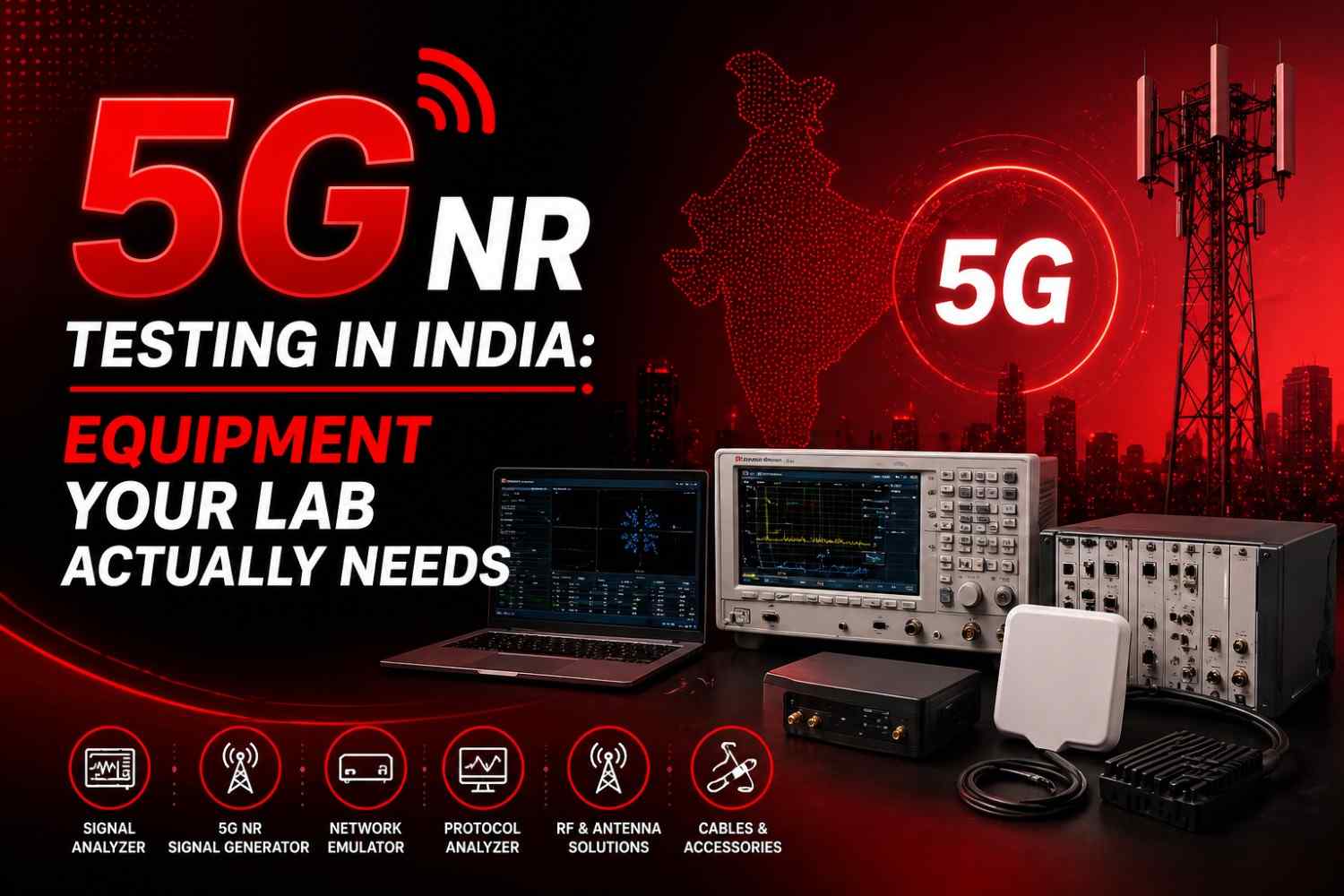
A wireless chipset design team in Noida was given eighteen months to bring a 5G NR modem from silicon tape-out to carrier certification. The team had strong RF design expertise, a well-equipped lab for 4G LTE work, and confidence that the transition to 5G would be straightforward. It was not. The 5G NR air interface introduced new waveform characteristics, new frequency bands, and new antenna requirements that their existing instruments could not measure. Six months into the program, the team realized they needed to rebuild their measurement capability almost from scratch. The eighteen-month timeline became twenty-eight months.
India's 5G rollout has moved from commercial launch to rapid infrastructure expansion across major cities. For electronics companies in India, this creates both an opportunity and a technical obligation. Designing 5G devices, validating 5G components, or certifying 5G network equipment all require test capabilities that are fundamentally different from what sufficed for 4G. Understanding what those requirements are before starting a 5G program determines whether the program runs on schedule or runs into the same wall as the Noida team.
What Makes 5G NR Different to Test
5G New Radio (NR) introduces several technical characteristics that create new measurement challenges. The first is wider channel bandwidth. While LTE used channels up to 20 MHz wide, 5G NR sub-6 GHz channels can reach 100 MHz, and millimeter-wave 5G channels can reach 400 MHz. Test instruments must have the analysis bandwidth to capture and characterize these wider channels accurately.
The second challenge is the numerology system. 5G NR defines multiple subcarrier spacing options, from 15 kHz for sub-6 GHz deployments up to 120 kHz for millimeter-wave, and each numerology requires different timing and synchronization parameters in the test setup. The third challenge is massive MIMO and beamforming. 5G base stations use antenna arrays with dozens or hundreds of elements, and validating beam management behavior requires over-the-air test methodologies rather than conducted measurements. This represents a fundamental shift in how RF conformance testing is performed.
Core Test Categories in a 5G NR Lab
RF Conformance Testing
RF conformance tests verify that a 5G device meets the transmitter and receiver specifications defined in 3GPP Release 15 and later releases. Transmitter tests include output power accuracy, error vector magnitude (EVM), adjacent channel leakage ratio (ACLR), and spurious emission levels. Receiver tests include reference sensitivity, blocking performance, and intermodulation rejection. Each test requires a signal analyzer capable of demodulating 5G NR waveforms and a signal source capable of generating them with the required modulation quality.
Protocol and Layer 2 Testing
Protocol testing verifies that the device's software stack implements the 5G NR protocol correctly. This includes testing Radio Resource Control (RRC) procedures, handover behavior between cells, carrier aggregation state machine transitions, and the signaling exchanges that occur during connection setup and release. Protocol testing typically uses a base station emulator that simulates the network side of the connection, allowing engineers to inject specific protocol scenarios and verify the device's response.
Over-the-Air Testing
For 5G devices with integrated antennas, particularly millimeter-wave designs where the antenna and radio frontend are tightly coupled, conducted testing through a cable connection is not feasible. Over-the-air (OTA) testing measures the device's radiated performance using an anechoic chamber or compact antenna test range (CATR). Total radiated power (TRP) and total isotropic sensitivity (TIS) are the key OTA metrics for 5G NR conformance. Setting up an OTA test capability requires careful chamber design and calibration in addition to the measurement instruments.
Network Performance and Field Testing
Beyond device conformance, 5G network deployments require ongoing performance verification. Drive testing captures signal quality metrics across geographic coverage areas. In-building testing evaluates how 5G signals penetrate structures and how coverage transitions between indoor and outdoor cells. Field test instruments must be portable, battery-powered, and capable of connecting to live 5G networks to capture real-world performance data.
Essential Instruments for a 5G NR Test Setup
Signal Analyzers with 5G NR Measurement Personalities
A signal analyzer with 5G NR demodulation capability is the centerpiece of any 5G test lab. The instrument must have sufficient analysis bandwidth for the channel widths in your test program, typically 200 MHz or more for sub-6 GHz 5G and 2 GHz or more for millimeter-wave work. It must also support the specific 5G NR measurement functions required: EVM, ACLR, channel power, occupied bandwidth, and beam measurement for MIMO applications. The Anritsu mobile wireless communications measurement instruments provide these measurement capabilities with the frequency coverage and analysis bandwidth required for 5G NR sub-6 GHz programs.
Signal Generators for 5G NR Stimulus
Receiver testing and base station emulation require a signal source capable of generating fully compliant 5G NR downlink waveforms. The generator must support the relevant 5G NR numerologies, channel bandwidths, and modulation schemes including 256-QAM. For receiver blocking and intermodulation tests, the generator must provide clean, low-phase-noise output at the desired aggressor frequencies without introducing its own distortion products into the measurement. Anritsu signal generators in combination with waveform generation software cover the stimulus requirements for 5G NR receiver characterization.
RF Signal Generators for Component and Module Testing
Below the system level, 5G NR development programs require extensive component testing. Power amplifiers, filters, switches, low-noise amplifiers, and antenna matching networks all need individual characterization before integration. RF signal generators with high output power, wide frequency coverage, and low phase noise are the primary stimulus instruments for this work. Combined with a vector network analyzer for S-parameter measurement, they form the core of a 5G component test setup.
Sub-6 GHz vs Millimeter-Wave: Different Test Challenges
Sub-6 GHz 5G NR testing shares significant infrastructure with LTE test programs. The frequency bands overlap in some cases, conducted testing via coaxial connections is feasible, and the analysis bandwidth requirements, while wider than LTE, are manageable with instruments already deployed in many Indian labs. This makes sub-6 GHz 5G a natural starting point for labs building 5G capability incrementally.
Millimeter-wave 5G testing is a different challenge. Signal losses at 28 GHz and above are high enough that every connector, cable, and adapter in the test path introduces measurement uncertainty. Over-the-air methodologies replace conducted testing at the device level. Instruments must maintain specification at frequencies that push the limits of many benchtop platforms. Millimeter-wave test capability requires purpose-built instrumentation and a more controlled lab environment than sub-6 GHz work.
How Indian Labs Are Approaching 5G Test Capability
Indian electronics companies working on 5G products fall into two broad categories. The first group consists of system integrators and network equipment vendors who need to validate complete 5G base station and radio access network (RAN) products against 3GPP specifications and operator acceptance criteria. These labs need comprehensive conformance and performance test capability, often including both sub-6 GHz and millimeter-wave coverage.
The second group consists of component and module designers, chipset companies, and device manufacturers who are developing 5G-capable products. These labs focus on component characterization, module integration testing, and pre-conformance verification before formal type approval submission. A phased approach to test capability, starting with the instruments needed for the earliest development stages and expanding as the program advances, is the most practical path for this group.
Building Your 5G Test Lab in Phases
- Phase 1 (Component and waveform development): RF signal generator, signal analyzer with 5G NR personality, vector network analyzer for passive and active component characterization
- Phase 2 (Integration and system testing): Base station emulator or protocol tester, wider analysis bandwidth for multi-carrier scenarios, real-time signal capture for intermittent fault analysis
- Phase 3 (Pre-conformance and OTA): Anechoic chamber or CATR access, OTA measurement software, full transmitter and receiver test suite covering 3GPP test cases
- Phase 4 (Field validation): Portable spectrum analyzers, drive test software, field measurement loggers for coverage verification in real deployment environments
Conclusion
5G NR testing demands instruments and methodologies that go beyond what LTE programs required. Wider channel bandwidths, new numerologies, massive MIMO beamforming, and the shift to over-the-air testing at millimeter-wave frequencies all create measurement requirements that need to be planned for explicitly. Indian labs entering the 5G space will build more effective programs by mapping their specific test requirements to instrument capabilities before procurement, rather than discovering the gaps mid-program.
Revine Technologies provides Anritsu test instruments and application support for 5G NR test program setup in India, covering both sub-6 GHz and millimeter-wave requirements. To discuss the right instrument configuration for your 5G development program, contact our RF and wireless testing team.