
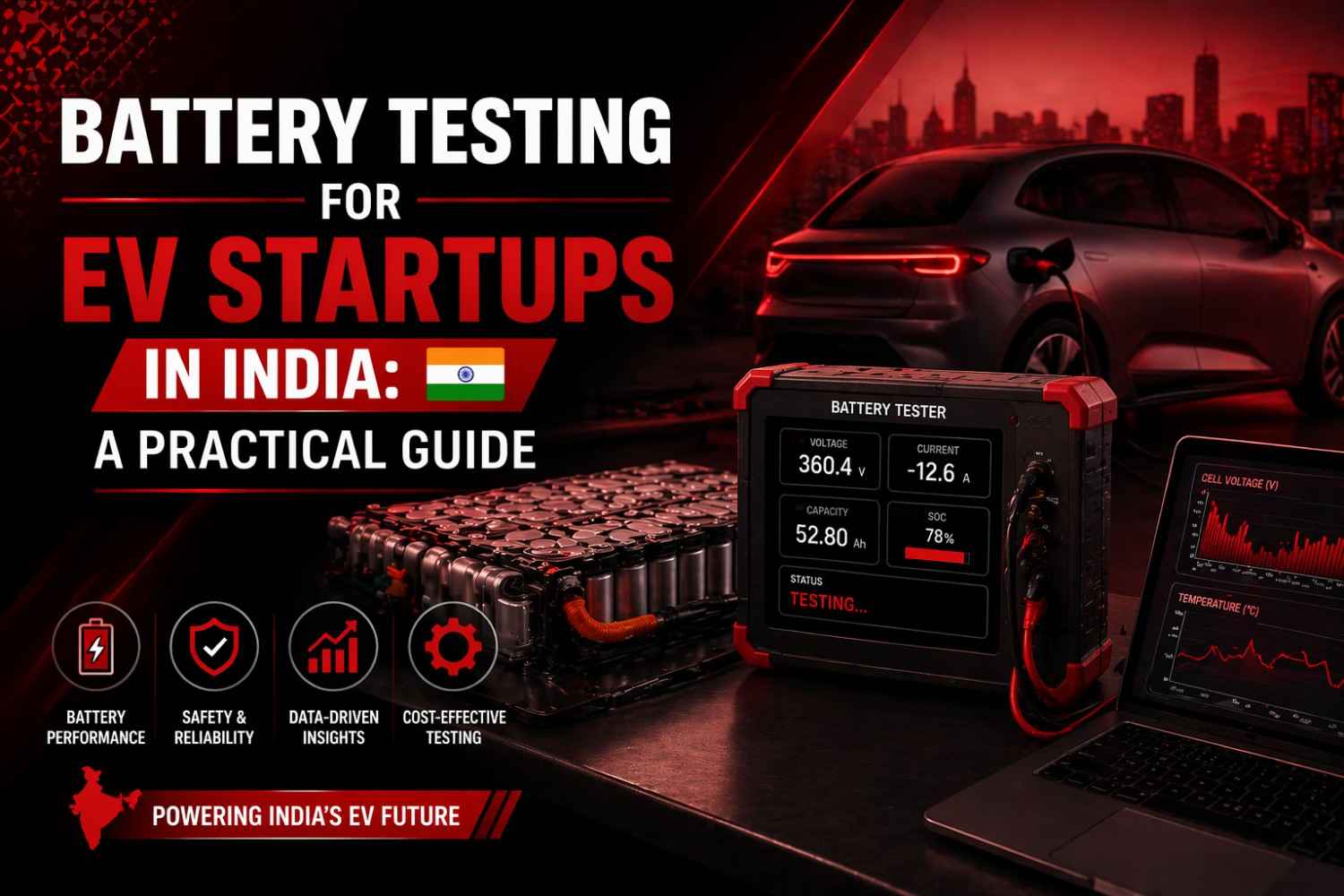
An EV two-wheeler startup in Hyderabad shipped its first batch of 200 vehicles with a battery pack that had passed every bench test in-house. Within four months, 23 units came back with range complaints. The pack capacity was degrading faster than predicted. A forensic review of the testing process revealed the problem: the team had validated the battery at room temperature with a constant discharge profile, but never tested it under the thermal and dynamic load conditions it would actually face on Indian roads in summer. The test data looked good because the test was incomplete.
Battery validation is the most consequential testing activity in EV development. A pack that behaves differently in the field than it did in the lab creates warranty costs, brand damage, and in the worst case, safety incidents. For Indian EV startups working under tight timelines and tighter budgets, building a structured battery test process from the beginning is not a luxury. It is the difference between a product that scales and one that stalls.
Why Battery Testing Cannot Be an Afterthought
The lithium-ion and lithium iron phosphate (LFP) cells used in Indian EV packs are sensitive to a range of operating conditions. Temperature, charge rate, discharge rate, and depth of discharge all affect both the immediate performance and the long-term life of the pack. A battery that delivers its rated capacity under ideal conditions may deliver 15 to 20 percent less under the thermal and load conditions of a real-world Indian duty cycle.
Regulatory requirements add another layer of obligation. The AIS 156 standard, which governs EV battery safety in India, mandates specific tests before a vehicle can receive type approval. Startups that treat validation as a pre-submission formality, rather than an ongoing engineering process, typically discover gaps in their test coverage at the worst possible time, which is during the approval process or after launch.
The Core Tests Every EV Battery Pack Needs
Capacity and State of Charge Verification
Capacity testing establishes the actual energy content of the pack under defined charge and discharge conditions. The test charges the pack to its upper voltage limit, holds it at a defined current until the charge current drops below a threshold, and then discharges it at a constant current until the lower voltage cutoff is reached. The discharge energy measured during this test is the actual capacity of the pack.
State of charge (SoC) calibration is a related requirement. The battery management system (BMS) estimates SoC from voltage and current data, and its accuracy depends on how well the cell model is characterized across the full temperature and aging range. Poor SoC calibration leads to incorrect range predictions, which is one of the most common customer complaints in early EV programs.
Cycle Life and Aging Tests
A cycle life test subjects the battery pack to repeated charge and discharge cycles and measures how capacity and internal resistance evolve over time. Indian EV applications often have aggressive duty cycles, with daily fast charging, high ambient temperatures, and high average discharge rates on congested urban roads. A cycle life test protocol that does not reflect these conditions will overestimate real-world longevity.
Accelerated aging tests compress the timeline by running cycles at elevated temperatures or higher stress levels, with correction factors applied to estimate field life. These tests require stable, programmable charge and discharge equipment that can run continuously for days or weeks without drift in the applied current or voltage profiles.
Thermal Performance Testing
Battery performance degrades significantly below 10 degrees Celsius and above 45 degrees Celsius. For a market that ranges from Ladakh winters to Rajasthan summers, thermal characterization across the operating envelope is essential. Tests should cover cold-start charge acceptance, high-temperature capacity derating, and the thermal management system's ability to maintain the pack within its safe operating temperature range during fast charge and peak discharge events.
Protection Circuit Validation
The BMS and protection circuit must respond correctly to fault conditions including overvoltage, undervoltage, overcurrent, short circuit, and overtemperature. Each fault condition needs to be deliberately induced in a controlled test setup, and the protection response must be verified to activate within the specified time window. This testing requires equipment that can apply precisely controlled fault stimuli without damaging the test instruments themselves.
Equipment Your Battery Test Lab Needs
Battery Testers
A dedicated battery tester combines a programmable charge source and a programmable discharge load in a single instrument, with integrated cell and pack voltage monitoring, temperature measurement inputs, and built-in test sequence programming. Purpose-built battery testers handle the charge and discharge transitions automatically, log data at high resolution, and flag anomalies during the test. For a startup running multiple packs simultaneously, channel-expandable battery test systems allow one control interface to manage several packs in parallel.
DC Electronic Loads
A high-power DC electronic load complements the battery tester for dynamic discharge profiling. When the test requires a realistic drive cycle simulation rather than a constant current discharge, a programmable electronic load running a current profile derived from real vehicle data gives far more accurate results. Dynamic loads with fast slew rates can reproduce the rapid current changes that occur during acceleration and regenerative braking events.
Power Meters
Accurate energy measurement during charge and discharge cycles requires a precision power meter capable of measuring both DC power and energy over time. Power meter data is the reference for capacity calculations, efficiency measurements of the BMS and thermal management system, and round-trip energy efficiency reporting. Instruments with data logging capability and communication interfaces simplify the integration of power measurement data into test reports.
Building a Battery Test Lab in India on a Practical Budget
Most early-stage EV startups in India do not need a full-scale battery test facility on day one. A practical first-phase setup includes a mid-range battery tester covering your cell and module voltage range, a DC electronic load sized to your peak discharge current, a precision power meter, a thermal chamber if thermal characterization is in scope, and a data acquisition system to log all sensor channels during tests.
The critical requirement is that the instruments share a common communication interface, typically USB, LAN, or RS-232, so that a single test automation script can control the full setup. Manual test execution for cycle life tests that run hundreds of cycles is not practical. Automation from the beginning builds the discipline that scales when the test program grows.
Common Mistakes Indian EV Startups Make in Battery Testing
- Testing cells only, without validating the assembled pack behavior including BMS overhead and thermal gradients across modules
- Running capacity tests at a single temperature and assuming the result represents field performance
- Using a general-purpose power supply for charging instead of a current-controlled charger with programmable cutoff conditions
- Skipping protection circuit fault injection tests until the regulatory submission stage, when failures are expensive to fix
- Logging voltage data only and omitting current and temperature channels, which are essential for accurate state-of-health trending
Conclusion
Battery testing is the engineering foundation on which EV product reliability is built. For Indian startups operating in a market where range anxiety, charging infrastructure gaps, and summer heat stress are real factors, a rigorous test process that covers capacity, cycle life, thermal performance, and protection circuit behavior is not optional. The cost of thorough battery validation is a fraction of the cost of a field failure campaign.
Revine Technologies supplies battery testers, DC electronic loads, and power meters configured for EV pack validation, with application support for test sequence design and lab setup. To discuss the right configuration for your battery test program, speak with our EV testing specialists.