
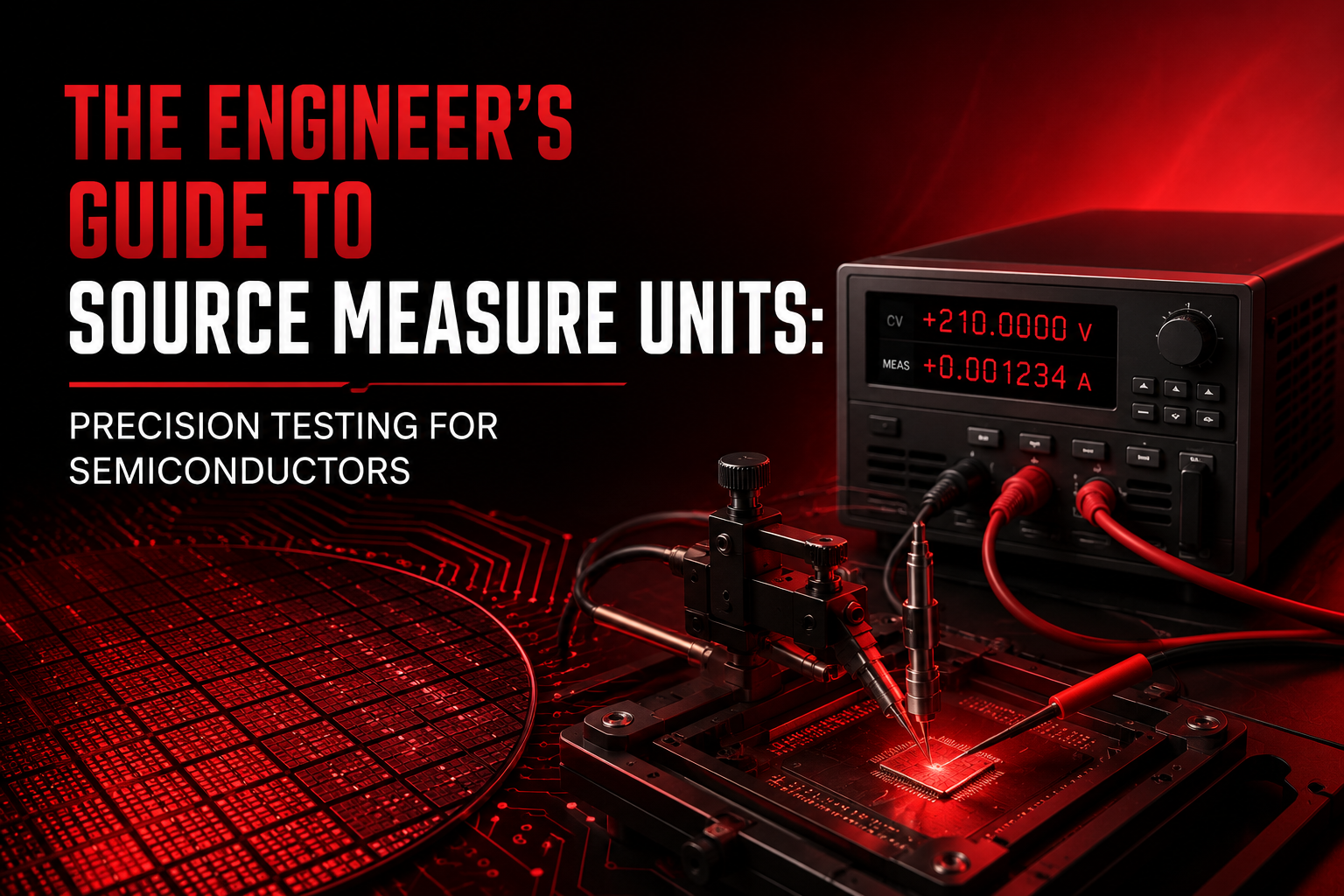
As the hardware design and manufacturing ecosystem expands, the demand for rigorous semiconductor testing in India is at an all-time high. Whether characterizing a new discrete diode, testing nanomaterials, or validating power management ICs (PMICs), engineers require instruments capable of extraordinary accuracy.
Standard lab equipment often falls short when measuring leakage currents in the nano-amp range or sweeping voltage with micro-volt precision. This is where the SMU instrument (Source Measure Unit) becomes an indispensable tool in an electronics lab.
What is an SMU Instrument?
A Source Measure Unit tightly integrates four critical lab instruments into a single, highly synchronized device:
-
A precision bipolar DC power supply.
-
A true current source.
-
A highly accurate digital multimeter (DMM).
-
An electronic load.
Unlike traditional power supplies, an SMU operates in four quadrants. This means it can both source (provide) and sink (absorb) power seamlessly while simultaneously measuring voltage and current.
Why Semiconductor Testing Demands Precision
When characterizing semiconductor devices like MOSFETs, LEDs, or photovoltaic cells, you are typically capturing their Current-Voltage (I-V) curves. This requires precision current voltage measurement over extremely wide dynamic ranges.
For example, a modern MOSFET in its "off" state might leak only a few pico-amps (pA), but in its "on" state, it could conduct several amps. Measuring this accurately requires an instrument that can seamlessly shift measurement ranges without interrupting the test—a capability unique to high-quality SMUs.
Common SMU Applications in Electronics Labs
| Device Under Test (DUT) | Key Measurement | Why an SMU is Required |
| Diodes & LEDs | Forward voltage drop, reverse leakage current. | Ability to sweep voltage and measure nano-amp reverse leakage simultaneously. |
| MOSFETs / BJTs | Transfer characteristics, threshold voltage. | Pulsed sweeps to prevent device self-heating during testing. |
| Sensors | Dark current, sensitivity. | Extreme low-level current sourcing and measurement. |
Setting Up Your Test: SMU vs. Standard Power Supply
A common mistake made by junior engineers or electronics learners is attempting to characterize a delicate component using a standard bench power supply and a separate DMM. This setup introduces synchronization errors, cabling resistance, and noise.
-
When to use a Power Supply: If your goal is simply to power up a PCB prototype, charge a battery, or drive a heavy DC motor, a standard ITECH DC Power Supply is the correct and most cost-effective choice.
-
When to use an SMU: If you need to generate an exact voltage sweep, measure the corresponding current with 6½-digit resolution, and plot an I-V curve, you need an ITECH Source Measure Unit.
Best Practices for High-Precision Measurements
To get the most out of your ITECH SMU, you must eliminate external sources of measurement error. Implementing a high-quality source measure unit India lab setup requires attention to the following:
1. Always Use Kelvin (4-Wire) Connections
When sourcing high current, the internal resistance of your test leads will cause a voltage drop ($V = I \times R$). By using a 4-wire connection, you separate the force leads (which carry the current) from the sense leads (which measure the voltage directly at the DUT). This eliminates lead resistance errors.
2. Implement Guarding for Low Current
When measuring currents below 1 micro-amp (µA), the leakage current running through the insulation of your coaxial cables can skew your results. Using a triaxial cable with a driven guard shield ensures that the cable insulation does not draw away the measurement current.
3. Limit Device Self-Heating
Continuous voltage sweeps can heat up semiconductor components, fundamentally altering their electrical characteristics. Use the "pulsed sweep" function on your ITECH SMU to apply power in brief, precise milliseconds, allowing the device to cool between measurement points.
Conclusion
Mastering precision electronics validation starts with the right equipment. By transitioning from disjointed power supplies and DMMs to a unified, four-quadrant SMU instrument, engineers can confidently characterize complex semiconductors, minimize testing errors, and accelerate the research and development lifecycle.
FAQ
1. What is four-quadrant operation in an SMU?
Four-quadrant operation means the SMU can operate as a positive voltage/positive current source (Quadrant 1), a positive voltage/negative current sink (Quadrant 2), a negative voltage/negative current source (Quadrant 3), and a negative voltage/positive current sink (Quadrant 4).
2. Can I use an SMU as a regular DMM?
Yes. An SMU can function as an extremely accurate standalone Digital Multimeter to measure voltage, current, or resistance by simply disabling its sourcing capabilities.
3. Why do I need triaxial cables instead of standard coaxial cables for my SMU?
For ultra-low current measurements (nano-amps and below), standard coaxial cables suffer from leakage currents through the insulation. Triaxial cables include an inner guard shield driven at the same potential as the signal, eliminating leakage and reducing settling time.
4. What is an I-V curve, and why is it important?
An I-V (Current-Voltage) curve is a graphical representation of how a component's current responds to varying voltages. It is the fundamental blueprint of a semiconductor's behavior, revealing parameters like breakdown voltage, operating regions, and efficiency.