
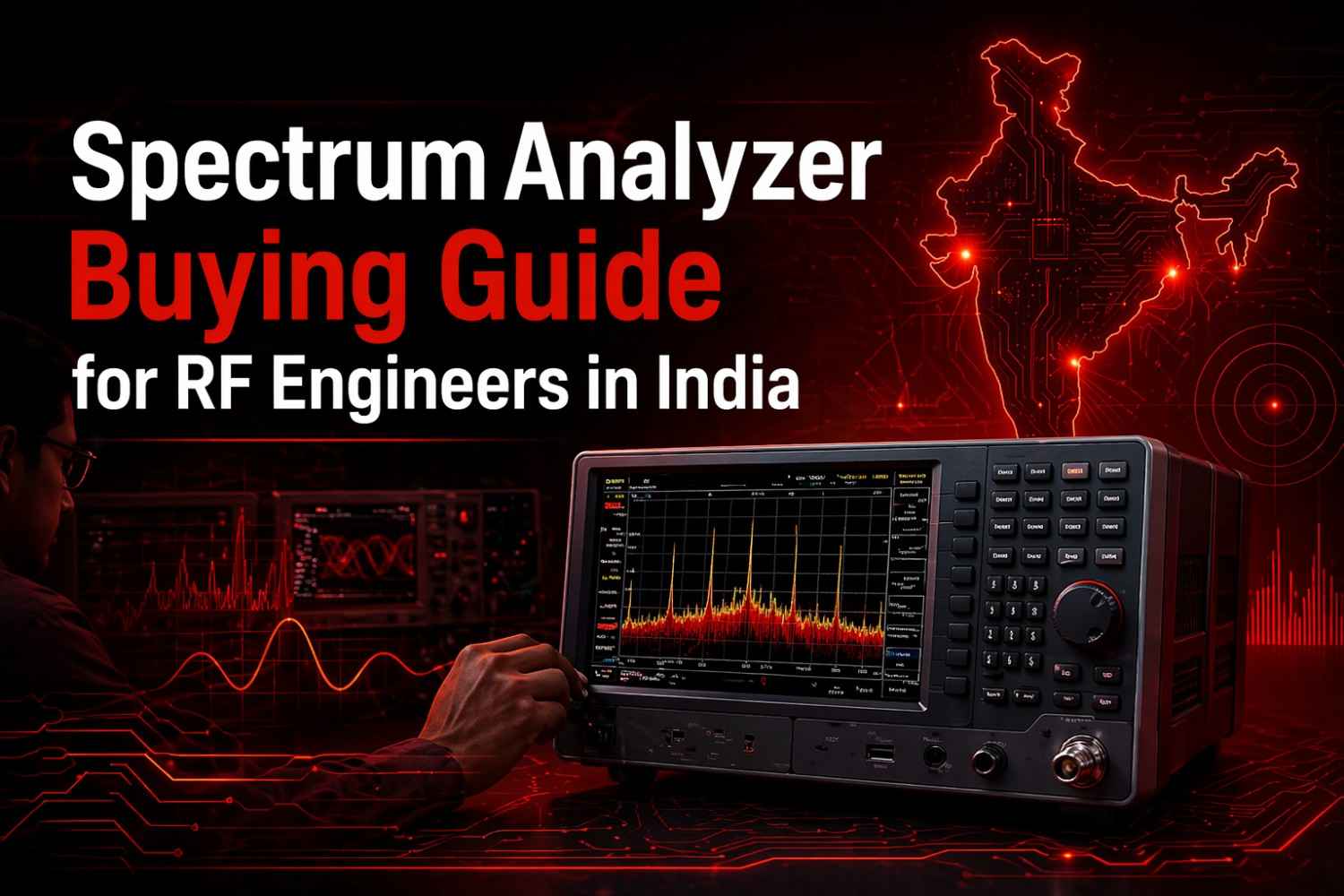
A defense electronics lab in the Delhi NCR region spent four months troubleshooting an interference problem in a communication system. The engineers had an older swept-tuned spectrum analyzer available, and while it could show the interference signature, it could not capture the intermittent spurious signals that were causing the problem. The signals appeared for milliseconds at unpredictable intervals and vanished before the analyzer could complete its sweep. The issue was finally isolated using a real-time spectrum analyzer borrowed from another facility. The resolution took a day. The delay cost four months.
A spectrum analyzer is the instrument that gives RF engineers visibility into the frequency domain. Without it, interference sources stay hidden, transmitter performance goes unverified, and certification testing becomes a guessing exercise. For Indian RF labs building capability in wireless design, telecom infrastructure, defense electronics, or EMI compliance, choosing the right spectrum analyzer is one of the highest-impact procurement decisions a team will make.
What a Spectrum Analyzer Actually Measures
A spectrum analyzer measures signal amplitude as a function of frequency. Where an oscilloscope shows how a signal changes over time, a spectrum analyzer shows which frequencies are present in a signal and how much power each frequency component carries. This view is essential for characterizing transmitters, identifying harmonic distortion, locating interference sources, verifying channel occupancy, and measuring spurious emissions against regulatory limits.
Modern spectrum analyzers come in two fundamental architectures. Swept-tuned analyzers scan across a frequency range sequentially, which works well for stable, continuous signals. Real-time spectrum analyzers (RTSA) capture the entire frequency span simultaneously using fast Fourier transform processing, which makes them the only viable option for detecting short-duration or intermittent signals. Understanding which signal behavior your application presents is the first step in selecting the right instrument.
Key Specifications to Evaluate
Frequency Range
The frequency range of the analyzer must cover every signal your test program requires, with margin. For general electronics work, a range up to 3 GHz covers most wireless protocols including Wi-Fi, Bluetooth, Zigbee, and sub-GHz IoT bands. Telecom testing for 4G and 5G sub-6 GHz bands requires coverage to at least 6 GHz. Microwave and millimeter-wave applications, including radar, satellite, and 5G mmWave, require coverage from 18 GHz to 40 GHz or higher. Buying an analyzer at the edge of your current requirement leaves no room for program growth.
Resolution Bandwidth
Resolution bandwidth (RBW) determines the analyzer's ability to separate two closely spaced signals in the frequency domain. A narrow RBW provides better frequency resolution but requires more sweep time. For applications that need to resolve adjacent channel interference or identify closely spaced spurious signals, an analyzer with RBW settings as narrow as 1 Hz or 10 Hz is necessary. For fast sweep applications where only approximate power levels matter, wider RBW settings are acceptable.
Phase Noise
Phase noise is the spectral impurity of the analyzer's internal reference oscillator. It appears as a noise skirt around every measured signal and can mask low-level signals that sit close in frequency to a strong carrier. For applications involving oscillator characterization, frequency synthesizer testing, or satellite communication system validation, phase noise specification is one of the most critical parameters to compare across instruments.
Dynamic Range and Sensitivity
Dynamic range describes the analyzer's ability to measure a weak signal in the presence of a strong one. Sensitivity, expressed as displayed average noise level (DANL), defines the weakest signal the instrument can detect. For applications like passive intermodulation (PIM) testing, receiver sensitivity validation, or radar cross-section measurement, both dynamic range and DANL are limiting factors. Preamplifier options can extend the sensitivity of many instruments when the standard specification falls short.
Real-Time Spectrum Analysis
Real-time spectrum analysis capability is defined by the probability of intercept (POI), which is the minimum signal duration the instrument can capture with 100 percent probability. Instruments with POI specifications in the microsecond range can capture fast frequency-hopping signals, radar pulses, and wireless protocol bursts that swept-tuned analyzers would miss entirely. For defense electronics, spectrum monitoring, and wireless protocol development, RTSA capability is not optional. It is the specification that determines whether the instrument can do the job.
Matching the Analyzer to Your Application
General-Purpose RF and Electronics Labs
A benchtop signal spectrum analyzer with a frequency range up to 3 GHz or 6.5 GHz, standard RBW filters, and basic tracking generator covers the requirements of most general-purpose RF labs working on wireless product development. The tracking generator enables scalar network analysis and filter characterization without a separate vector network analyzer, which is a practical cost saver for labs that do not need full S-parameter measurement capability.
Wireless and Telecom Testing
Labs validating 4G LTE, 5G NR, Wi-Fi 6, and private network equipment need analyzers with built-in measurement personalities for these standards. These personalities automate measurements of channel power, adjacent channel leakage ratio (ACLR), error vector magnitude (EVM), and occupied bandwidth, which would otherwise require manual configuration for each test. The Anritsu signal spectrum analyzer range supports these measurement modes with high accuracy across the relevant frequency bands.
Defense and Aerospace
Defense applications demand wide frequency coverage, high dynamic range, fast capture capability, and in many cases, ruggedized or portable form factors for field deployment. Pulse analysis, radar characterization, and electronic warfare signal analysis all benefit from RTSA capability combined with deep memory for long capture windows. Spectrum analyzers used in defense programs must also meet specific calibration traceability requirements that align with NABL or equivalent standards.
EMI Pre-Compliance Testing
Pre-compliance EMI testing uses a spectrum analyzer with a LISN (line impedance stabilization network) and appropriate antennas to measure conducted and radiated emissions against CISPR or BIS limits before formal certification. This process identifies emission problems early, when circuit changes are inexpensive, rather than during formal testing, when a failure requires a complete resubmission cycle. An analyzer with quasi-peak and average detectors, and the appropriate limit line overlays, simplifies this workflow significantly. The Anritsu RF and microwave instruments support pre-compliance workflows with built-in limit line functionality.
Handheld vs Benchtop: Which Form Factor Fits Your Lab
Benchtop spectrum analyzers offer the highest performance in terms of dynamic range, phase noise, and measurement flexibility. They are the right choice for lab-based development and verification work where the instrument stays at a fixed location. Handheld spectrum analyzers sacrifice some performance for portability and battery operation, which makes them better suited for field troubleshooting, site surveys, tower maintenance, and in-building RF coverage assessment. Some programs maintain both: a benchtop unit for development and a handheld for field verification.
What Indian RF Engineers Often Overlook When Buying
- Calibration interval and the availability of NABL-accredited calibration for the specific model in India
- Software license costs for measurement personalities, which are sometimes sold separately and can add 20 to 40 percent to the instrument cost
- Probe and accessory compatibility, including the availability of appropriate RF cables, adapters, and antennas from local suppliers
- Local application support: an instrument that comes with in-country application engineers who can help configure test setups saves significant time during initial deployment
- Upgrade paths: a platform that supports future frequency range or measurement personality upgrades protects the investment as program requirements evolve
Conclusion
A spectrum analyzer is a long-term investment in your lab's measurement capability. Selecting the right instrument requires matching frequency range, resolution bandwidth, phase noise, dynamic range, and real-time capability to the specific signals and applications in your test program. For Indian RF labs working across wireless product development, telecom infrastructure, defense, or EMI compliance, the right starting point is a clear map of your current and planned measurement requirements.
Revine Technologies offers a curated range of spectrum analyzers for RF and microwave applications, backed by application support and calibration services. To get a recommendation matched to your specific test program, speak with our RF instrumentation team.