
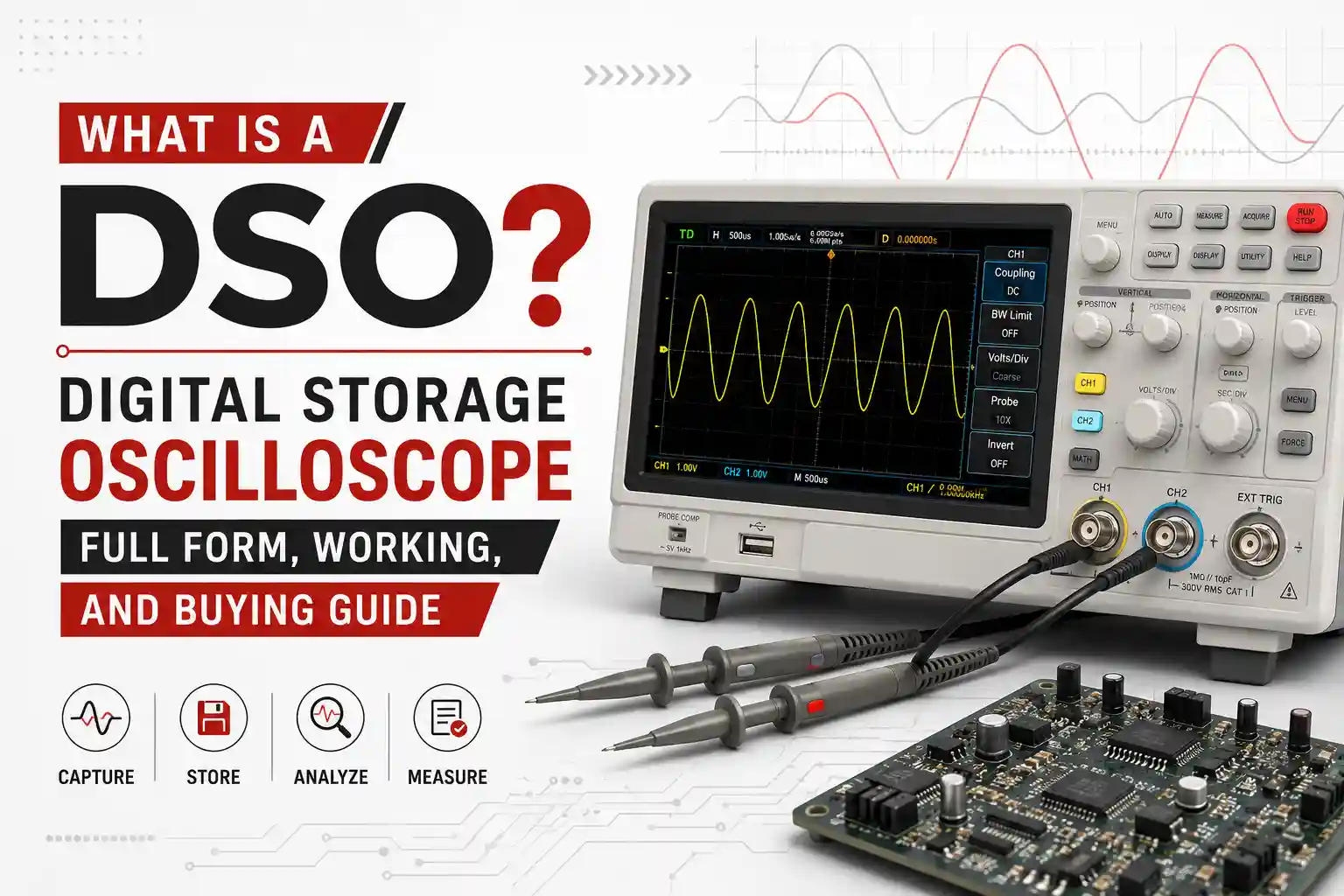
The oscilloscope is the instrument engineers reach for first when a circuit is not behaving as expected. And while analog oscilloscopes served the industry well for decades, the digital storage oscilloscope - the DSO - transformed what was possible at the bench. The ability to capture, store, and analyse transient events changed how engineers debug, validate, and document electronic designs.
If you have searched for 'DSO full form' or 'what is a digital storage oscilloscope', this guide gives you a complete answer: what DSO stands for, how the instrument works internally, the specifications that determine what it can measure, how it compares to analog and mixed-signal oscilloscopes, and how to select the right model for your application.
DSO Full Form - What Does DSO Stand For?
DSO stands for Digital Storage Oscilloscope. The name captures two defining characteristics: 'digital' because the instrument converts analog input signals into digital data using an analog-to-digital converter, and 'storage' because that digital data is retained in memory so the waveform can be displayed, analysed, and recalled after the event has passed.
This distinguishes the DSO from a traditional analog oscilloscope, which displays a live waveform on a phosphor CRT screen but cannot capture or store transient events for later analysis. The storage capability is what makes the DSO essential for debugging intermittent faults, characterising single-shot events, and performing measurements that require post-capture processing.
What Is a Digital Storage Oscilloscope?
A digital storage oscilloscope is a test instrument that measures and displays the voltage of electrical signals as a function of time. It converts the input signal from analog to digital form, stores the samples in acquisition memory, and reconstructs a visual representation of the waveform on its display.
Modern DSOs offer capabilities that analog instruments cannot approach: variable persistence displays, automatic parametric measurements (rise time, frequency, RMS voltage, THD), FFT-based frequency domain analysis, serial bus decoding (I2C, SPI, UART, CAN), mask testing for production verification, and data export for post-processing in external software.
The DSO is the dominant oscilloscope type in electronics labs worldwide, with variants ranging from compact entry-level two-channel instruments for student and hobbyist use to high-performance multi-channel units with bandwidths in the gigahertz range for RF, high-speed digital, and mixed-signal applications.
How Does a DSO Work? Block Diagram Explained
Tracing the signal through each stage of the DSO's acquisition chain gives a clear picture of what the instrument is doing and why each specification matters.
Analog Input and Probe
The signal enters the DSO through a probe connected to one of the input channels. Understanding different probe types and their applications is essential for accurate measurements, as discussed in oscilloscope probes explained. The probe performs two functions: it attenuates the signal to a level the oscilloscope's input circuit can safely handle (a 10:1 probe, for instance, reduces the voltage by a factor of ten), and it presents a high impedance to the circuit under test so the measurement does not load the circuit and alter its behaviour. The input amplifier then conditions the signal—adjusting gain and offset—before it reaches the ADC.
Analog-to-Digital Converter (ADC)
The ADC samples the analog input signal at the oscilloscope's sample rate and converts each sample into a digital value. Sample rate is measured in samples per second (Sa/s). A DSO sampling at 1 GSa/s captures one billion voltage readings per second. The ADC resolution - typically 8 bits in standard DSOs, 12 bits in high-resolution modes - determines how many distinct voltage levels can be represented: 256 levels at 8 bits, 4096 at 12 bits.
Acquisition Memory
The digitised samples are stored in acquisition memory. Memory depth - the total number of samples the memory can hold - determines how long a waveform can be captured at maximum sample rate without the oscilloscope being forced to reduce its sample rate to fit the capture within memory. For engineers looking to understand this concept in greater detail, what is memory depth in oscilloscopes provides a comprehensive explanation of how memory impacts waveform capture and analysis.
A DSO with 50 Mpts (megapoints) of memory at 1 GSa/s can capture 50 milliseconds of signal at full resolution. Deeper memory allows longer captures at higher sample rates, which is critical for debugging protocols, capturing intermittent glitches, and analysing modulated signals.
Trigger System
The trigger system determines when the DSO captures a waveform segment. Without triggering, the display would show a continuously scrolling signal that is impossible to interpret. The trigger fires when the signal meets a defined condition - crossing a voltage threshold on a rising edge, for example, or matching a specific digital pattern. Advanced trigger modes include pulse-width trigger, runt trigger, glitch trigger, and serial bus trigger, each targeting specific signal anomalies that would be impossible to capture with a simple edge trigger.
Display and Processing
The captured waveform data is processed by the DSO's signal processing engine, which applies the selected timebase and voltage scale, performs automatic measurements, calculates FFT spectra, decodes serial bus data, and renders the waveform on the instrument's display. Modern DSOs use bright, high-resolution LCD or capacitive touchscreen panels that can show multiple waveforms simultaneously with sufficient vertical resolution to distinguish signal details clearly.
Key Specifications in a DSO
Four specifications determine what a DSO can measure and how accurately it can measure it. Understanding each one prevents the common mistake of selecting an instrument that cannot meet the application's requirements.
Bandwidth
Bandwidth is the frequency at which the DSO's input circuit attenuates the signal by 3 dB (approximately 30%). A signal at the DSO's specified bandwidth is measured at 70% of its actual amplitude. For readers seeking a deeper understanding of this specification, what is bandwidth in an oscilloscope explains how bandwidth affects signal measurement accuracy and oscilloscope selection.
For accurate amplitude measurement, the oscilloscope bandwidth should be at least three times the highest frequency of interest; for accurate rise-time measurement, the widely used rule is five times the highest frequency component in the signal's edges.
A 100 MHz DSO is suitable for signals up to roughly 20-30 MHz. A 500 MHz DSO handles signals up to around 100 MHz, and so on. Choosing insufficient bandwidth causes rise time errors, amplitude roll-off, and missed high-frequency content.
Sample Rate
Sample rate defines how many samples per second the ADC captures. For engineers new to digital oscilloscopes, understanding sampling rate is essential because it directly affects waveform accuracy and the ability to capture fast signal events.
The Nyquist theorem states that the sample rate must be at least twice the highest frequency present in the signal to avoid aliasing. In practice, DSOs use sample rates of five to ten times the bandwidth to represent waveforms accurately. A 200 MHz DSO typically samples at 1-2 GSa/s. Note that sample rate is sometimes quoted per channel and sometimes as a shared total across channels - verify which is specified before selecting an instrument.
Memory Depth
Memory depth determines how long a waveform can be captured at the maximum sample rate. It is expressed in points, kpts (kilopoints), Mpts (megapoints), or Gpts (gigapoints). Deep memory is important when capturing long time windows while maintaining fine time resolution - for example, capturing an entire communication frame at full sample rate, or holding a long acquisition to search for an infrequent glitch. Standard entry-level DSOs offer 14-24 Mpts; professional instruments offer hundreds of megapoints or more.
Number of Channels
Most DSOs are available in two-channel and four-channel configurations. Two-channel instruments suit the majority of single-signal or two-signal comparison measurements. Four-channel instruments are necessary for tasks like measuring differential signals on multiple power rails simultaneously, debugging multi-phase power converters, or comparing stimulus and response across multiple signal paths. Some DSOs offer eight or more channels as optional upgrades.
DSO vs Analog Oscilloscope
Analog oscilloscopes have been largely superseded by DSOs for general lab use, but understanding their differences clarifies the DSO's advantages and the few remaining cases where analog instruments are preferred.
| Feature | Digital storage oscilloscope (DSO) | Analog oscilloscope |
| Signal capture | Stores digital samples; can capture single-shot events | Continuously displays live signal; no storage |
| Waveform analysis | Automatic measurements, FFT, cursor readouts, math functions | Manual measurement from graticule |
| Triggering | Advanced: pulse-width, glitch, pattern, serial decode | Basic: edge and TV trigger only |
| Display | High-resolution LCD or touchscreen | CRT phosphor screen |
| Update rate | Limited by processing (waveform/sec) | Very high (real-time analog display) |
| Noise floor | Quantisation noise from ADC | Inherently analog, no quantisation noise |
| Price (entry) | Rs. 30,000 and upward | Generally lower for basic models |
| Status | Current standard for most applications | Legacy; preferred in niche RF/analog work |
DSO vs MSO - What Is the Difference?
A mixed-signal oscilloscope (MSO) is an extension of the DSO that adds digital logic analyser channels alongside the standard analog channels. An MSO with four analog channels and 16 digital channels can simultaneously capture analog waveforms and digital bus signals on a common timebase, which is essential when debugging embedded systems where software and hardware interact.
The digital channels on an MSO use a simpler single-bit comparator (threshold detection) rather than a full ADC, so they capture logic-level high/low states at high sample rates but cannot resolve signal amplitude. For pure analog measurement, a DSO is sufficient. For embedded system debugging, protocol analysis, or any application requiring simultaneous analog and digital visibility, an MSO provides a significant advantage.
Common Applications of a DSO
Embedded System Debugging
DSOs are the primary tool for debugging microcontroller-based systems. Serial bus decoding (I2C, SPI, UART, CAN, LIN) allows the engineer to verify protocol timing and data content directly on the oscilloscope display, while simultaneously viewing the analog waveform to check signal integrity.
Power Supply Testing and Characterisation
Measuring switching ripple, transient response to load steps, and startup/shutdown behaviour all require a DSO's storage capability. A two-channel DSO can simultaneously display the input and output of a power stage to characterise efficiency and identify resonance.
Signal Integrity Analysis
High-speed digital signals - PCIe, USB 3.0, DDR4 memory interfaces - require bandwidth in the hundreds of megahertz to gigahertz range to characterise eye diagrams, jitter, and inter-symbol interference. High-bandwidth DSOs with sampling rates in the multi-GSa/s range are the standard tool for this work.
Audio and RF Testing
FFT analysis on a DSO turns it into a real-time spectrum display for audio-frequency and low-RF applications. Distortion analysis, harmonic measurement, and signal-to-noise characterisation are all accessible through the built-in math functions of a modern DSO.
How to Choose a DSO for Your Lab
Selecting the right DSO starts with defining your application's requirements, then matching them to the available specifications and budget.
Step 1: Define Your Bandwidth Requirement
Identify the highest frequency signal you will need to measure accurately. Apply the 5x rule: if your highest frequency of interest is 50 MHz, you need at least a 250 MHz oscilloscope. For embedded system work involving microcontrollers below 100 MHz, a 200-300 MHz DSO covers most scenarios. For power electronics, automotive, and general analog work, 100-200 MHz is usually sufficient. For high-speed digital interfaces, 500 MHz to 1 GHz or beyond is needed.
Step 2: Determine Channel Count
Two channels are sufficient for most single-signal debugging and two-signal comparisons. Four channels are needed for differential measurements, multi-rail power analysis, or any application where you need to view three or four signals simultaneously on a common timebase. If you need digital channel capability, look at MSO variants.
Step 3: Evaluate Memory Depth
For general debugging, 14-24 Mpts is adequate. For capturing long protocols (CAN frames, Modbus packets, bootloader sequences), or for hunting infrequent glitches over long time windows, 100 Mpts or deeper is worthwhile. Check whether the quoted memory depth is per channel or total shared across all channels.
Entry-Level vs Advanced DSOs
Entry-level DSOs in the Rs. 30,000-80,000 range (such as models available within the RIGOL oscilloscopes at Revinetech range) cover the requirements of most general electronics labs, educational institutions, and embedded development work. USB-based solutions such as PICO oscilloscopes are also popular where portability, PC integration, and advanced analysis software are important.
Mid-range instruments in the Rs. 1-3 lakh range offer higher bandwidth, deeper memory, touchscreen interfaces, and built-in serial decode. Alternative PC-based measurement platforms such as Cleverscope oscilloscopes provide additional flexibility for engineers who prefer software-driven test and measurement environments.
High-performance instruments above Rs. 3 lakh are designed for signal integrity, automotive, and RF applications where bandwidth and low noise floor are critical.
Find the Right Oscilloscope for Your Lab
Revinetech stocks RIGOL, PICO, and Cleverscope digital storage oscilloscopes across a range of bandwidths, channel counts, and memory depths, with models suitable for student labs, professional R&D benches, and production test systems. Our applications team in Pune can help you match the right instrument to your measurement requirements.
Explore the full RIGOL digital storage oscilloscope range - starting from under Rs. 40,000 for the DS1054Z - and contact our team for a demo or technical recommendation.
Frequently Asked Questions
What is the full form of DSO?
DSO stands for Digital Storage Oscilloscope. It is a type of oscilloscope that converts analog input signals to digital form using an ADC, stores the samples in acquisition memory, and reconstructs the waveform on a digital display.
What is the difference between a DSO and a normal oscilloscope?
A 'normal' or analog oscilloscope displays a live signal on a CRT screen without storage capability. A DSO digitises the signal, stores it in memory, and can display, analyse, and recall the waveform after the event. The DSO's storage capability makes it essential for capturing transient events, intermittent faults, and single-shot signals.
What bandwidth DSO do I need for embedded systems work?
For most microcontroller-based work involving signals below 100 MHz, a 200-300 MHz DSO provides comfortable margin. If you are debugging high-speed interfaces like USB 2.0, Ethernet, or PCIe, you will need bandwidth in the 500 MHz to 1 GHz range or beyond. Apply the 5x rule to your highest signal frequency to determine the minimum bandwidth needed.
Can a DSO replace a spectrum analyser?
For audio-frequency and low-frequency RF applications, the FFT function on a modern DSO provides useful spectral analysis. For dedicated RF work above a few hundred megahertz, a spectrum analyser is a better choice: it provides wider frequency span, better sensitivity, and purpose-built markers and measurement functions that a DSO's FFT cannot match.
Is a DSO or MSO better for embedded system debugging?
An MSO is generally better for embedded debugging because it adds digital logic channels that can decode serial buses (I2C, SPI, UART, CAN) on a common timebase with the analog channels. If your work involves purely analog signals or single-board digital debugging with no complex serial bus analysis, a DSO is sufficient. If you need to correlate software behaviour with hardware signals, an MSO provides a decisive advantage.