
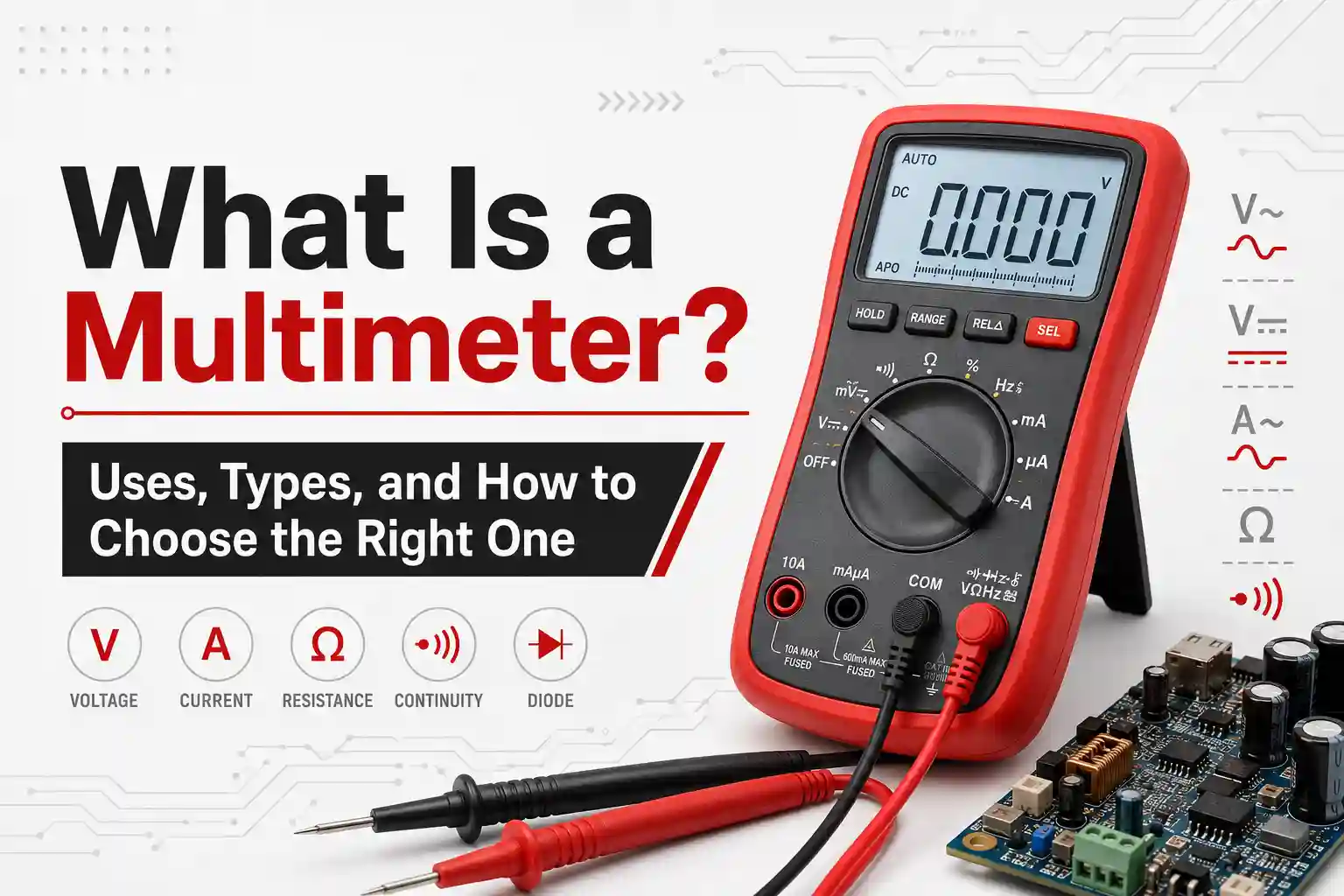
The multimeter is the most widely used electrical test instrument in the world. Every electronics engineer, electrician, maintenance technician, and automotive mechanic relies on one to verify circuit behaviour, isolate faults, and make the measurements that define whether a system is working as intended. Understanding what a multimeter measures, how its different modes work, and what separates a reliable professional instrument from a basic unit saves time during commissioning, troubleshooting, and safety-critical maintenance work.
This guide covers the multimeter meaning and full form, the functions it performs, the difference between analog and digital types, the practical uses of a multimeter across different industries, and a clear framework for selecting the right instrument for your application.
Multimeter Meaning and Full Form
A multimeter is an electronic test instrument that combines multiple measurement functions in a single device. The name itself describes the concept: multi (many) plus meter (measurement instrument). The word is also written as multi-meter in some contexts, though multimeter is the standard single-word form in technical literature.
The digital variant is widely known by its abbreviation DMM, which stands for Digital Multimeter. A DMM displays measurements on a digital numeric readout rather than a moving-needle analog scale, and it typically offers higher accuracy, greater input impedance, and additional measurement functions compared to analog instruments.
In everyday use, the terms multimeter, DMM, and digital multimeter are used interchangeably. Strictly, DMM refers specifically to digital instruments, while multimeter covers both digital and analog types. In professional and industrial contexts, DMM is the dominant term.
What Does a Multimeter Measure?
A standard DMM measures three fundamental electrical quantities, and most modern instruments extend beyond these three into additional functions that were once only available in specialised instruments.
DC Voltage (VDC)
The most commonly used function on any multimeter. DC voltage measurement is used to check battery states, verify power supply outputs, measure signal levels in electronic circuits, and diagnose wiring faults. Professional DMMs measure DC voltage across multiple ranges, from millivolts to hundreds or thousands of volts, with accuracy specifications typically expressed as a percentage of reading plus a number of counts (for example, 0.05% + 2 counts on a high-end instrument).
AC Voltage (VAC)
AC voltage measurement covers mains supply verification (checking that a 230V outlet is within tolerance), monitoring inverter and UPS output, and measuring AC signals in power electronics and motor drive systems. Entry-level DMMs measure RMS voltage of a pure sine wave; true-RMS DMMs correctly measure the RMS value of distorted waveforms, which is essential when working with variable-speed drives, UPS systems, and switching power supplies.
DC and AC Current
Current measurement requires the multimeter to be placed in series with the circuit. Most DMMs include a dedicated current input terminal rated for a maximum current (commonly 10A), a separate high-current terminal for brief measurements, and internal fuses to protect the input if the range selection is wrong. Clamp meters measure current non-invasively by sensing the magnetic field around a conductor, which is safer and more practical for high-current applications in the field.
Resistance
Resistance measurement applies a known current through the component under test and measures the resulting voltage to calculate resistance using Ohm's law. Multimeters measure resistance from fractions of an ohm to tens of megohms. Four-wire (Kelvin) resistance measurement, available on precision DMMs, eliminates the effect of lead resistance and is essential for accurate measurements below a few ohms.
Continuity
Continuity mode audibly beeps when resistance between the probes falls below a threshold (typically a few ohms or tens of ohms depending on the instrument). It is the fastest way to verify wiring connections, check for broken traces, confirm relay contact closure, and identify short circuits without needing to read a display value.
Diode Test
Diode test mode applies a small forward voltage and displays the forward voltage drop across a diode junction. A silicon diode in good condition shows approximately 0.5-0.7V in forward bias and overrange in reverse bias. This function quickly verifies diodes, transistor junctions, and LEDs, and identifies open or shorted semiconductor junctions.
Additional Functions on Modern DMMs
Beyond the six core measurements, modern professional DMMs offer capacitance measurement, frequency and duty cycle measurement, temperature measurement via thermocouple or RTD probe, AC+DC current measurement via clamp adapter, low-pass filter mode for measuring fundamental frequency in the presence of harmonics (important for VFD output measurement), and data logging via Bluetooth or USB.
The Fluke digital multimeter range at Revinetech includes models with advanced diagnostic and logging capabilities for industrial, maintenance, and electronics applications. The Fluke 87V, for example, adds a MIN/MAX/AVG recording function and a 20 kHz low-pass filter specifically for variable-frequency drive measurements.
Analog vs Digital Multimeter
Analog and digital multimeters both measure the same electrical quantities, but their operating principles, display types, and practical characteristics differ in ways that determine which suits a given application.
| Display | Needle deflects over a printed scale | Numeric digits on LCD or LED display |
| Accuracy | Typically 2-5% full scale | Typically 0.05-1% of reading |
| Input impedance | 10 kohm/V (loads the circuit) | 10 Mohm (negligible loading effect) |
| True-RMS | Not available | Available on true-RMS models |
| Resistance ranges | Limited, scale is non-linear | Wide, linear digital display |
| Data logging | Not available | Available on professional models |
| Continuity beeper | Not standard | Standard on most DMMs |
| Battery drain indication | Visual needle drop | Low-battery icon on display |
| Best use case | Observing trends and relative changes | Precise digital readout, all industrial applications |
Analog multimeters retain value in two specific scenarios: observing slowly changing values where needle movement is easier to track than a rapidly updating digital display, and in situations where an EMI-sensitive environment makes a purely passive analog instrument preferable. For all other professional and industrial applications, the digital multimeter is the appropriate choice.
Uses of a Multimeter
The practical applications of a multimeter span virtually every discipline that involves electrical circuits. Understanding the specific measurement tasks in each domain clarifies which instrument specifications matter most.
Electronics Lab and R&D
In an electronics lab, a DMM verifies DC power supply output, checks component values before soldering, measures quiescent current to verify standby power consumption, probes logic levels, and confirms I2C pull-up resistor values. A bench DMM with four-wire resistance measurement and sub-milliohm resolution is valuable for measuring PCB trace resistance and connector contact resistance in signal integrity work.
Industrial Maintenance and Commissioning
Industrial maintenance technicians use DMMs to verify three-phase supply voltages, measure motor winding resistance, check insulation resistance (in conjunction with a dedicated insulation tester), test control loop 4-20 mA signals, and verify PLC input/output voltage levels. A CAT III or CAT IV rated DMM is mandatory for work on industrial panels and distribution boards, where voltage transients from inductive switching can reach several kilovolts.
Automotive Diagnostics
Automotive electricians use multimeters to check battery voltage and charging system output, measure starter motor cranking current with a clamp adapter, test fuel injector resistance, verify sensor output voltages (MAF, MAP, O2 sensors), and diagnose wiring harness continuity and ground path resistance. Some automotive DMMs include RPM measurement via inductive clamp and dwell angle measurement.
Power Electronics and Drives
Measuring the output of a variable-frequency drive or inverter requires a true-RMS DMM with a low-pass filter function. The switched output of a VFD contains high-frequency PWM harmonics that cause non-true-RMS instruments to read significantly higher than the actual fundamental voltage. The Fluke 87V's 20 kHz low-pass filter is specifically designed for this measurement, and it is the reason this model is the standard recommendation for VFD commissioning work.
Building and Electrical Contracting
Electrical contractors use DMMs to verify phase-to-phase and phase-to-neutral voltages, check neutral-to-earth voltage, identify reversed polarity, test residual current device (RCD) trip response (with a dedicated tester), and measure earth resistance. Safety category rating is paramount in this environment: mains distribution boards and substation panels require CAT III 600V or CAT IV 600V rated instruments.
Safety Categories - What CAT Rating Means
The IEC 61010-1 standard defines four overvoltage categories (CAT I through CAT IV) that describe the energy level of the electrical environment where a measurement instrument is used. Choosing a DMM with the correct CAT rating is a safety requirement, not a preference.
| CAT I | Electronic equipment | Signal levels, low-energy circuits, battery-powered devices |
| CAT II | Single-phase mains load | Outlets, appliances, portable equipment connected to fixed installation |
| CAT III | Three-phase distribution, fixed installation | Distribution boards, industrial panels, building wiring |
| CAT IV | Origin of installation, utility supply | Meter box, electricity supply entrance, outdoor conductors |
A higher CAT number means the environment has higher available fault energy and the instrument must withstand larger voltage transients. A CAT II instrument used in a CAT III or CAT IV environment poses a serious safety risk from arc flash and measurement category violations. Always select a DMM rated at or above the category of your working environment.
Key Specifications When Choosing a DMM
The right multimeter for a job depends on matching four specification areas to the measurement requirements.
Accuracy and Resolution
DMM accuracy is specified as a percentage of reading plus a number of least-significant digits (counts). A specification of 0.5% + 2 counts means a 10.00V reading could be anywhere between 9.88V and 10.12V. For most field and lab measurements, 0.5-1% accuracy is sufficient. For calibration, standards work, or precision characterisation, look for 0.05% or better. Resolution (the number of digits displayed) is related but separate from accuracy: a 6.5-digit DMM displays more decimal places but the accuracy specification defines how reliable those digits are.
True-RMS vs Average-Responding
Average-responding DMMs measure the average of the rectified AC waveform and multiply by a correction factor calibrated for a pure sine wave. They give accurate readings for clean sine waves but can be off by 30-40% or more on distorted waveforms (PWM outputs, VFD outputs, non-linear loads). True-RMS DMMs calculate the actual root-mean-square value of any waveform. For any professional or industrial application involving non-sinusoidal waveforms, true-RMS is a requirement, not an option. Many professional-grade Fluke digital multimeter models provide True-RMS capability for accurate measurements in real-world industrial environments.
Input Impedance
Most DMMs present a 10 Mohm input impedance on voltage ranges, which is high enough that the instrument draws negligible current from the circuit under test in most situations. Some DMMs offer a low-input-impedance mode (LoZ, typically 3-9 kohm) that prevents ghost voltage readings on de-energised conductors coupled to live circuits - a common source of false positives during electrical troubleshooting.
Safety Rating and Build Quality
Verify the CAT rating matches your working environment. Check the current input fuse ratings - a properly fused 10A input that blows safely during a fault is far preferable to an unfused input. For harsh environments, look for IP-rated DMMs with drop protection and rubberised housings. Fluke's range carries CAT III and CAT IV ratings across its professional product line, with build quality and fuse protection engineered to the IEC 61010-1 standard. For advanced electrical diagnostics and power system analysis, a Fluke power quality analyzer can provide deeper insight into voltage events, harmonics, and power disturbances beyond the capabilities of a standard DMM.
DMM vs Oscilloscope - Which Do You Need?
A common question in electronics labs is whether a DMM or an oscilloscope is the right tool for a given measurement. The answer depends on what you need to know about the signal.
A DMM gives you a single number: the RMS voltage, the frequency, the resistance. It averages over time and gives a stable, readable value. It cannot show you signal shape, transient events, noise, or how a signal changes over time.
An oscilloscope shows you the signal waveform in the time domain. It captures transients, shows rise times, reveals noise and overshoot, and displays the relationship between multiple signals simultaneously. It cannot give you an accurate RMS reading of a complex waveform as conveniently as a true-RMS DMM.
In practice, most lab benches need both. A DMM for routine supply voltage checks, resistance measurements, and continuity testing, and an oscilloscope for waveform analysis, trigger-based capture, and time-domain debugging. The two instruments are complementary, not competing.
Choosing a Multimeter for Your Lab or Site
Revinetech stocks the Fluke range of professional DMMs and power quality analysers, covering instruments from general-purpose field DMMs to high-accuracy bench instruments and power quality logging systems. Fluke's CAT III and CAT IV rated instruments are the standard choice for industrial maintenance, commissioning, and manufacturing quality teams across India.
Whether you need a compact everyday DMM for field service or a logging multimeter with Bluetooth connectivity for remote monitoring, our applications team can help you identify the right model for your measurement requirements and budget.
Frequently Asked Questions
What is a multimeter used for?
A multimeter measures electrical quantities including DC and AC voltage, DC and AC current, and resistance. Modern DMMs also measure capacitance, frequency, duty cycle, and temperature. Uses span electronics labs, electrical maintenance, automotive diagnostics, industrial commissioning, and building services.
What is the full form of DMM?
DMM stands for Digital Multimeter. It is a multimeter that displays measurements on a digital numeric readout rather than a moving-needle analog scale. DMM is the standard term used in professional and industrial contexts for all modern digital measurement instruments of this type.
What is a true-RMS multimeter?
A true-RMS multimeter calculates the actual root-mean-square value of an AC waveform regardless of its shape. Average-responding multimeters only give accurate readings on pure sine waves. True-RMS instruments give correct readings on distorted waveforms including VFD outputs, PWM signals, and non-linear loads. True-RMS is necessary for any application involving power electronics, variable-speed drives, or industrial loads.
What CAT rating do I need for electrical panel work?
Work inside low-voltage distribution boards and industrial panels requires a minimum of CAT III 600V rated instrument. Work at the origin of an installation, outdoor conductors, or utility metering points requires CAT IV 600V. Always match or exceed the category of the environment. Using an under-rated instrument in a high-energy environment is a documented cause of instrument failure, arc flash, and operator injury.
Can I measure AC voltage with a DC setting by mistake?
Yes, and the result is a near-zero or zero reading that can mislead you into thinking a circuit is de-energised when it is not. AC voltage on a DC setting reads close to zero because the AC waveform averages to zero over a full cycle. Always verify the measurement function matches the type of signal being measured before probing any live circuit.