
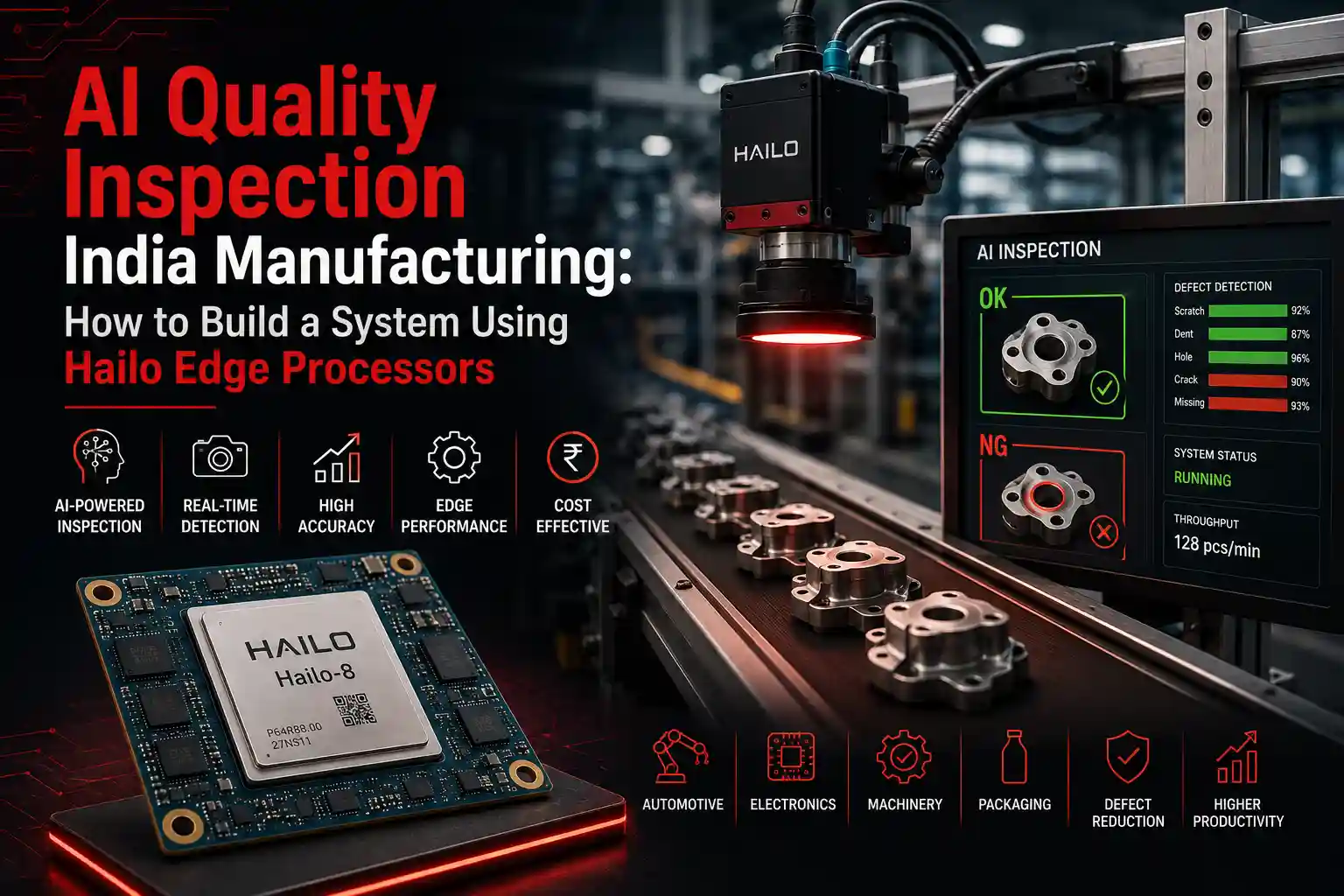
An AI quality inspection India manufacturing project should begin with the defect, not the AI processor. The first objective is to define exactly what the system must inspect and what qualifies as an unacceptable product.
Factories often want to automate visual checks previously handled by operators. AI can help identify missing components, surface defects, incorrect assembly, printing errors and other visual quality problems.
However, reliable inspection requires more than a neural network. The complete system also needs consistent imaging, suitable optics, representative training data and reliable production-line integration.
Hailo specifically positions its edge AI processors for automatic optical inspection, anomaly detection, sorting and industrial machine vision. These capabilities make edge AI suitable for production environments where inspection decisions must happen close to the manufacturing line.
AI Quality Inspection India Manufacturing: What Does the System Need?
An AI quality inspection India manufacturing system needs controlled lighting, a suitable industrial camera, reliable triggering, edge computing and a validated AI model. It also needs PLC or manufacturing-system integration so inspection results can influence the production process.
The accelerator performs inference, but inspection quality still depends on image quality, representative data and correctly defined pass-or-fail criteria. A powerful processor cannot compensate for unclear images or poorly labelled training data.
A typical system contains several layers. The first layer captures the product image, while the second prepares that image for inference.
The third layer runs the neural network and the fourth interprets the result. The final layer communicates the decision to production equipment or manufacturing software.
A Typical Architecture is:
Product → Sensor Trigger → Camera → Edge Computer → Hailo Accelerator → AI Model → Decision Logic → PLC/MES
Each stage can create its own failure modes. A poor camera angle can hide a defect, while unstable lighting can change the product's visual appearance.
A badly labelled dataset can train the wrong behaviour. Slow communication can also delay the reject mechanism and cause the wrong product to be removed.
Therefore, the complete system must be engineered as one production tool rather than a collection of separate components.
Machine Vision India Factory Projects: Define the Inspection Task First
A machine vision India factory project should define exactly what counts as a defect before collecting data. The team should specify defect size, location, appearance and acceptable variation.
Production speed and false-reject limits should also be documented. These requirements directly influence camera resolution, lighting, AI model complexity and processing capacity.
Begin by creating a defect taxonomy. This is a controlled list of defects the inspection system must identify during production.
For an electronics assembly, defects could include missing parts, wrong orientation or poor component placement. For machined components, the problem may involve scratches, dents or surface damage.
Packaging inspection may focus on labels, printed information, seals or missing contents.
Define the Smallest Relevant Defect
The camera must resolve the smallest important defect clearly. A defect occupying only a few unstable pixels will be difficult for the model to classify reliably.
The optics, working distance and camera resolution should therefore follow the inspection requirement. The imaging system should make the defect clearly visible before AI is introduced.
Define the Decision Time
The system must complete inference before the product reaches the rejection point. Production speed therefore creates a strict timing budget for the inspection system.
This budget includes camera capture, image preprocessing, AI inference and result communication. Communication with the PLC and reject mechanism must also remain within the available time.
Define False Accepts and False Rejects
A false accept allows a defective product to continue through production. A false reject removes a valid product and can increase waste, rework or operator intervention.
Both outcomes have commercial consequences. The acceptable balance depends on product value, safety requirements and quality objectives.
AI Defect Detection India: Camera, Lens and Lighting Selection
Reliable AI defect detection India systems require repeatable images. Camera resolution should be selected according to the smallest defect that must be identified.
The optics should then provide the required field of view without losing important visual detail. Lighting should maximise the contrast between acceptable and defective features.
Stable illumination often improves inspection accuracy more than adding a larger neural network. AI cannot recover information that the camera never captured.
Image quality is therefore the first technical priority when designing an AI-powered inspection system.
Camera Resolution
Camera resolution must match the inspection area and the smallest feature that matters. Higher resolution provides more visual detail for small defects.
However, increasing resolution also increases image size, data bandwidth and processing requirements. The selected resolution should therefore be sufficient without creating unnecessary computational load.
Global vs Rolling Shutter
Fast-moving products can create image distortion when the camera sensor captures different image lines at different times. This can affect measurements and defect appearance.
Global-shutter cameras can be valuable for motion-sensitive applications because the full frame is captured at the same moment. The correct choice depends on line speed, exposure time and movement.
Lens Selection
Lens selection controls field of view, working distance and image scale. A suitable lens should capture the full inspection area while preserving enough detail for the smallest relevant defect.
Optical distortion can affect dimensional or position-based checks. Depth of field also becomes important when product height or position varies.
Lighting Selection
Lighting should make the target defect visually obvious and repeatable. Different lighting techniques are useful for different inspection problems.
Backlighting can highlight silhouettes and dimensions. Diffuse lighting can reduce unwanted reflections from polished surfaces.
Directional lighting may reveal scratches, dents or surface texture. Consistent lighting conditions help prevent the AI model from reacting to environmental changes instead of real defects.
Hailo AI Use Case India: Running Inspection at the Edge
A practical Hailo AI use case India is running inspection models directly beside the production line. Hailo processors perform neural-network inference on edge devices, allowing vision systems to make local decisions.
This architecture can reduce network dependency and supports real-time industrial video analytics. It can also reduce the amount of raw image or video data sent to remote systems.
Edge inference keeps processing close to the camera and production machine. Raw video does not need to travel to a remote data centre for every inspection decision.
This approach is useful where manufacturing must continue during network interruptions. It also reduces bandwidth requirements because only selected results, events or images may need to leave the edge system.
Hailo-8 offers up to 26 TOPS, while Hailo-8L offers up to 13 TOPS for lighter AI workloads. The processor should be selected according to the model requirement rather than headline performance alone.
Use Hailo-8L When
Hailo-8L can be considered when the workload is relatively light and the inspection system uses one camera. The AI model may perform basic classification, presence detection or standard object detection.
If the required frame rate and latency are comfortably achieved, the lower-capacity accelerator can be an efficient option.
Use Hailo-8 When
Hailo-8 becomes more relevant when the system has several image streams or a more demanding neural network. It may also be useful when several models must run concurrently.
The additional compute headroom can support higher image resolution, more cameras or future model expansion.
Teams can compare Hailo AI accelerators during the architecture-selection stage.
Edge AI Quality Control: Building and Training the Dataset
An edge AI quality control model needs data that represents the real production environment. Images should be collected across different batches, shifts, machines and acceptable product variations.
Defective examples must reflect actual failure modes rather than idealised demonstrations. Training and validation data should also be separated carefully.
The final model must be tested against production data that was not used during training. This provides a more realistic view of expected performance.
Dataset quality determines what the neural network learns. A large dataset can still produce an unreliable model when images are inconsistent or labels are incorrect.
Whenever possible, data should be collected using the intended production camera system. This keeps resolution, optics and lighting conditions realistic.
Include Normal Variation
Good products are not always visually identical. Materials may vary slightly, surface finish can change between batches and labels may shift within acceptable limits.
The dataset should include these valid variations. Otherwise, the model may reject normal products because they differ from the examples used during training.
Collect Real Defects
Synthetic data can supplement model training, especially when genuine defects are rare. However, real manufacturing defects remain extremely valuable.
Real defects show how failures actually appear under production lighting, optics and handling conditions. These examples help the model learn realistic defect characteristics.
Avoid Data Leakage
Images of nearly identical products should not be distributed carelessly between training and validation sets. This can cause the model to perform well during validation without learning robust inspection behaviour.
The validation dataset should represent unseen production examples rather than near-duplicates of training images.
Track Dataset Versions
Production AI models should be traceable. Record which dataset was used to train each deployed model version.
The team should also record model configuration, thresholds and relevant preprocessing settings. This improves troubleshooting and supports controlled updates after deployment.
Integrating AI Quality Inspection with PLCs and Production Lines
AI inspection only creates production value when its decision reaches the machine reliably. The edge system should exchange trigger, product identity and inspection status with the PLC.
It must also handle communication failures and delayed results. Result timing should be tested at full production speed before the system controls rejection equipment.
The AI model should not operate as an isolated software application. The production line needs predictable and repeatable behaviour.
A common inspection sequence begins when the PLC identifies the product position. A sensor or PLC command then triggers the camera.
The edge computer processes the image and the AI model generates a result. Decision logic converts that output into PASS, FAIL or REVIEW.
The PLC receives the final status and activates the reject mechanism at the correct station when required.
Add Product Tracking
High-speed conveyors may contain several products between the inspection point and rejection point. Each AI result must remain associated with the correct physical product.
Product IDs, encoder counts or PLC tracking logic can help maintain this relationship throughout the process.
Design Failure States
The system should define what happens when a camera disconnects, inference exceeds the allowed time or model confidence is too low.
These failure states should be designed before commissioning. Production equipment should not rely on undefined AI behaviour.
Store Useful Evidence
Saving selected failed images helps quality teams investigate recurring defects and review borderline cases. These images can also support future model retraining.
Saving every raw frame may create unnecessary storage requirements. The retention strategy should match the manufacturing and quality requirement.
Selecting the Edge Computing Platform
The edge computer should be selected according to camera interfaces, AI workload and factory communication requirements. A Hailo accelerator can provide neural-network inference while a host platform manages cameras, storage and PLC communication.
MYIR embedded platforms can also support customised edge systems when industrial I/O or carrier-board integration is required.
An inspection system needs more than an AI accelerator. The host computer may require multiple hardware and communication interfaces.
These can include:
- Ethernet
- USB or MIPI camera interfaces
- Digital I/O
- CAN
- RS-485
- Storage
- TPM or secure element
- Industrial power input
A conventional industrial PC may meet these requirements for many factory installations. A custom embedded product may instead benefit from a system-on-module architecture, Teams building compact or customised hardware can review MYIR Solutions.
Teams designing camera-centric hardware can compare AI vision processors.
The correct architecture depends on whether the company is integrating one machine, deploying many inspection stations or developing a commercial machine-vision product.
How to Validate AI Defect Detection Before Production
AI inspection should be validated using complete production metrics rather than model accuracy alone. Measure false accepts, false rejects, latency and inspection coverage.
Run the system across realistic product batches and line speeds. Challenge it with lighting changes, normal production variation and borderline products.
Production approval should use a documented acceptance test. This creates a clear reference for future software or hardware changes.
False Accept Rate
False accept rate measures defective products incorrectly accepted by the system. For many quality applications, this is the most critical metric.
A low false-accept rate is especially important when defects create customer complaints, safety concerns or expensive downstream rework.
False Reject Rate
False reject rate measures good products incorrectly rejected by the inspection system. A high value can increase waste and operator intervention.
The system therefore needs an operating threshold that balances defect detection with acceptable production efficiency.
Latency
Latency should be measured from the original camera trigger to the final inspection result. Reporting only neural-network inference time gives an incomplete picture.
Camera exposure, image transfer, preprocessing, inference, post-processing and PLC communication all contribute to the final response time.
Stability
Run the complete system continuously under realistic operating conditions. Observe performance across production shifts, temperature changes and machine operating states.
This testing can reveal timing, memory, communication or thermal problems that short demonstrations may miss.
Drift
Manufacturing processes change over time. New suppliers, tooling, materials or surface finishes may alter product appearance.
The inspection model therefore needs ongoing monitoring. Retraining should follow a controlled validation and release process rather than an informal update.
Building Reliable AI Quality Inspection Systems
Successful AI quality inspection India manufacturing projects combine machine vision, artificial intelligence and industrial automation.
The neural network is only one component of the inspection system. Camera quality, lighting, production data and machine integration are equally important.
Start by defining the defect and inspection criteria. Then optimise the camera, lens and lighting so the defect is consistently visible.
Next, train the AI model on representative production data and validate it against realistic product variation.
Finally, benchmark the complete system and integrate it with the actual production line.
Hailo edge processors can provide local AI inference for these applications. The best system is the one that identifies meaningful defects consistently without becoming a production bottleneck.
Frequently Asked Questions
AI-powered inspection works best when the visual defect is consistently observable in the captured image. Hailo processors can accelerate edge inference for industrial vision, but the complete solution also requires imaging hardware, a host platform and production integration, Companies should first prove inspection accuracy on real products before investing in a large-scale production deployment.
Can AI Replace Traditional Machine Vision?
Sometimes, Traditional rule-based vision remains effective for predictable geometric checks and measurements. AI becomes useful when visual variation makes fixed inspection rules difficult to define.
What Defects Can AI Inspection Identify?
Applications can include missing parts, incorrect assembly, surface anomalies, printing errors and classification problems, The exact defect must be visually distinguishable in the camera image and represented adequately in the training dataset.
Is Cloud Connectivity Required?
No, Edge AI systems can perform inference locally beside the production line. Cloud or central systems may still be used for dashboards, storage, model distribution or analytics.
Should We Use Hailo-8 or Hailo-8L?
The choice should be based on benchmark results, Hailo-8 provides more AI capacity, while Hailo-8L can be sufficient for lighter workloads with fewer streams or smaller models.
Can an Edge AI System Connect to a PLC?
Yes, The host computer can exchange inspection results through supported industrial interfaces or communication protocols. Integration should include timing, error handling and product tracking.