
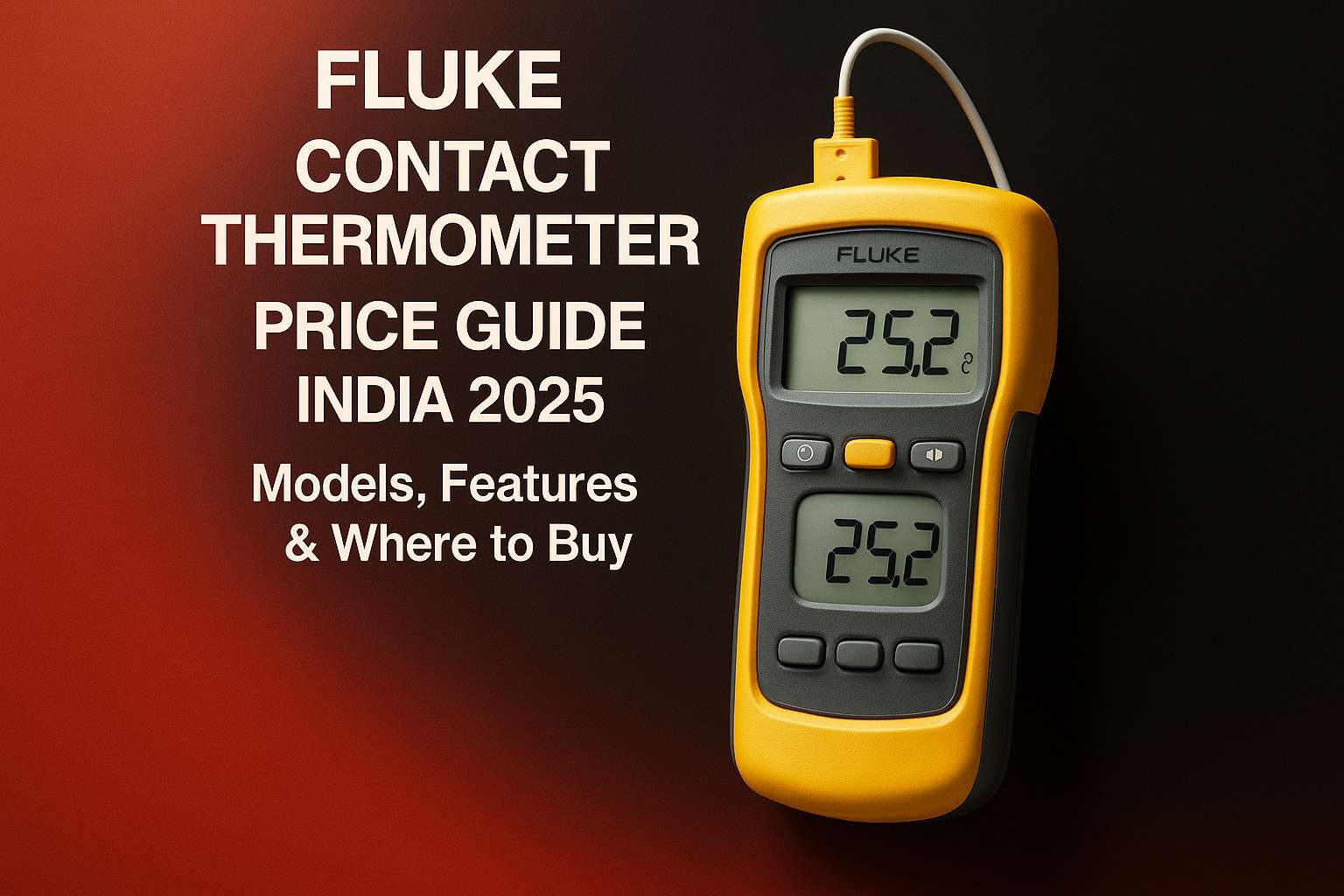
Fluke Contact Thermometer Price Guide India 2025: Models, Features & Where to Buy
Temperature measurement is fundamental to quality control, maintenance, and troubleshooting across industries. When precision matters, Fluke contact thermometers stand out as the gold standard for engineers, technicians, and quality assurance professionals.
In this comprehensive guide, we'll explore Fluke's contact thermometer lineup available in India for 2025, break down pricing, compare key features, and help you select the right model for your specific application. Whether you're working in HVAC, food processing, pharmaceutical validation, or electronics manufacturing, understanding your options ensures you invest in the right measurement tool.
Why Choose Fluke Contact Thermometers?
Fluke Corporation has built its reputation on rugged, accurate test and measurement instruments. Their contact thermometers deliver several advantages that matter in real-world applications:
Accuracy and Reliability: Fluke thermometers typically offer accuracy within ±0.05% to ±0.3% of reading, making them suitable for calibration labs and critical process monitoring.
Industrial Durability: Built to withstand harsh environments, drops, and daily abuse that comes with field work and manufacturing floors.
Wide Temperature Range: Most models handle temperatures from -200°C to +1372°C depending on probe type, covering virtually any industrial application.
Fast Response Time: Critical when measuring moving processes or when efficiency matters in high-volume testing scenarios.
Engineers who work with Digital Multimeters for electrical measurements often pair them with Fluke thermometers for comprehensive troubleshooting, especially in motor diagnostics and power system monitoring.
Popular Fluke Contact Thermometer Models in India (2025)
Here's a detailed breakdown of commonly available Fluke thermometers in the Indian market:
Fluke 51-II Single Input Digital Thermometer
The Fluke 51-II is a workhorse for single-point temperature measurements.
Key Features:
- Single input K-type thermocouple
- Temperature range: -200°C to +1372°C
- Resolution: 0.1° for temperatures below 1000°
- Data logging: Min/Max/Avg recording
- Display hold function
- Sleep mode for extended battery life
Typical Applications:
- HVAC commissioning and troubleshooting
- Food service equipment verification
- General industrial maintenance
- Laboratory research
Approximate Price Range: ₹18,000 - ₹24,000
This model works exceptionally well when paired with various Probes designed for specific measurement scenarios, from surface to penetration applications.
Fluke 52-II Dual Input Digital Thermometer
The 52-II adds dual-input capability, enabling differential temperature measurements crucial for many applications.
Key Features:
- Dual input for J, K, T, or E-type thermocouples
- T1-T2 differential measurement
- Temperature range: -200°C to +1372°C (K-type)
- 0.1° resolution
- Backlit display for low-light environments
- Data logging with timestamps
Typical Applications:
- Heat exchanger efficiency testing
- Refrigeration system diagnostics
- Process validation in pharmaceuticals
- Thermal profiling in electronics manufacturing
Approximate Price Range: ₹24,000 - ₹32,000
The differential measurement capability makes this particularly valuable for engineers working on thermal validation projects alongside Data Acquisition Systems for long-term monitoring.
Fluke 54-II Dual Input Thermometer with Data Logging
The 54-II represents Fluke's advanced offering with enhanced logging capabilities.
Key Features:
- Dual input supporting J, K, T, E-type thermocouples
- 10,000-point data logging
- PC connectivity via USB
- Advanced statistics and graphing
- Programmable alarm setpoints
- Adjustable logging intervals
Typical Applications:
- Qualification and validation protocols
- Research and development testing
- Quality assurance documentation
- Environmental chamber verification
Approximate Price Range: ₹32,000 - ₹42,000
Fluke 561 HVAC Pro Infrared and Contact Thermometer
This hybrid instrument combines infrared and contact measurement in one tool.
Key Features:
- Infrared temperature measurement: -40°C to +550°C
- Contact probe measurement with K-type thermocouple
- 12:1 distance-to-spot ratio
- Dual laser targeting
- Min/Max/Avg/Dif functions
Typical Applications:
- HVAC system diagnostics
- Electrical panel inspections
- Motor and bearing troubleshooting
- Building energy audits
Approximate Price Range: ₹28,000 - ₹38,000
Understanding Thermocouple Types and Selection
Selecting the right thermocouple for your Fluke contact thermometer is as important as choosing the meter itself.
| Thermocouple Type | Temperature Range | Best Applications | Accuracy |
|---|---|---|---|
| K-Type (Chromel-Alumel) | -200°C to +1372°C | General purpose, industrial | ±2.2°C or ±0.75% |
| J-Type (Iron-Constantan) | -40°C to +750°C | Older equipment, reducing atmospheres | ±2.2°C or ±0.75% |
| T-Type (Copper-Constantan) | -200°C to +400°C | Low temperature, food service | ±1°C or ±0.75% |
| E-Type (Chromel-Constantan) | -200°C to +900°C | High sensitivity, cryogenics | ±1.7°C or ±0.5% |
Pro Tip: K-type thermocouples offer the best balance of range, cost, and availability for most industrial applications. However, T-type provides better accuracy for food safety and low-temperature work.
Key Features to Consider When Buying
Accuracy Requirements
Match the thermometer's accuracy to your application needs. Calibration labs require ±0.05% accuracy, while general maintenance work may be fine with ±0.3%.
Temperature Range
Consider both your current and future measurement needs. Buying a meter with wider range provides flexibility as your applications expand.
Response Time
Fast response times (under 1 second) are crucial for moving processes or high-throughput testing. Slower response may be acceptable for static measurements.
Data Logging Capabilities
If you need documentation for compliance or quality records, invest in models with logging and PC connectivity like the 54-II.
Display Visibility
Backlit displays are essential for work in dimly lit environments like equipment cabinets, underground facilities, or nighttime field service.
Durability and Protection Rating
Look for IP ratings if you're working in wet environments. Fluke thermometers typically handle drops from 1 meter, but consider protective holsters for extreme conditions.
Common Applications Across Industries
Manufacturing and Quality Control
Contact thermometers verify process temperatures in injection molding, heat treating, welding, and coating operations. Engineers use them alongside Oscilloscopes when troubleshooting temperature-dependent electronic failures.
HVAC and Refrigeration
Technicians rely on contact measurements for superheat and subcooling calculations, air handler performance verification, and refrigerant line diagnostics.
Food Safety and Processing
Temperature monitoring ensures compliance with HACCP protocols. Surface and penetration probes verify cooking, cooling, and holding temperatures meet safety standards.
Pharmaceutical Manufacturing
Validation protocols demand documented temperature measurements during sterilization cycles, storage verification, and environmental chamber qualification.
Electronics Testing and R&D
Thermal profiling of PCBs, component junction temperatures, and environmental stress testing all require precision contact thermometry often integrated with Embedded Tools for automated testing.
Energy Auditing
Building energy assessors use contact thermometers to measure surface temperatures, identify thermal bridges, and verify insulation performance.
Maintenance and Calibration Best Practices
Regular Calibration Schedule
Plan annual calibration for general industrial use, or quarterly/semi-annual for critical quality applications. Use NABL-accredited calibration labs for documented traceability.
Probe Care
Clean probes after each use, especially in food applications. Store probes properly to prevent bending or damage to the tip, which affects accuracy and response time.
Battery Management
Replace batteries promptly when low battery indicators appear. Store meters with batteries removed if not used for extended periods.
Verification Checks
Perform ice-point (0°C) or boiling-point (100°C adjusted for altitude) verification monthly to catch drift early.
Common Mistakes to Avoid
Insufficient Contact: Poor contact between probe and surface leads to inaccurate readings. Use thermal paste or compound for improved thermal coupling when measuring flat surfaces.
Wrong Probe Type: Using surface probes for internal measurements or vice versa. Match probe design to application requirements.
Ignoring Thermocouple Accuracy: Thermometer accuracy is only part of the equation. Total system accuracy includes thermocouple tolerance.
Measurement Timing: Taking readings before thermal equilibrium is reached. Allow adequate soak time for stabilization.
Environmental Factors: Ambient temperature compensation matters. Understand how radiation, convection, and conduction affect your measurements.
Where to Buy Fluke Contact Thermometers in India
Authorized Distributors
Purchase from Fluke's authorized distributors in India to ensure genuine products, warranty coverage, and calibration certificates. RevineTech offers comprehensive Test & Measurement solutions including Fluke's complete thermometer lineup with expert technical support.
Online Platforms
While online marketplaces offer convenience, verify seller authorization and product authenticity. Check for:
- Official Fluke hologram stickers
- Serial number verification on Fluke's website
- Included accessories and documentation
- Warranty registration process
What's Included
Genuine Fluke thermometers typically include:
- Thermometer unit
- One or two K-type bead probes (model dependent)
- 9V battery
- Test certificate
- User manual
- Protective holster (model dependent)
Making the Right Investment Decision
Consider total cost of ownership beyond the initial purchase price:
Basic Single-Point Measurements: Fluke 51-II provides excellent value for straightforward temperature verification tasks.
Differential and Comparative Work: Fluke 52-II's dual-input capability justifies the additional cost when you regularly measure temperature differences.
Documentation Requirements: Fluke 54-II's logging features eliminate manual record-keeping and reduce compliance burden.
Hybrid Needs: Fluke 561 combines contact and infrared measurements for maximum flexibility in HVAC and electrical applications.
Engineers building comprehensive test setups often integrate Fluke thermometers with Function Generators and Power Supplies for thermal characterization of electronic designs under various operating conditions.
Future-Proofing Your Purchase
Technology evolves, but certain features ensure longevity:
- Probe compatibility: Choose models accepting standard thermocouple types rather than proprietary connectors
- Firmware updates: Some advanced models offer updateable firmware
- Accessory ecosystem: Fluke's extensive probe and accessory lineup grows with your needs
- Software support: PC connectivity and software compatibility with modern operating systems
Frequently Asked Questions
Q1: What is the difference between Fluke 51-II and 52-II thermometers?
The primary difference is input channels. The 51-II has a single input for one thermocouple, while the 52-II has dual inputs allowing simultaneous measurement of two points and differential temperature calculations (T1-T2). The 52-II also typically includes a backlit display and slightly enhanced data logging features. Choose 51-II for basic single-point work and 52-II when you need to compare temperatures or measure differences.
Q2: Can I use any K-type thermocouple with Fluke contact thermometers?
Yes, Fluke thermometers accept standard K-type (and other type) thermocouples with mini-connector plugs. However, total measurement accuracy depends on both the meter and thermocouple accuracy combined. Using quality thermocouples from reputable manufacturers ensures system accuracy. Fluke offers calibrated probe sets if you need documented accuracy for your complete measurement system.
Q3: How often should Fluke thermometers be calibrated?
For general industrial applications, annual calibration is standard practice. Critical quality applications in pharmaceuticals, aerospace, or calibration labs may require semi-annual or quarterly calibration. ISO 17025 labs typically calibrate more frequently. Keep calibration certificates as part of your quality documentation. If a meter is dropped or shows unusual readings, perform immediate verification or recalibration.
Q4: What's the typical battery life of Fluke contact thermometers?
Fluke thermometers typically provide 400-1000 hours of operation on a standard 9V battery, depending on the model and features used. Backlight usage and data logging reduce battery life. The 51-II and 52-II include sleep mode that extends battery life significantly. Always carry spare batteries for field work, and replace batteries when the low-battery indicator appears to prevent data loss.
Q5: Are Fluke contact thermometers suitable for food safety applications?
Absolutely. Fluke thermometers are widely used in food service and processing industries. For food applications, use food-grade penetration probes with proper sanitation between measurements. T-type thermocouples offer excellent accuracy in the food safety temperature range. Ensure you follow proper cleaning and sanitization protocols for probes, and consider dedicated probes for food use to prevent cross-contamination with industrial chemicals.