
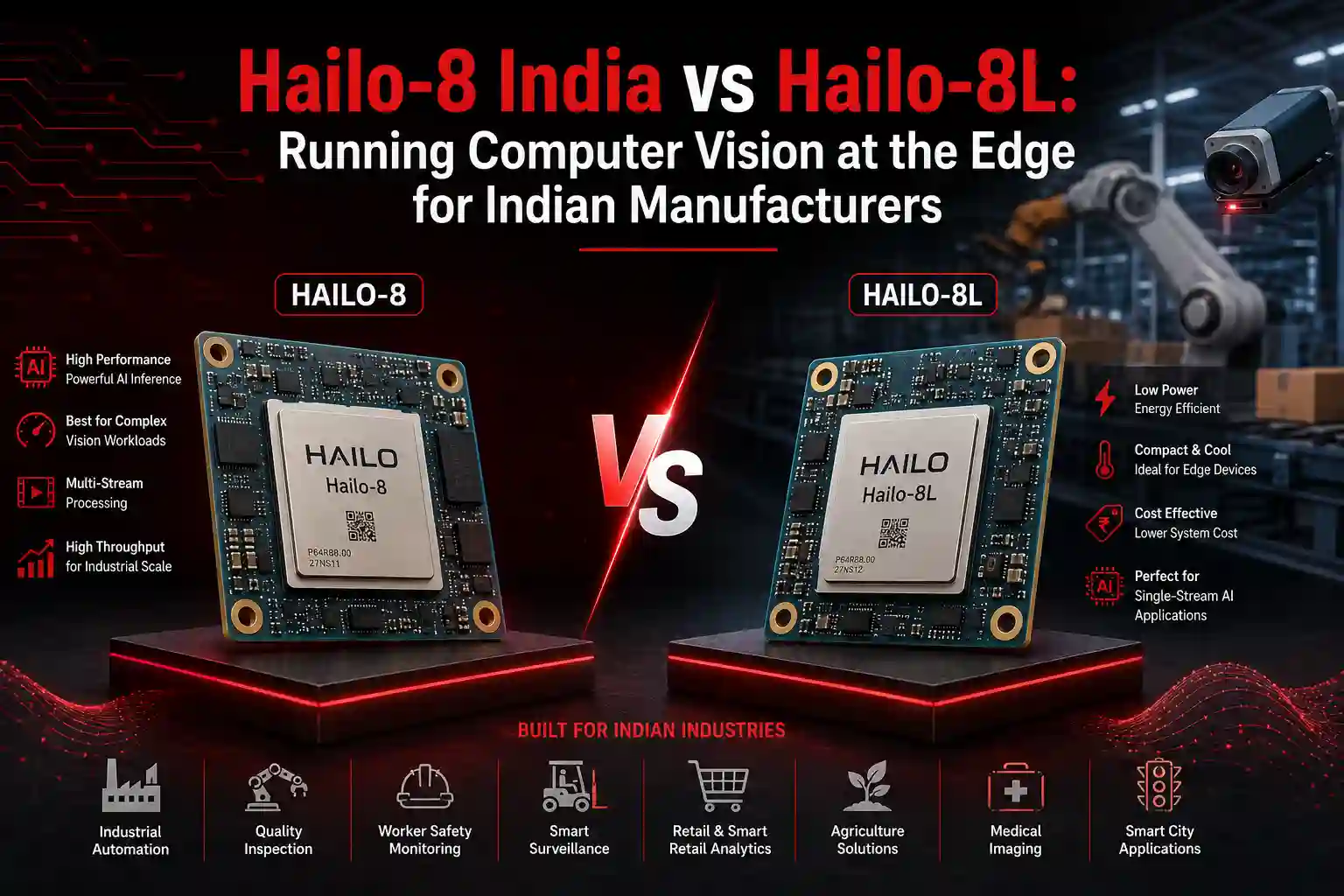
Interest in Hailo-8 India is growing alongside practical industrial uses for edge computer vision. Manufacturers can now run object detection, anomaly detection, OCR and visual inspection close to production equipment.
This reduces dependence on remote processing. Hailo-8 and Hailo-8L target different performance levels, Hailo specifies up to 26 TOPS for Hailo-8. Hailo-8L provides up to 13 TOPS and targets applications requiring lower AI capacity, The correct processor depends on the workload, Camera count, model complexity, resolution and frame rate matter more than TOPS alone.
Hailo-8 India vs Hailo-8L: What Is the Technical Difference?
In a Hailo-8 India deployment, Hailo-8 offers up to 26 TOPS for demanding edge AI workloads. Hailo-8L offers up to 13 TOPS for lighter applications. Both target low-latency edge inference. Engineers should compare actual model throughput, camera count, host architecture and thermal limits before choosing either processor.
The headline difference is compute capacity.
However, a useful comparison requires more context.
|
Selection Factor |
Hailo-8 |
Hailo-8L |
|
AI performance |
Up to 26 TOPS |
Up to 13 TOPS |
|
Positioning |
Higher-performance edge AI |
Entry-level/lighter edge AI |
|
Typical use |
Complex or multi-stream workloads |
Lower-capacity workloads |
|
Multi-model use |
Strong fit |
Workload dependent |
|
Power focus |
High efficiency |
Lower-capacity efficiency |
|
Deployment choice |
More compute headroom |
Cost-sensitive designs |
Hailo positions Hailo-8L for products requiring limited AI capacity or lower performance, Hailo-8 targets higher-performance neural-network inference, M.2 Hailo-8 modules support PCIe connectivity and standard AI frameworks, This does not mean every application needs Hailo-8, Unused AI capacity adds little operational value.
When Does Hailo-8 India Make Sense for Manufacturing?
Hailo-8 India is suited to manufacturing applications with complex neural networks, several camera streams or multiple concurrent AI models. Examples include automated optical inspection, robotic guidance and central vision gateways. The extra compute capacity provides more headroom when image resolution, frame rate or model complexity increases.
Automated optical inspection can require substantial computing power, as a production station may inspect multiple surfaces. One model might locate the product, another model may classify defects, and an OCR model may verify printed information. Hailo describes automated optical inspection as an industrial use case for real-time anomaly detection, sorting, and quality control.
Multi-Camera Inspection
A component may need cameras above and beside the production line, with each stream consuming inference resources. The total requirement depends on factors such as resolution and neural-network architecture.
Multi-Model Pipelines
One image can pass through several models, and a pipeline might perform detection, classification, and OCR. Hailo hardware supports multi-stream and multi-model edge AI use cases.
Robotic Vision
Robots may use detection, segmentation, or pose estimation, making low end-to-end latency important. The processor must also leave sufficient capacity for future model revisions. These workloads make Hailo AI accelerators relevant to industrial edge computing.
When Is Hailo-8L the Better Choice?
Hailo-8L can be the better choice when 13 TOPS provides sufficient performance. It suits compact vision nodes, single-camera inspection and cost-sensitive embedded systems. Selecting a smaller accelerator can lower power and hardware cost. Engineers should still benchmark the production model before making a volume decision.
Many factory vision tasks are not extremely complex. A camera may only need to determine whether a component is present, another station may classify a small number of known defects, and a packaging line may verify a label. These applications may not require the full Hailo-8 compute envelope. Hailo positions the Hailo-8L as an entry-level accelerator offering up to 13 TOPS. Official Hailo documentation also lists M.2 options for embedded integration.
Potential applications include:
- Presence and absence inspection
- Basic object detection
- Label verification
- Simple OCR pipelines
- Smart cameras
- Compact vision gateways
- Single-station quality inspection
The decision should come from benchmark results.
A lower-cost accelerator that meets throughput requirements is often the better engineering choice.
How Should Engineers Evaluate Edge AI Inference India Performance?
For edge AI inference India projects, TOPS should be treated as a capacity indicator rather than a direct frame-rate guarantee. Real throughput depends on the neural network, image resolution, quantisation, camera count and host system. Benchmark the exact deployed model under realistic production conditions before final hardware selection.
TOPS means trillions of operations per second and is useful for broad processor positioning, but it does not directly tell an engineer how many products can be inspected each minute. Model architecture matters, as YOLO-based detection, segmentation, and classification networks create different workloads. Input resolution also matters, because a 1280-pixel inspection image requires more processing than a much smaller input. Preprocessing consumes time, while post-processing also adds latency. The host CPU may become the bottleneck, and PCIe configuration can affect data movement. Camera acquisition adds another delay. The only reliable purchasing benchmark is the complete application.
Measure These Metrics
Measure sustained frames per second, camera-to-decision latency, accelerator utilisation, host CPU utilisation, system temperature, and memory usage. Then compare those results with the production takt time.
AI Vision Processor India: Accelerator or Integrated Vision Processor?
An AI vision processor India design can use either an accelerator or a processor integrating vision functions. Accelerators such as Hailo-8 add neural-network inference to a host computer, while Hailo also offers AI vision processors that combine inference with camera-oriented image processing. The correct architecture depends on the complete camera system. An AI accelerator does not replace every system component. A Hailo-8 deployment still requires a host platform, which handles application logic and external communication and may also manage camera capture and preprocessing. Integrated vision processors follow another architecture, with Hailo's vision processor portfolio combining AI inference with camera-oriented processing capabilities. This distinction matters when selecting hardware. A retrofit industrial computer may only require an accelerator, while a new smart camera may benefit from a dedicated vision processor. A central machine-vision controller may require several interfaces and storage. Engineers can compare AI vision processors for edge systems when the complete camera architecture is still open.
How to Benchmark Hailo Edge AI India Before Deployment
A reliable Hailo edge AI India benchmark should use the final neural network, real production images, and intended host hardware. Test sustained throughput, accuracy, latency, and temperature, and include the complete image pipeline. Reserve compute headroom for model updates because future models may require additional processing capacity. Start with a production requirement rather than a processor specification. Define products per minute, the maximum acceptable inspection delay, and the number of cameras before defining the AI task.
Use Real Factory Images
Training and benchmarking data should represent the deployment site. Include different batches, shifts, and lighting conditions, along with valid and defective products and edge cases.
Test the Complete Software Pipeline
Hailo provides a software toolchain for deploying neural-network models onto its processors. However, model compilation is only one step. The complete application may include image resizing, normalisation, and result filtering.
Leave Capacity Margin
Do not design a production system at constant maximum load. Future software revisions may require more processing, and a second model may also be added later. Compute headroom extends the useful life of the platform.
Hailo-8L Comparison: Practical Selection Matrix
A useful Hailo-8L comparison maps hardware to workload rather than comparing TOPS alone. Start with Hailo-8L for lighter single-camera applications. Start with Hailo-8 for complex or multi-camera workloads. Then benchmark both where cost, power and performance are close. The smallest compliant configuration usually gives better deployment economics.
|
Application |
Suggested Starting Point |
|
Single-camera presence detection |
Hailo-8L |
|
Simple visual classification |
Hailo-8L |
|
Compact AI camera |
Hailo-8L |
|
OCR on one production stream |
Benchmark Hailo-8L |
|
Multi-camera inspection |
Hailo-8 |
|
Multiple concurrent models |
Hailo-8 |
|
Advanced defect segmentation |
Hailo-8 |
|
Central vision gateway |
Hailo-8 |
|
Future model expansion |
Hailo-8 may offer more headroom |
These are architecture starting points,They are not guaranteed performance results, Every production model should be benchmarked, Indian engineering teams can also compare broader AI accelerators for edge inference.
Conclusion
Hailo-8 India and Hailo-8L solve different edge AI requirements, Hailo-8 provides more processing capacity for complex and multi-camera systems, Hailo-8L can reduce system cost for lighter workloads, Neither should be selected from TOPS alone, Indian manufacturers should benchmark the final camera, model and host architecture, That approach produces a system sized for actual production performance.
Frequently Asked Questions
Buyers comparing Hailo-8 and Hailo-8L should focus on workload size, not only TOPS. Hailo-8 provides greater compute capacity. Hailo-8L targets lighter applications. Both can support edge inference, but actual suitability depends on the neural network, camera pipeline, host system and required production throughput.
Is Hailo-8 twice as fast as Hailo-8L?
Not necessarily,Hailo-8 provides twice the stated peak TOPS, Application throughput depends on the complete workload.
Is Hailo-8L suitable for machine vision?
Yes, Hailo positions it for lower-capacity AI applications.
Can Hailo run computer vision without the cloud?
Yes, The processors are designed for AI inference on edge devices.
Does Hailo-8 replace the CPU?
No, It accelerates neural-network inference, A host processor still handles the broader application.
Which Hailo processor is better for multiple cameras?
Hailo-8 is the stronger starting point because it offers more AI compute capacity, Benchmarking is still required.