
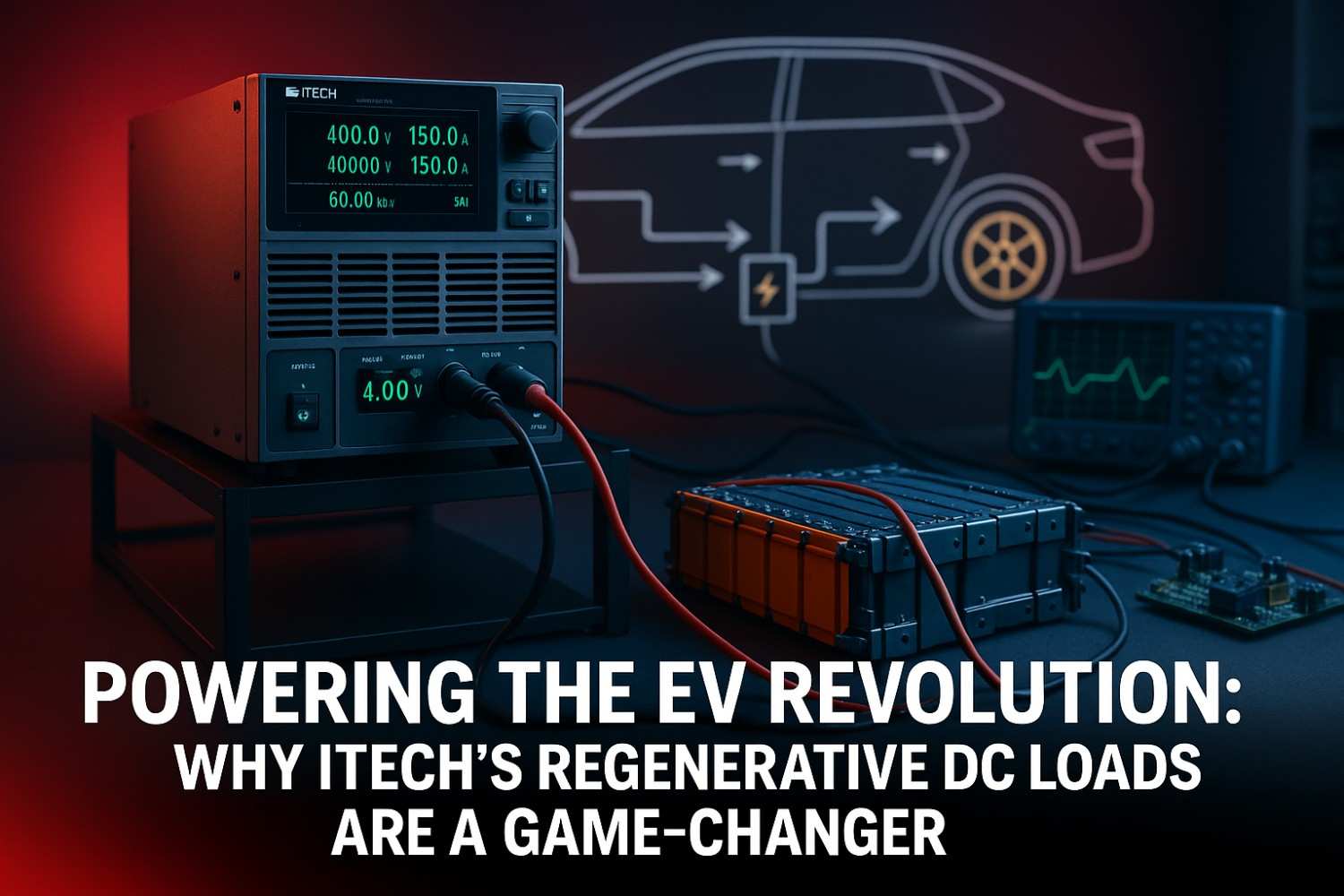
A regenerative DC load is an advanced testing instrument that, instead of wasting energy as heat, captures and recycles up to 95% of it back to the power grid. This makes testing more efficient, cost-effective, and environmentally friendly.
India's electric vehicle (EV) revolution is here, and it's moving at lightning speed. From bustling city streets to national highways, the hum of electric motors is becoming the new sound of progress. For every company in this ecosystem—whether you're a battery manufacturer, a charging station operator, or an automotive component supplier—this is the opportunity of a lifetime.
But with great opportunity comes great responsibility. The success of the entire EV industry hinges on one word: reliability.
Your customers need to trust that their EV battery will last for years, that their on-board charger (OBC) will work flawlessly every time, and that the public DC fast charger they pull up to will be safe and effective. Ensuring this level of quality requires rigorous, relentless testing.
However, there's a hidden problem in traditional testing methods that most companies don't talk about—a massive financial drain that works directly against the sustainable mission of the EV industry.
At Revine Technologies, our job is to bring the best global testing solutions to India's innovators. That's why we've partnered with ITECH, a world leader in power electronics testing. In this guide, we'll break down the problem with old-school testing and show you how ITECH's regenerative technology isn't just an upgrade; it's a complete game-changer for your business.
The Hidden Problem in EV Testing: The Massive Cost of Wasted Energy
To build a reliable EV, you have to push its core components to their limits. This means running high-power tests on batteries, OBCs, and DC fast chargers for hours, days, or even months. The traditional tool for this job is a dissipative electronic load.
What is a Dissipative Load? (And Why It's Like Running a Heater in a Mumbai Summer)
Think of a traditional dissipative load as a giant, highly controllable resistor. Its job is to draw power from the device you're testing (like a battery) to simulate real-world use. But here's the catch: it converts 100% of that electrical energy into waste heat.
Imagine you're testing a 100 kW DC fast charger. A dissipative load will draw that 100 kW of power and turn it into 100 kW of pure heat. That's like running dozens of industrial heaters in your lab, all day long. In a country like India, that's not just inefficient; it's madness.
The Real Cost of "Old School" Testing: More Than Just Your Electricity Bill
This fundamental inefficiency creates a cascade of costs that many businesses fail to account for. Most experts agree that the Total Cost of Ownership (TCO) for dissipative loads is far higher than the initial price tag.
Here’s what you’re really paying for:
- Massive Electricity Bills: You pay your utility company for every kilowatt-hour of energy your device outputs during a test. With a dissipative load, all of that money is instantly converted into useless heat and vented into the atmosphere.
- Sky-High Cooling Costs: Now you have a second problem: getting rid of all that heat. This requires powerful, energy-hungry air conditioning systems, water chillers, and ventilation fans. In effect, you pay for electricity twice: once to generate the heat, and a second time to remove it.
- Expensive Infrastructure: These heavy-duty cooling systems aren't cheap. They represent a major capital investment and require a huge amount of precious floor space in your lab or factory, driving up real estate and construction costs.
- A Noisy, Unproductive Environment: The constant hum and roar of large fans and chillers create a loud and unpleasant working environment for your valuable engineers and technicians, impacting focus and productivity.
This "hidden tax" on innovation forces companies to make compromises. You might reduce the duration of a critical battery life-cycle test or delay investing in higher-power equipment, slowing down your time-to-market and putting product quality at risk.
The Smarter Solution: How Regenerative Technology Changes Everything
What if, instead of throwing all that energy away, you could capture it and reuse it? That’s exactly what a regenerative DC load does. It represents a fundamental shift from a wasteful, linear process to an efficient, circular one.
What is a Regenerative DC Load? The Simple Explanation
A regenerative DC load works like a smart, high-efficiency inverter. As it draws DC power from the device you're testing, it cleanly converts that energy into grid-compliant AC power and feeds it right back into your facility's electrical system.
This recycled energy can then power other equipment in your lab, the office lights, or even the standard air conditioning. Modern systems from ITECH achieve this with an incredible energy recovery efficiency of up to 95%. This means for every 100 kW of test power, 95 kW is returned as usable electricity. The waste heat generated is less than 5 kW—a reduction of over 90%!
The Game-Changing Benefits for Your Business
Adopting this technology isn't just an incremental improvement; it delivers transformative results that directly impact your bottom line and your ability to innovate.
- Slash Your Energy Bills: By recycling up to 95% of the test energy, you dramatically cut your net electricity consumption. This translates to massive, immediate savings on your operational expenses.
- Eliminate Costly Cooling Systems: With waste heat reduced by over 90%, the need for dedicated, noisy, and expensive chillers is often completely eliminated. Your standard facility HVAC is usually more than enough.
- Save Valuable Floor Space: ITECH's regenerative loads are incredibly compact. Without the need for bulky cooling equipment, you can fit more test channels into a smaller area, maximizing the productivity of your expensive lab or factory space.
- Embrace "Green" Testing: The EV industry is built on the promise of sustainability. Using wasteful testing methods contradicts this core mission. Regenerative loads align your internal processes with your external brand message, significantly reducing your company's carbon footprint.
Comparison: Traditional vs. ITECH Regenerative Loads
|
Feature |
Traditional Dissipative Load |
ITECH Regenerative Load |
|
Energy Efficiency |
0% (100% of energy becomes waste heat) |
Up to 95% (Energy is recycled to the grid) |
|
Cooling Requirement |
Very High (Needs dedicated, expensive chillers/HVAC) |
Minimal (Standard facility ventilation is often enough) |
|
Physical Footprint |
Large and Bulky |
Compact and Space-Saving |
|
Operational Noise |
High (Loud fans and cooling systems) |
Low (Quiet internal fans) |
|
Total Cost of Ownership |
Extremely High (Massive ongoing energy & cooling costs) |
Low (Fast ROI from huge operational savings) |
Why ITECH is the Gold Standard in Regenerative Testing (And Why We at RevineTech Trust Them)
As a provider of advanced test and measurement solutions in India, we at Revine Technologies have a simple mission: to empower our clients with the best tools for the job. When it comes to power electronics testing, that choice is unequivocally ITECH. Their engineering excellence goes far beyond just energy savings.
More Power, Less Space: ITECH's Industry-Leading Power Density
In a modern R&D lab or production facility, space is money. ITECH understands this better than anyone. Their IT8000 series, for example, can pack a massive 18 kW of regenerative power into a tiny 3U rack-mountable chassis. (A "U" is a standard measurement for rack equipment, and 3U is incredibly compact for this power level). This allows you to build extremely powerful test systems without sacrificing valuable floor space.
Why Most Testing Setups Fail the Future: The Power of a Modular Design
The EV industry is in a constant "power race." Today you're testing 400V batteries and 150 kW chargers. Tomorrow, it will be 800V batteries and 350 kW chargers. Buying test equipment that becomes obsolete in two years is a massive waste of capital.
This is where ITECH's modular and scalable architecture becomes your secret weapon. Their systems are designed like building blocks. Using a patented master-slave paralleling technology, you can seamlessly connect multiple units to create a single, unified test system with power ratings scalable up to 2 MW.
This means you can future-proof your lab. Start with the power you need today, and as your products become more powerful, you can cost-effectively expand your testing capabilities by simply adding more modules. This protects your investment and ensures you're always ready for the next generation of EV technology.
Not Just a Load, a Complete Testing Ecosystem
ITECH provides a complete, integrated portfolio of sources, loads, meters, and software. This allows us at RevineTech to design and deliver turnkey solutions tailored to your exact needs.
- For High-Power Applications (OBCs, DC Fast Chargers): The IT8000/IT8300 Series are the workhorses. With extreme scalability and high voltage capabilities, they are built to handle the most demanding tests.
- For Bidirectional & Battery Testing: The IT-M3600 Regenerative Power System is a marvel of integration. It combines a bidirectional DC power supply and a regenerative load in one compact unit. It's the perfect tool for battery simulation and testing modern V2G (Vehicle-to-Grid) chargers.
- For Automated Battery Validation: The ITS5300 Battery Test System is a complete, automated solution. It integrates ITECH's regenerative hardware with powerful software to run complex life-cycle tests on battery cells, modules, and packs, dramatically speeding up your validation process.
Real-World Scenarios: How ITECH Solves India's Toughest EV Testing Challenges
Let's move from theory to practice. Here’s how ITECH's technology is directly solving the critical problems faced by EV engineers across India today.
Challenge 1: Ensuring Battery Life and Safety (The 1,60,000 km Warranty Problem)
EV manufacturers are offering warranties of eight years or 1,60,000 km on their batteries. To back this up, you need to prove your batteries can handle years of abuse. This requires accelerated life-cycle testing, where batteries are charged and discharged thousands of times over several months.
- The Old Way: Using a dissipative load for this would be financially crippling due to the sheer amount of wasted electricity.
- The ITECH Way: The ITS5300 Battery Test System makes these essential long-duration tests economically feasible. By recycling over 95% of the discharge energy, it allows you to run comprehensive tests 24/7 without worrying about a gigantic electricity bill. The system also provides real-time data on cell temperature and internal resistance, giving you deep insights into battery degradation and helping you build a safer, longer-lasting product.
Challenge 2: Validating On-Board Chargers (The Gateway to the Grid)
The On-Board Charger (OBC) is a critical component that must be efficient, compact, and increasingly, bidirectional to support Vehicle-to-Grid (V2G) functions. Testing its performance under all possible grid conditions is non-negotiable.
- The Old Way: Testing an 11 kW or 22 kW OBC at full power would turn your test bench into a furnace, requiring noisy, dedicated cooling.
- The ITECH Way: An IT8000 series load can perfectly simulate the vehicle's battery, absorbing the OBC's full power output and regenerating it back to the grid. For V2G testing, the versatile
- IT-M3600 can act as the battery, sourcing power back through the OBC in a highly efficient, closed-loop system. This allows for thorough, high-power testing in a cool, quiet, and controlled environment.
Challenge 3: Testing High-Power DC Fast Chargers (Ending Range Anxiety)
The rollout of 350 kW+ ultra-fast chargers is key to eliminating range anxiety and accelerating EV adoption. Before these expensive units are deployed, every single one must be "burn-in" tested at full power to ensure reliability.
- The Old Way: Finding a fleet of high-end EVs to test these chargers is impractical, and using a dissipative load would waste an astronomical amount of energy—350 kW for hours on end, for every unit.
- The ITECH Way: A scalable system of paralleled IT8000 units can create a single load capable of sinking 350 kW, 500 kW, or even over a megawatt of power. This allows manufacturers to perform 100% end-of-line testing on every charger, cycling the energy back into the factory grid. It dramatically reduces the cost of quality assurance and prevents costly field failures.
The RevineTech Advantage: Your Partner in Advanced EV Testing
Bringing world-class technology like ITECH to India is only half the battle. At Revine Technologies, we believe in being more than just a distributor; we are your one-stop solution partner.
We don't just sell you a box. Our team of experienced application engineers works with you to understand your unique challenges. We help you design, integrate, and commission a complete test bench that is perfectly tailored to your needs. With our NABL-accredited calibration lab and local service support, you can be confident that your investment is protected for the long term. We are the bridge that connects your ambition with the technology you need to succeed.
What's the Right ITECH Solution for You in 2025?
The journey to building a best-in-class EV product starts with a best-in-class testing strategy. ITECH's regenerative platform is the foundation for that strategy.
Here’s a simple guide to get you started:
- If you're developing and validating battery packs and modules, the ITS5300 Automated Test System is your most powerful and efficient solution.
- If you're designing On-Board Chargers, DC-DC converters, or other bidirectional components, the versatile IT-M3600 or the powerful IT8000 series are your ideal tools.
- If you're manufacturing high-power DC fast charging stations, the modular and scalable IT8000 series provides the future-proof platform you need to ensure quality and reliability.
The EV revolution waits for no one. Using outdated, inefficient testing methods is no longer a viable option. It's time to embrace a smarter, more sustainable, and more profitable way to validate your products.
Ready to stop burning money and start powering innovation? Contact the experts at Revine Technologies today for consultation. Let's build the future of mobility, together.