
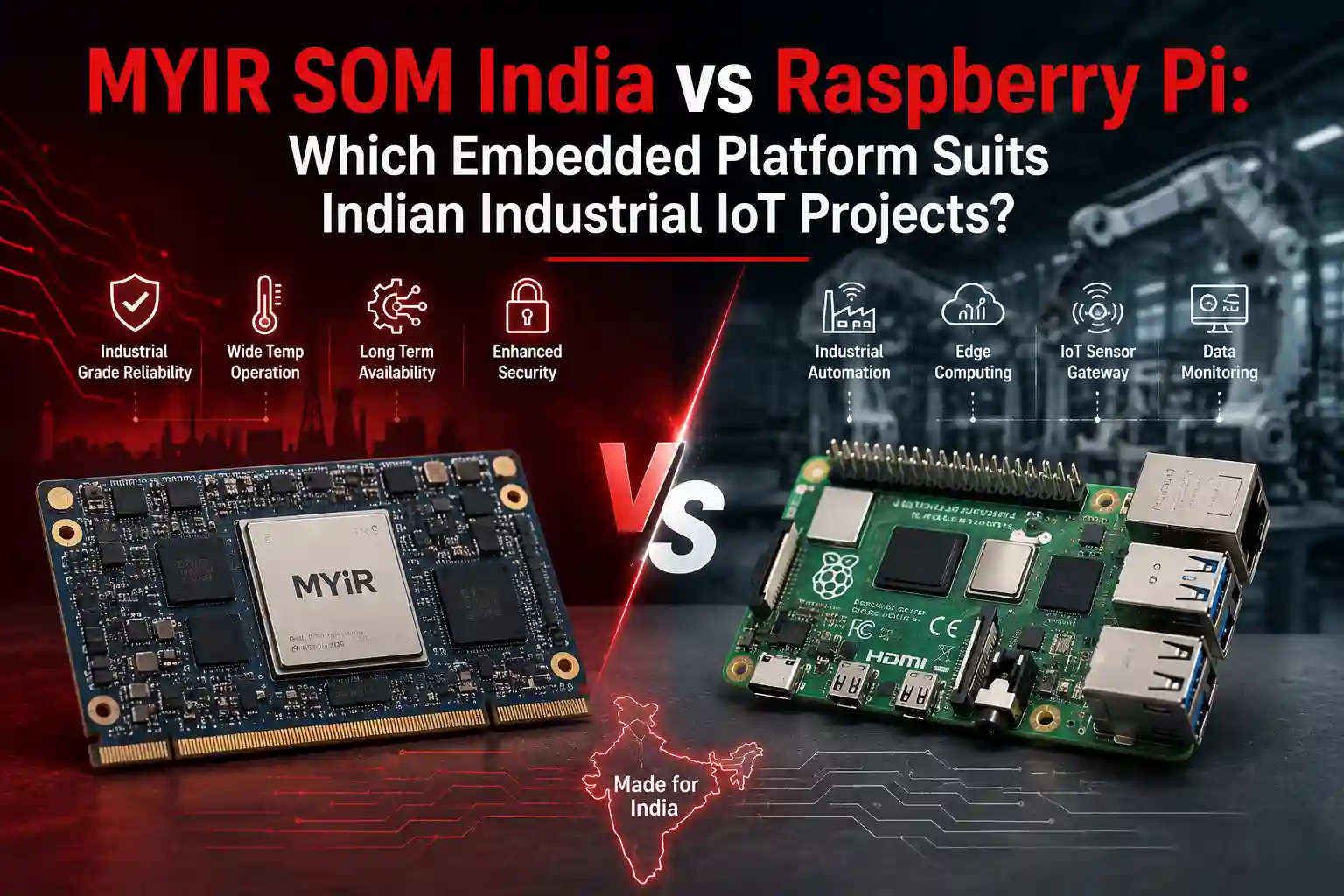
Choosing between MYIR SOM India platforms and Raspberry Pi requires more than comparing processor speed or board price.
Industrial IoT products operate for years. They may face heat, electrical noise, vibration, network interruptions and controlled maintenance schedules.
The embedded platform must therefore fit the complete product architecture.
Raspberry Pi boards are widely used for development, prototyping and deployed applications. Raspberry Pi also offers Compute Modules specifically designed for embedded and industrial systems.
MYIR provides system-on-modules and single-board computers based on several processor families. Certain MYIR modules include industrial temperature options and ready-to-run Linux support.
The right choice depends on I/O, lifecycle, carrier-board design, software support and environmental requirements.
What Is a MYIR SOM India Platform?
A MYIR SOM India platform integrates the processor, memory, storage and core support circuitry into a compact module. Engineers connect it to a custom carrier board containing product-specific interfaces. This architecture suits industrial IoT products requiring customised I/O, controlled hardware design and production-focused embedded Linux deployment.
A system-on-module, or SOM, separates the computing core from the application-specific electronics.
The SOM normally handles the difficult high-speed processor design.
The carrier board then adds interfaces required by the final machine.
These may include:
- CAN or CAN-FD
- RS-232 and RS-485
- Industrial Ethernet
- Digital inputs and outputs
- Display interfaces
- Cellular connectivity
- GNSS
- USB
- Sensor interfaces
- Relays
- Isolated communication
- Custom power circuitry
This architecture allows one computing module to support several products.
For example, MYIR's MYC-LMX91 uses an NXP i.MX 91 processor. It includes LPDDR4, eMMC and extensive peripheral connectivity. MYIR specifies an operating range of -40°C to +85°C for this particular module.
That temperature specification should not be assumed for every MYIR board.
Engineers must verify the exact selected model.
For teams developing gateways, HMIs or controllers, MYIR System-On-Modules for industrial IoT provide a useful starting point.
MYIR SOM India vs Raspberry Pi: What Is the Real Difference?
The main difference between MYIR SOM India products and a standard Raspberry Pi SBC is system architecture. A Raspberry Pi SBC arrives as a complete board with standard connectors. A SOM expects a carrier board. However, Raspberry Pi Compute Modules also use a SOM architecture, making them a closer technical comparison.
It is inaccurate to describe every Raspberry Pi platform as only a hobby board.
Raspberry Pi Compute Module 5 is explicitly intended for embedded and industrial applications.
CM5 includes a Broadcom BCM2712 processor, memory options and optional eMMC storage. It connects to a carrier board through two 100-pin high-density connectors.
Therefore, engineers should make two separate comparisons.
MYIR SOM vs Standard Raspberry Pi SBC
A standard Raspberry Pi provides a ready-made board.
This simplifies early development because USB, Ethernet, display and GPIO interfaces are immediately accessible.
A MYIR SOM normally requires carrier-board development.
That requires more engineering effort initially.
However, the custom carrier can include only the interfaces required by the final product.
MYIR SOM vs Raspberry Pi Compute Module
This is a much closer comparison.
Both approaches allow engineers to design a custom carrier.
Raspberry Pi CM5 provides the Raspberry Pi software ecosystem and hardware architecture. MYIR provides access to several processor families and application-specific embedded platforms.
The decision should therefore focus on requirements, not brand category.
System on Module India IoT Projects: When Does a SOM Make Sense?
A system on module India IoT design makes sense when a product needs custom connectors, industrial communication, controlled dimensions or long-term hardware reuse. SOMs reduce the need to design complex processor circuitry from scratch. The carrier board can then focus on power, protection, field interfaces and application-specific electronics.
Industrial IoT products rarely need only HDMI, USB and Ethernet.
A factory gateway may require dual Ethernet ports, isolated RS-485 and CAN.
A machine HMI may require a display, touchscreen, digital I/O and fieldbus interfaces.
A medical device may need custom sensors and controlled power sequencing.
A SOM architecture helps keep those requirements separate from the processor subsystem.
MYIR offers modules using processor families from NXP and other semiconductor vendors. Individual products provide different mixes of CPU, MCU, NPU and communication interfaces.
This makes SOMs useful when processor selection is driven by an application.
Typical Industrial IoT Applications
Industrial gateways can collect data from PLCs and sensors.
Edge gateways can process information before forwarding selected data to servers.
HMIs can combine local graphical interfaces with industrial communication.
Machine controllers can combine Linux applications with dedicated real-time control hardware.
Vision systems may combine an application processor with an AI accelerator.
For teams that need a more complete board, MYIR Single Board Computers can reduce carrier-board development.
Embedded Linux India: Which Platform Has the Better Software Story?
For embedded Linux India projects, software quality depends on the exact board, kernel, drivers and maintenance strategy. Raspberry Pi provides a mature common software ecosystem. MYIR provides Linux support and development resources for individual embedded platforms. Production teams should verify BSP versions, driver coverage, update methods and long-term maintenance.
Linux support is not a simple yes-or-no specification.
The engineering team should check the complete board support package.
Important items include the bootloader, kernel, device tree, drivers and filesystem.
MYIR states that products such as the MYC-LMX91 ship with Linux support. Other MYIR products may support Linux, Debian or Android depending on the processor.
Raspberry Pi provides a large software ecosystem around Raspberry Pi OS and Linux.
That ecosystem can reduce software development time.
However, production engineering requires additional decisions.
The team must define:
- Software image version
- Update policy
- Security patch process
- Remote recovery
- Rollback mechanism
- Device identity
- Secure credentials
- Logging
- Watchdog recovery
A successful prototype is not automatically a maintainable industrial product.
Long-term software operations should be designed before deployment.
Industrial SBC India: When Is a Complete SBC Better?
An industrial SBC India project benefits from a complete board when development speed matters more than hardware customisation. SBCs suit prototypes, research systems, low-volume machines and gateways using standard interfaces. A SOM becomes more attractive when product size, connectors, field I/O, environmental design or production volume justify a custom carrier.
An SBC reduces non-recurring engineering work.
The engineering team does not need to design high-speed memory routing or the processor power system.
Standard interfaces are already available.
This can significantly shorten proof-of-concept development.
SBCs are particularly useful when production volumes are modest.
They are also practical for laboratory automation and machine retrofits.
However, using a complete SBC can create mechanical constraints.
Unused connectors still occupy board area.
External adapters may be required for industrial communication.
Connectors may also require retention mechanisms inside vibrating equipment.
The final enclosure must manage cooling and cable strain.
MYIR offers complete SBC platforms alongside SOM products. Engineers can compare MYIR Single Board Computers when custom carrier development is unnecessary.
Raspberry Pi Alternative Industrial Buying Criteria
Selecting a Raspberry Pi alternative industrial platform should begin with environmental, I/O and lifecycle requirements. Compare processor capability, temperature rating, storage, Linux support, carrier design, security and supply continuity. Avoid selecting solely by CPU benchmark or board price because those metrics ignore the cost of building a maintainable product.
1. Operating Temperature
Check the specified temperature range for the exact board.
Do not transfer one model's specification to an entire brand.
Raspberry Pi CM5 specifies an overall operating temperature range of -20°C to +85°C, non-condensing. Thermal throttling can occur if adequate cooling is unavailable.
Certain MYIR industrial modules specify -40°C to +85°C.
2. Storage
eMMC is often attractive for embedded products.
It avoids exposed removable media.
However, filesystem architecture still matters.
Engineers should consider write endurance, recovery and power-failure behaviour.
3. Industrial Interfaces
List every required communication interface before selecting the processor.
Do not assume an adapter can solve every missing interface.
4. Carrier-Board Complexity
A SOM reduces processor design complexity.
It does not eliminate electrical engineering.
The carrier still requires power protection, EMC design and interface protection.
5. Thermal Design
Processing performance creates heat.
The final enclosure can operate very differently from an open development bench.
Thermal testing should use realistic workload and ambient conditions.
6. Product Lifecycle
Availability matters for production systems.
Raspberry Pi currently states that the previous CM4 generation will remain in production until at least January 2034.
For MYIR products, confirm lifecycle commitments for the exact selected module.
How to Choose Between MYIR, Raspberry Pi and an Industrial SBC
Choose Raspberry Pi for rapid development when its hardware meets final requirements. Choose Raspberry Pi Compute Module when the software ecosystem is valuable but a custom carrier is needed. Choose MYIR SOMs when processor choice, industrial I/O or custom embedded design drives the project. Use an SBC when standard interfaces are sufficient.
A practical selection process starts with the finished product.
Define the required interfaces first.
Then define environmental requirements.
Next, determine the software and maintenance model.
Only then compare processors.
For example, a simple dashboard may need little custom hardware.
A Raspberry Pi SBC could be appropriate.
A compact industrial gateway may need isolated CAN and RS-485.
A SOM and custom carrier could provide a cleaner architecture.
An advanced edge system may need an application processor plus AI acceleration.
That requirement may lead to a different embedded platform.
Teams evaluating wider options can review MYIR embedded solutions.
The selection should also consider development support.
Schematics, reference designs and software documentation can reduce project risk.
Conclusion
The MYIR SOM India versus Raspberry Pi decision should begin with the final industrial system.
Raspberry Pi remains strong for rapid development and ecosystem access.
Compute Modules extend that architecture into custom embedded products.
MYIR provides another path through application-focused SOMs and SBCs across multiple processor families.
For Indian industrial IoT teams, the best platform is the one that meets environmental, I/O, software and lifecycle requirements without unnecessary design complexity.
Frequently Asked Questions
Engineers comparing MYIR and Raspberry Pi usually ask about industrial reliability, Linux support and carrier-board requirements. Neither platform category is automatically superior. The correct choice depends on the exact model and finished system. Environmental ratings, power design, software maintenance and product lifecycle should determine the final architecture.
Is MYIR better than Raspberry Pi for industrial IoT?
Not universally. MYIR offers several industrial-focused SOM and SBC options, Raspberry Pi Compute Modules are also designed for embedded and industrial applications.
Can Raspberry Pi be used in industrial products?
Yes. The complete product must still manage power, temperature, EMC, storage and mechanical reliability.
Does a MYIR SOM require a carrier board?
Most SOM deployments use a carrier board, Development kits may include a ready-made board for evaluation.
What is the biggest advantage of a SOM?
The SOM separates complex processor circuitry from product-specific I/O. This allows engineers to customise the carrier without redesigning the entire computing subsystem.
Is MYIR suitable for embedded Linux?
Many MYIR platforms support Linux. Support varies by module, so engineers should confirm the current BSP before selection.